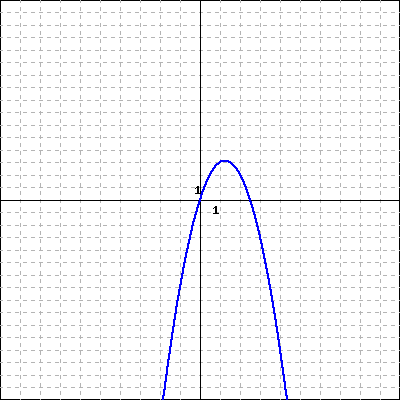
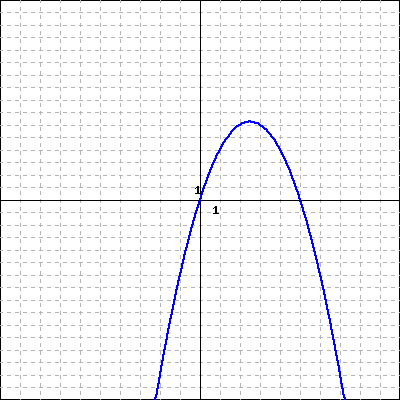
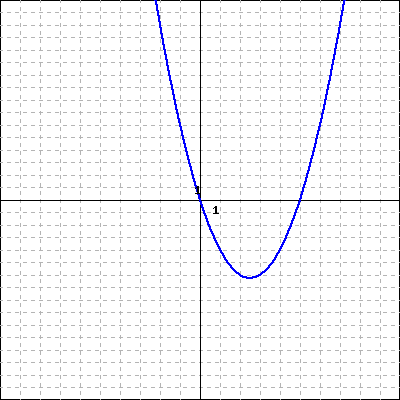
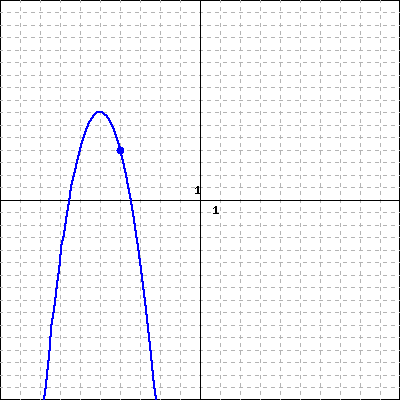
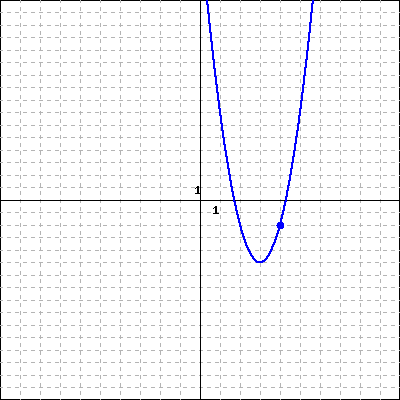
For this equation, \(a = -2\text{,}\) \(b = 1\text{,}\) and \(c = 1\text{.}\) The \(x\)-coordinate of the vertex is given by
\begin{equation*}
x_v =\frac{-b}{2a}=\frac{-1}{2(-2)}=\frac{1}{4}.
\end{equation*}
To find the \(y\)-coordinate of the vertex, we substitute \(x = \alert{\frac{1}{4}}\) into the equation. We can do this by hand to find
\begin{align*}
y_v\amp= -2\left(\alert{\frac{1}{4}}\right)^2+ \alert{\frac{1}{4}}+1\\
\amp= -2\left(\frac{1}{16}\right)+ \frac{4}{16}+\frac{16}{16}=\frac{18}{16} =\frac{9}{8}.
\end{align*}
So the coordinates of the vertex are \(\left(\dfrac{1}{4},\dfrac{9}{8}\right)\text{.}\) Alternatively, we can use the calculator to evaluate \(-2x^2 + x + 1\) for \(x = 0.25\text{.}\) The calculator returns the \(y\)-value \(1.125\text{.}\) Thus, the vertex is the point \((0.25, 1.125)\text{,}\) which is the decimal equivalent of \(\left(\dfrac{1}{4},\dfrac{9}{8}\right)\text{.}\)