Section 6.1 Intro to Quadratic Functions

In this chapter, we shall define a quadratic function and what information each way of writing such a function presents to the reader. It should be noted that the shape of the graph of a quadratic function is called a parabola.

Quadratic Function.

A quadratic function is one that can be written in the form
\begin{equation*} f(x)=ax^2+bx+c \end{equation*}
where \(a,b,\) and \(c\) are constants with \(a\neq 0\text{.}\)
When a quadratic function is written in this form, we say that the quadratic function is written in standard form.
In the definition above, notice that if \(a\) is zero, there is no \(x\)-squared term, so the function is not quadratic (it would then be linear).
Suppose that the height of a baseball \(t\) seconds after being hit is given by
\begin{equation*} h = -16t^2 + 64t + 4. \end{equation*}
How can we find two times when the baseball is \(64\) feet high?
We are looking for values of \(t\) that produce \(h = 64\) in the height equation. So, if we substitute \(h = 64\) into the height equation, we need to solve the quadratic equation
\begin{equation*} 64 = -16t^2 + 64t + 4 \end{equation*}
This equation cannot be solved by extraction of roots, because there are two terms containing the variable \(t\text{,}\) and they cannot be combined. To solve this equation, we will appeal to a property of our number system, called the zero-factor principle.

Subsection 6.1.1 Zero-Factor Principle

Can you multiply two numbers together and obtain a product of zero? Only if one of the two numbers happens to be zero. This property of numbers is called the zero-factor principle.

Zero-Factor Principle.

The product of two factors equals zero if and only if one or both of the factors equals zero. In symbols,
\begin{equation*} ab=0\ \ \text{if and only if}\ \ a=0\ \ or\ \ b=0. \end{equation*}
The principle is true even if the numbers \(a\) and \(b\) are represented by algebraic expressions, such as \(x - 5\) or \(2x + 1\text{.}\) For example, if
\begin{equation*} (x - 5)(2x + 1) = 0 \end{equation*}
then it must be true that either \(x - 5 = 0\) or \(2x + 1 = 0\text{.}\) Thus, we can use the zero-factor principle to solve equations.

Example 6.3.

  1. Solve the equation \((x - 6)(x + 2) = 0\text{.}\)
  2. Find the \(x\)-intercepts of the graph of \(f(x) = x^2 - 4x - 12\text{.}\)
Solution.
  1. We apply the zero-factor principle to the product \((x - 6)(x + 2)\text{.}\)
    \((x - 6)(x+ 2) = 0\) Set each factor equal to zero.
    \(x - 6 =0 \) or \(x + 2 = 0\) Solve each equation.
    \(x =6\) or \(x=-2\)
    There are two solutions, \(6\) and \(-2\text{.}\) (You should check that both of these values satisfy the original equation.)
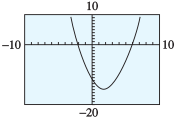
  2. To find the \(x\)-intercepts of the graph, we set \(y = 0\) and solve the equation
    \begin{equation*} 0 = x^2 - 4x - 12 \end{equation*}
    But this is the equation we solved in part (a), because \(x^2 - 4x - 12=(x - 6)(x + 2)\text{.}\) The solutions of that equation were \(6\) and \(-2\text{,}\) so the \(x\)-intercepts of the graph are \((6,0)\) and \((-2,0)\text{.}\) You can see this by using a graphing utility, as shown in Figure 6.4.
    described in detail following the image
    parabola with x-intercepts
    Figure 6.4.

Subsection 6.1.2 Solving Quadratic Equations by Factoring

Before we apply the zero-factor principle to solve a quadratic equation, we must first write the equation so that one side of the equation is zero. Let us introduce some terminology.

Forms for Quadratic Equations.

  1. A quadratic equation written
    \begin{equation*} ax^2 + bx + c = 0 \end{equation*}
    is in standard form .
  2. A quadratic equation written
    \begin{equation*} a(x - r_1)(x - r_2) = 0 \end{equation*}
    is in factored form .
Once we have written the equation in standard form, we factor the left side and set each variable factor equal to zero separately.

Example 6.5.

Solve \(3x(x + 1) = 2x + 2\text{.}\)
Solution.
First, we write the equation in standard form.
\begin{align*} 3x(x + 1) \amp = 2x + 2\amp\amp\text{Apply the distributive law to the left side.}\\ 3x^2 + 3x \amp = 2x + 2\amp\amp\text{Subtract }2x + 2 \text{ from both sides.}\\ 3x^2 + x - 2 \amp = 0 \end{align*}
Next, we factor the left side to obtain
\begin{equation*} (3x - 2)(x + 1) = 0. \end{equation*}
We then apply the zero-factor principle by setting each factor equal to zero.
\begin{equation*} 3x - 2 =0 ~~\text{ or }~~ x + 1 = 0 \end{equation*}
Finally, we solve each equation to find
\begin{equation*} x = \frac{2}{3} ~~\text{ or }~~ x = -1. \end{equation*}
The solutions are \(\dfrac{2}{3}\) and \(-1\text{.}\)

Caution 6.6 .

When we apply the zero-factor principle, one side of the equation must be zero. For example, to solve the equation
\begin{equation*} (x - 2)(x - 4) = 15 \end{equation*}
it is incorrect to set each factor equal to \(15\text{!}\) (There are many ways that the product of two numbers can equal \(15\text{;}\) it is not necessary that one of the numbers be \(15\text{.}\)) We must first simplify the left side and write the equation in standard form. (The correct solutions are \(7\) and \(-1\text{;}\) make sure you can find these solutions.)
We summarize the factoring method for solving quadratic equations as follows.

Example 6.7.

Solve by factoring: \((t - 3)^2 = 3(9 - t)\text{.}\)
Solution.
First, we need to write this equation in standard form. To do that, we must expand and then regroup the terms.
\begin{equation*} \begin{aligned} (t - 3)^2 \amp= 3(9 - t) \\ t^2-6t+9 \amp= 27-3t \\ t^2-3t-18 \amp= 0 \end{aligned} \end{equation*}
Next, we factor the left side of the equation.
\begin{equation*} \begin{aligned} t^2-3t-18 \amp= 0 (t+3)(t-6) \amp= 0 \end{aligned} \end{equation*}
We then apply the zero-factor principle by setting each factor equal to zero.
\begin{equation*} t+3=0 \hspace{.5cm}\text{or}\hspace{.5cm}t-6=0 \end{equation*}
Finally, solving each equation, we find
\begin{equation*} t=-6 \hspace{.5cm}\text{or}\hspace{.5cm}t=6 \end{equation*}
Therefore the solutions are \(-3\) and \(6\text{.}\)
We can use factoring to solve the equation
\begin{equation*} 64=-16t^2+64t+4 \end{equation*}
from the beginning of the section.

Example 6.8.

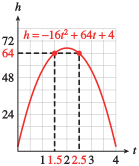
The height, \(h\text{,}\) of a baseball \(t\) seconds after being hit is given by
\begin{equation*} h = -16t^2 + 64t + 4. \end{equation*}
When will the baseball reach a height of \(64\) feet?
Solution.
We substitute \(64\) for \(h\) in the formula, and solve for \(t\text{.}\)
\begin{align*} 64 = -16t^2 + 64t \amp + 4\amp\amp\text{Write the equation in standard form.}\\ 16t^2 - 64t + 60 \amp= 0\amp\amp\text{Factor 4 from the left side.}\\ 4(4t^2 - 16t + 15) \amp= 0\amp\amp\text{Factor the quadratic expression.}\\ 4(2t - 3)(2t - 5) \amp= 0\amp\amp\text{Set each variable factor equal to zero.}\\ 2t - 3 =0 ~~\text{ or }~~ 2t - 5 \amp= 0\amp\amp\text{Solve each equation.}\\ t = \frac{3}{2} ~~\text{ or }~~ t \amp = \frac{5}{2} \end{align*}
There are two solutions to the quadratic equation. At \(t = \dfrac{3}{2}\) seconds, the ball reaches a height of \(64\) feet on the way up, and at \(t = \dfrac{5}{2}\) seconds, the ball is \(64\) feet high on its way down. (See Figure 6.9.)
described in detail following the image
height of baseball
Figure 6.9.

Note 6.10.

In the solution to the above exercise, the factor \(4\) does not affect the solutions of the equation at all. You can understand why this is true by looking at some graphs. First, check that the two equations
\begin{equation*} x^2 - 4x + 3 = 0 ~~\text{ and }~~ 4(x^2 - 4x + 3) = 0 \end{equation*}
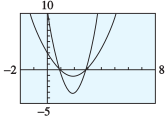
have the same solutions, \(x = 1\) and \(x = 3\text{.}\) Then use your graphing calculator to graph the equation
\begin{equation*} Y_1 = X^2 - 4X + 3 \end{equation*}
in the window
\begin{align*} \text{Xmin} \amp = -2 \amp\amp \text{Xmax} = 8\\ \text{Ymin} \amp = -5 \amp\amp \text{Ymax} = 10. \end{align*}
Notice that when \(y = 0\text{,}\) \(x = 3\) or \(x = 1\text{.}\) These two points are the \(x\)-intercepts of the graph. In the same window, now graph
\begin{equation*} Y_2 = 4(X^2 - 4X + 3). \end{equation*}
(See Figure 6.11.) This graph has the same \(x\)-values when \(y = 0\text{.}\) The factor of \(4\) stretches the graph vertically but does not change the location of the \(x\)-intercepts. The value of the constant factor \(a\) in the factored form of a quadratic function, \(f(x) = a(x - r_1)(x - r_2)\text{,}\) does not affect the location of the \(x\)-intercepts, because it does not affect the solutions of the equation \(a(x - r_1)(x - r_2) = 0\text{.}\)
described in detail following the image
two parabolas with the same x-intercepts
Figure 6.11.

Subsection 6.1.3 The Quadratic Formula

Suppose we wanted to solve the equation \(x^2-8x+4=0\text{.}\) Since \(x^2-8x+4\) cannot be factored, we cannot use the zero-factor principle! Another strategy we can use to solve quadratic equations that you may have seen before is the quadratic formula.

The Quadratic Formula.

The solutions of \(ax^2+bx+c=0\) are
\begin{equation*} x = \dfrac{-b\pm\sqrt{b^2-4ac}}{2a} \end{equation*}

Note 6.12.

The quadratic formula can be used even if a quadratic function is factorable, but it is advised that you try factoring first since the computations for the quadratic formula often become messy.
We will now solve the formula from before.

Example 6.13.

solve the equation \(x^2-8x+4=0\text{.}\)
Solution.
Since we cannot factor this equation, we will use the quadratic formula. Since the equation is already in standard form, we can see that \(a=1\text{,}\) \(b=-8\text{,}\) and \(c=4\text{.}\)
\begin{equation*} \begin{aligned} x \amp= \dfrac{-b\pm\sqrt{b^2-4ac}}{2a} \\ \amp= \dfrac{-(-8)\pm\sqrt{(-8)^2-4(1)(4)}}{2(1)} \\ \amp= \dfrac{8\pm\sqrt{64-16}}{2} \\ \amp= \dfrac{8\pm\sqrt{48}}{2} \\ \amp= \dfrac{8\pm4\sqrt{3}}{2} \\ \amp= 4\pm2\sqrt{3} \end{aligned} \end{equation*}
Therefore the solutions are \(4+2\sqrt{3}\) and \(4-2\sqrt{3}\text{.}\)

Exercises 6.1.4 Exercises

1. Intercepts of Quadratic Functions.

Let \(f\left(x\right) = 170 x^2 - 510\text{.}\)
a) What is the \(y\)-intercept of the function?
b) What are the \(x\)-intercepts?
Hint.
We first take a moment to note what it means to be an \(x\)- or \(y\)-intercept of a function. As we can see from graph of a function, the intercepts are the places on the axes where the function passes through. At an \(x\)-intercept, the corresponding value of \(y\) is always 0. At a \(y\)-intercept, the corresponding value of \(x\) is always 0.
For part b), remember that you should consider the positive and negative square root when solving for \(x\text{.}\)

2. Graphs of Quadratic Functions.

On a piece of paper, sketch the graphs of the functions \(f(x) = x^2+10 x+25\) and \(g(x) = -x^2+4 x-3\text{.}\)
a) What is the \(y\)-intercept of \(f(x)\text{?}\)
What is the \(y\)-intercept of \(g(x)\text{?}\)
b) What are the coordinates of the \(x\)-intercepts of \(f(x)\text{?}\)
What are the coordinates of the \(x\)-intercepts of \(g(x)\text{?}\)
c) The negative sign in front of the \(x^2\) term in \(g(x)\)
Hint.
Recall what it means to be an \(x\)- or \(y\)-intercept of a function. The intercepts are the points on the axes that the graph of a function passes through. At an \(x\)-intercept, the corresponding value of \(y\) is always 0. At a \(y\)-intercept, the corresponding value of \(x\) is always 0.
For part c), think about the difference between the graphs of \(y=x^2\) and \(y=-x^2\text{.}\)

3. Standard Form.

Write each of the following quadratic functions in standard form, and give the values of \(a,b,\) and \(c\text{.}\) Identify the \(y\)-intercept of each function.
a) \(f(x) = 3 (x-1)^2 +5\)
\(a\text{:}\)
\(b\text{:}\)
\(c\text{:}\)
\(y\)-intercept: \((\), \()\)
b) \(h(x) = -(x-5)(x+5)\)
\(a\text{:}\)
\(b\text{:}\)
\(c\text{:}\)
\(y\)-intercept: \((\), \()\)
Hint.
a) It may be helpful to rewrite the equation in the following way
\begin{equation*} 3 (x-1)^2 +5=3 (x-1)(x-1)+5. \end{equation*}
Then you can expand the expression by FOILing and combining like-terms.
b) You should expand the expression by FOILing and combining like-terms.
For each part, recall the standard form of a quadratic equation is
\begin{equation*} y=ax^2+bx+c. \end{equation*}
The y-intercept occurs where \(x=0\text{,}\) so you can find the value by evaluating the function at \(x=0\text{.}\)

4. Factored Form.

Find, by factoring, the \(x\)-intercepts of the following functions, and choose the factored form of each quadratic function. List the \(x\)-intercepts in order with the least \(x\)-value first and greatest \(x\)-value second.
a) \(f(x) = x^2 - 2 x - 8\)
\(x\)-intercepts: \((\), \()\text{,}\) \((\), \()\)
Factored form:
b) \(g(x) = -170 x^2+170\)
\(x\)-intercepts: \((\), \()\text{,}\) \((\), \()\)
Factored form:
Hint.
a) We will find the intercepts by factoring. We are looking for factors of the form \((x-r)(x-s)\text{.}\) Since the sign in front of \(-8\) is negative, we can also tell that we are looking for \(r\) and \(s\) with different signs, since when we multiply them together, we get a negative number. So that also means that we are actually subtracting one of \(r\) and \(s\) to get \(-2\text{.}\) So we need two numbers such that \(r-s = -2\) and \(rs = + 8\text{.}\) Remember that \(x\)-intercepts occur when the output is 0.
It may be useful to first write the equation in factored form and then determine the \(x\)-intercepts.
b) You’ll want to approach this in a similar fashion to part a). It may be useful to factor out -170 first.

5. Using the Quadratic Formula.

Consider the function \(g(t) = t^2+142 t+142\text{.}\) You may notice if you try to find the \(t\) intercepts of \(g(t)\) by factoring, something goes wrong.
a) Find the zeros of \(g(t)\) using the quadratic formula. Enter the root with the positive square root first, if applicable.
\(x =\) and \(x =\)
b) What is \(g(t)\) in factored form?
  • \((x - (\frac{1}{2}(-142 + \sqrt{19596})))\)\((x - (\frac{1}{2}(-142 - \sqrt{19596})))\)
  • \((x + (\frac{1}{2}(-142 + \sqrt{19596})))\)\((x + (\frac{1}{2}(-142 + \sqrt{19596})))\)
  • \((x - (\frac{1}{2}(-142)))\)\((x + (\frac{1}{2}(-142)))\)
Hint.
a) We want to find the zeros of \(g(t) = t^2+142 t+142\) using the quadratic formula. The quadratic formula is, given \(y = a t^2 + bt + c\text{,}\)
\begin{equation*} t = \frac{-b \pm \sqrt{b^2 -4ac}}{2a} \end{equation*}
So, we just need to plug the values of \(a,b,\) and \(c\) from \(g\) into this formula.
b) To write \(g\) in factored form, we write \((t - r_1)(t- r_2)\text{.}\) Substituting the zeros from part (a) in appropriately.

6. Writing Equations from a Graph.

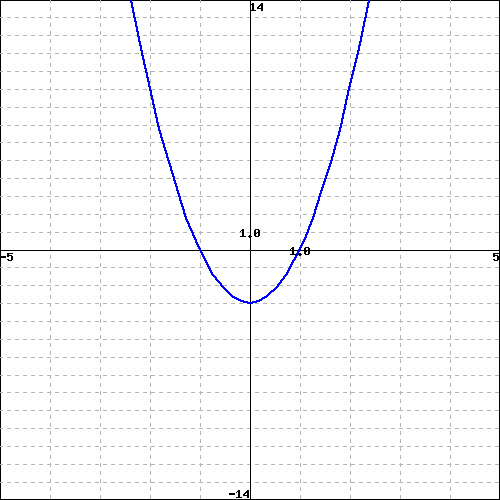
Find a formula of the form \(y = ax^2 + bx + c\) for the quadratic function shown below.
\(y=\)
Hint.
Our first step is to note where the zeros of \(f(x)\) are. Use the graph to find the \(x\)-intercepts and another point on the graph (the \(y\)-intercept is a good one to use).
You can use factored form for a quadratic equation to find the formula:
\begin{equation*} y=a(x-r)(x-s), \end{equation*}
where \(r\) and \(s\) are \(x\)-intercepts. You can use the additional point to find the value of \(a\text{.}\)

7. Using Quadratic Functions.

A ball is thrown into the air. Its height, in feet, \(t\) seconds later is given by
\begin{equation*} h(t)= 64 t-16t^2 \end{equation*}
a) Evaluate and interpret \(h(2)\text{.}\)
\(h(2) =\)
b) Solve the equation \(h(t) = 48\text{.}\) Enter the smaller number first, if applicable. Interpret your solutions.
c) When does the ball hit the ground after it is thrown?
At time \(t =\)
Hint.
a) To evaluate \(h(2)\text{,}\) we substitute \(2\) in for \(t\) in the formula of \(h(t)\text{.}\) To interpret, think about the units for the input and output values.
b) To solve \(h(t) = 48\text{,}\) we first substitute in the formula of \(h(t)\text{.}\) This gives us
\begin{equation*} 64 t-16t^2 = 48. \end{equation*}
You should solve this for \(t\text{.}\) To interpret, think about the units for the input and output values.
c) Finding the time at which the ball hits the ground after it is thrown is equivalent to finding the time at which the height of the ball is 0. So, we can set \(h(t)=0\) and solve for \(t\text{.}\) You may want to factor the equation to find the time(s).