Section 4.4 Applications of the Logarithm

This section is all about taking everything you have learned thus far about exponential and logarithmic functions and applying it to solve real world problems.

Subsection 4.4.1 Graphs, Domain, and Range

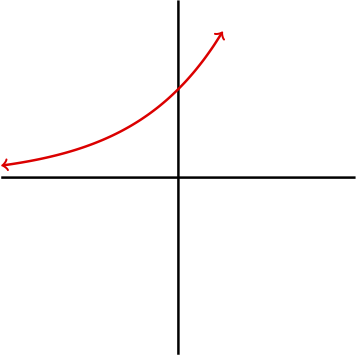
In order to use the logarithm function in applications, it is useful to understand a few properties about the logarithm including its graph, domain, and range. Recall that the logarithm function is the inverse of an exponential function. Therefore, it may be helpful to first consider the graph of the function \(f(x)=e^x\text{.}\)
described in detail following the image
A graph of the function \(f(x)=e^x.\)
Figure 4.33. A graph of the function \(f(x)=e^x.\)
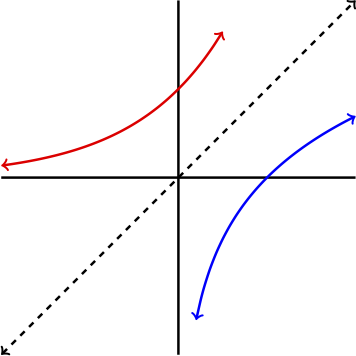
From our previous understanding of exponential functions, we know that the domain of the function \(f(x)=e^x \) is \((-\infty,\infty)\) and the range is \((0,\infty)\text{.}\) Since the function \(g(x)=\ln(x) \) is the inverse of the function \(f(x)=e^x \) we know that the domain of \(g(x)=\ln(x) \) must be \((0,\infty)\) and the range must be \((-\infty,\infty)\text{.}\) Furthermore, the graph of the function \(g(x)=\ln(x) \) must look like a reflection of the graph \(f(x)=e^x\) reflected through the line \(y=x\text{.}\)
described in detail following the image
A graph of the function \(f(x)=e^x\) (red), the line \(y=x\) (dashed), and \(g(x)=\ln(x)\text{.}\)
Figure 4.34. A graph of the function \(f(x)=e^x\) (red), the line \(y=x\) (dashed), and \(g(x)=\ln(x)\) (blue).
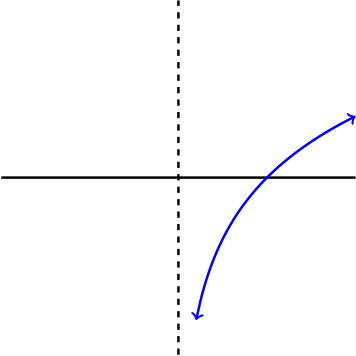
Inspecting the graph and realizing that the domain of \(g(x)=\ln(x) \) is \((0,\infty)\text{,}\) we are in the position to see that the graph of \(g(x)=\ln(x)\) actually has a vertical asymptote at \(x=0\text{.}\)
described in detail following the image
A graph of the function \(g(x)=\ln(x)\text{.}\)
Figure 4.35. A graph of the function \(g(x)=\ln(x)\text{.}\)
Knowing these properties of the logarithm will be important for understanding some applications.

Subsection 4.4.2 Applications of the Logarithm

Since this section is about applying what is already known, let’s work through a problem together.

Example 4.36.

According to recent research published by the Nature Publishing Group, the concentration of microplastic in the Great Pacific garbage patch (GPGP) is growing exponentially. In the year 1990 the concentration of microplastic was \(.4 \text{kg}/\text{km}^2\text{,}\) and in 2015 the concentration was \(1.2 \text{kg}/\text{km}^2\text{.}\)
  1. Find a formula for the concentration in \(\text{kg}/\text{km}^2\) of microplastics in the GPGP \(t \) years after 1990.
  2. How long will it take for the concentration to double?
Solution.
  1. The information provided in the problem is giving us two points on the graph of our exponential function. Starting with the exponential \(A(t)=a(b)^t\text{,}\) we begin trying to find the values of \(a\) and \(b \text{.}\) Since the function is to be in years since 1990, and the first value they gave us was for the year 1990, we immediately know that the value of \(a \) must be \(.4\text{.}\) Thus, our function now is read
    \begin{equation*} A(t)=.4(b)^t. \end{equation*}
    Since 2015 is \(\alert{25}\) years after 1990, the second point they gave us now yields the equation
    \begin{equation*} 1.2=.4(b)^{\alert{25}}. \end{equation*}
    Now, do not be fooled into thinking logarithms are needed for this equation. We only need logarithms when the unknown value is in the exponent, but the unknown here is the base. So, we simply divide each side by .4 and take the 25th root of each side. These steps look as follows:
    \begin{align*} 1.2\amp = .4(b)^{25}\\ \frac{1.2}{.4}\amp = b^{25}\\ \sqrt[25]{3}=b \end{align*}
    Then our formula is
    \begin{equation*} A(t)=.4(\sqrt[25]{3})^t. \end{equation*}
  2. To identify the doubling time, we simply set our function equal to .8 as this is double the inital concentration of .4. Solving as we did in the previous section we have:
    \begin{align*} .8\amp =.4(\sqrt[25]{3})^t\ \ \text{now divide both sides by .4}\\ 2\amp = (\sqrt[25]{3})^t\ \ \text{apply log to each side}\\ \log(2)\amp = \log(\sqrt[25]{3})^t\ \ \text{use properties of logarithms to pull down t}\\ \log(2)\amp = t\cdot \log(\sqrt[25]{3})\ \ \text{divide each side by log(1.045)}\\ \frac{\log(2)}{\log(\sqrt[25]{3})}\amp = t. \end{align*}
    Thus, we see that \(t \approx 15.75\ \text{years}\text{.}\)
There will be several more examples covered in your course packet. This is often a scary section as word problems can seem a bit overwhelming. To help pick out information which is important and understand what the problems are asking you to do, try following a procedure like the one given below:

Tips for Starting Word Problems.

  1. Identify the units of the input and output of the function given, or the function you are instructed to make.
  2. If you are told to make a function, write down the general form of the function you are asked to make. For example, if told to make an exponential function, start by writing \(A(t)=a(b)^t\text{.}\)
  3. Plug in all given information, and think about what exactly you are being instructed to do.
  4. Once you have the final answer, go back to the problem and make sure your answer makes sense in the context of the problem.

Exercises 4.4.3 Exercises

1. Cat Hoarding.

Millicent is a cat hoarder. She currently has \(95\) cats in her basement and plans to increase the size of her brood by \(2 \%\) each year. The federal government will evict her if she surpasses \(150\) cats. How many years can Millicent operate on the fringes of society before being evicted? Round to two decimal places.
years

2. Temperature Decay.

Suppose the temperature of a cup of tea in degrees Fahrenheit \(t\) minutes after it has been poured may be modeled by the equation \(T(t)=103 (0.94)^{t}+79\text{.}\)
a) What is the temperature of the tea after 3 hours?
degrees Fahrenheit
b) How long does it take for the cup of tea to cool to 100 degrees?
minutes
c) What does each part of this equation mean?
\(T(t)=\underbrace{103}_{A} (\underbrace{0.94}_{B})^{t}+\underbrace{79}_{C}\)
A:
  • This represents the temperature of the room the cup is in
  • This represents the rate at which the tea is decreasing in temperature every minute
  • This represents the how much hotter than room temperature the initial temperature of the tea is
B:
  • This represents the temperature of the room the cup is in
  • This represents the rate at which the tea is decreasing in temperature every minute
  • This represents the how much hotter than room temperature the initial temperature of the tea is
C:
  • This represents the temperature of the room the cup is in
  • This represents the rate at which the tea is decreasing in temperature every minute
  • This represents the how much hotter than room temperature the initial temperature of the tea is
Hint.
a) You need to evaluate the function at 3 hours. Note that the input units are in minutes, so you will need to convert 3 hours to minutes before evaluating the function.
b) We want to find the time \(t\) in minutes at which the temperature of the tea is 100 degrees Fahrenheit. This can be done by setting the model equal to 100 and solving for \(t\text{.}\) That is, we want to solve
\begin{equation*} 100=103 (0.94)^{t}+79 \end{equation*}
for \(t\text{.}\)
Note that you will need to use logarithms to do this.
c) Try to use process of elimination to answer these interpretations. It may be easiest to identify the initial value or growth factor first.
You can also think about what happens to the function after a long amount of time. In context, does it make sense to have a sort of cut-off value for the temperature? What would that temperature represent?

3. Molar PH.

The pH of a solution is a measure of its acidity or basicity. In fact, pH is related to the molar concentration (in moles per liter) of hydrogen ions in the substance. In particular, if \(C\) is the molar concentration of hydrogen ions in a solution, then the approximate pH of that solution is given by:
\begin{equation*} pH = -\log(C). \end{equation*}
a) If a certain type of vinegar has a molar concentration of hydrogen ions of approximately \(10^{-4}\) moles per liter, what is the approximate pH of the vinegar?
b) Pure water has a pH of 7 and marks the neutral point between acids and bases, with acidic solutions having a lower pH value, and basic solutions having a higher pH value. What is the molar concentration of hydrogen ions in pure water?
c) Over what interval of molar concentrations of hydrogen ions will the solution be an acid? (Hint: is vinegar an acid or a base? Is its molar concentration smaller or larger than that of pure water?)
d) How many times more concentrated are hydrogen ions in the vinegar than in pure water?
Hint.
a) For this part, since we are given an equation that tells us the pH of solutions given their chemical concentrations, we can just evaluate the equation at \(10^{-4}\text{.}\)
b) This is asking us to find the value of \(C\) in the equation given if we know the pH of water. That is, we want to solve for \(C\) in
\begin{equation*} 7 = -\log(C). \end{equation*}
c) Answering the questions in the hint, vinegars are acids. The interval of values that is larger than the molar concentration of water will result in acids.
d) We calculate this by dividing \(10^{-4}\) by \(10^{-7}\text{.}\) This will tell us what we would have to multiply the molar concentration of water by to get the molar concentration of the vinegar, which is another way of saying this will tell us how many more times concentrated the vinegar is than the water.

4. Sound Levels.

A sound’s noise level is measured in decibels (dB) by comparing the sound’s intensity, \(I\text{,}\) to a benchmark sound that has an intensity of \(10^{-16}\) watts/cm\(^2\text{.}\) In particular,
\begin{equation*} \text{dB}=10\log(I/10^{-16})=10\log(10^{16}I). \end{equation*}
a) The intensity of Joel’s whisper is approximately \(10^{-12}\) watts/cm\(^{2}\text{.}\) Compute the noise level of the whisper in decibels.
b) A certain sound with a noise level of 91 dB has been known to damage hearing. Compute the sound’s intensity at this noise level.
watts/cm\(^2\)
c) Kansas City Chiefs’ fans recently broke the world record for "loudest roar" at a sports event. The fans reached a noise level of 142.2 dB. The previous world record was held by Seattle Seahawks’ fans, with a noise level of 137.6 dB. About many times more intense was the roar of the Chiefs’ fans than the roar of the Seahawks’ fans?
Hint.
a) We are given an equation that uses intensity as an input, and we are given an intensity. So, we can evaluate the equation at the given intensity of Joel’s whisper to find out how many decibels the noise level of his whisper was.
b) Here, we want to solve for \(I\) in the decibel equation, given the decibels of a certain noise level. That is, we want to solve for \(I\) in
\begin{equation*} 91=10\log(10^{16}I) \end{equation*}
c) We calculate this by first finding the intensity of the noise levels of both fan groups. This can be done by following the steps in part (b) but using the decibels given in this part, solving for \(I_1\) in
\begin{equation*} 137.6=10\log(10^{16}I_1) \end{equation*}
and for \(I_2\) in
\begin{equation*} 142.2=10\log(10^{16}I_2) \end{equation*}
Once we have these, we can find how many times more intense the Chiefs’ fans’ noise was than the Seahawks’ fans’ noise by dividing the Chiefs’ fans’ intensity by the Seahawks’ fans’ intensity. This will tell us what we would need to multiply the Seahawks’ fans’ intensity by to get the Chiefs’ fans’ intensity, which is another way of saying how many times more intense the Chiefs’ fans’ noise was than the Seahawks’ fans’ noise.

5. Sound Levels.

A sound’s noise level is measured in decibels (dB) by comparing the sound’s intensity, \(I\text{,}\) to a benchmark sound that has an intensity of \(10^{-16}\) watts/cm\(^2\text{.}\) In particular,
\begin{equation*} \text{dB}=10\log(I/10^{-16})=10\log(10^{16}I). \end{equation*}
A single jet engine that is 100 feet away from the listener has a noise level of 140dB.
a) Find the sound intensity of the jet engine in watts/cm\(^2\text{.}\)
watts/cm\(^2\)
b) Suppose two jet engines are 100 feet away from a person, each with the same sound intensity as the jet engine from part (a). What is the combined noise level in decibels? [Hint: the combined sound intensity is the sum of the intensities of the two engines.]
c) Suppose a source has sound intensity \(I\text{.}\) Using the definition of decibels, write an expression for the noise level in decibels if two sources with sound intensity \(I\) are present.
\(D(I) =\)
d) Using properties of logarithms, write the expression from part (c) as the sum of two logarithms.
\(D(I) =\)
Hint.
a) Here, we want to solve for \(I\) in the decibel equation, given the decibels of a certain noise level. That is, we want to solve for \(I\) in
\begin{equation*} 140=10\log(10^{16}I). \end{equation*}
b) Using the hint, we know that the combined intensities is the sum of the two intensities, which means that we should add the value found in part a) to itself to get the total intensity. We will then need to evaluate our function at the combined intensity.
c) Following what we did in part (b), we can write an expression for the noise level in decibels if two sources with sound intensity \(I\) are present by using \(2I\) in the decibel equation instead of just \(I\text{.}\)
d) Recall the following properties of logarithms:
\begin{equation*} \log_a(x\cdot y)=\log_a(x)+\log_a(y) \end{equation*}
\begin{equation*} \log_a(x/ y)=\log_a(x)-\log_a(y) \end{equation*}
\begin{equation*} \log_a(x^y)=y\log_a(x) \end{equation*}
\begin{equation*} \log_a(a^x)=x \end{equation*}
\begin{equation*} a^{\log_a(x)}=x. \end{equation*}

6. Earthquakes.

The strength of an earthquake is measured on a logarithmic scale called the Richter scale. The amplitude, \(A\text{,}\) of the seismic waves of an earthquake is compared to \(A_0\text{,}\) the amplitude of the seismic waves of a chosen standard earthquake. The Richter scale rating, \(M\text{,}\) of an earthquake with seismic wave amplitude \(A\) is given by
\begin{equation*} M=\log\left(\frac{A}{A_0}\right). \end{equation*}
a) In January 2011, Seattle Seahawks fans started an earthquake with a rating of 1 on the Richter scale, cheering on running back Marshawn Lynch during a 67-yard touchdown run. How many times larger were the seismic waves of the so-called "Beast Quake" than than those of the standard earthquake?
b) In April 2015, seismographs measured the Nepal earthquake to have a Richter scale rating of 7.8. How many times larger were the seismic waves of the Nepal earthquake than those of the standard earthquake?
c) Aftershocks of the Nepal earthquake rated as high as 7.3 on the Richter scale. How many times larger were the seismic waves of the strongest aftershocks than those of the standard earthquake?
Hint.
a) Here, we are given a rating on the Richter scale and are asked to find the ratio of the amplitude of the associated seismic waves compared to a standard earthquake’s seismic waves. That is, we want to solve for \(\frac{A}{A_0}\) in
\begin{equation*} 1=\log\left(\frac{A}{A_0}\right). \end{equation*}
b) Again, we are given a rating on the Richter scale and are asked to find the ratio of the amplitude of the associated seismic waves compared to a standard earthquake’s seismic waves. That is, we want to solve for \(\frac{A}{A_0}\) in
\begin{equation*} 7.8=\log\left(\frac{A}{A_0}\right). \end{equation*}
c) Again, we are given a rating on the Richter scale and are asked to find the ratio of the amplitude of the associated seismic waves compared to a standard earthquake’s seismic waves. That is, we want to solve for \(\frac{A}{A_0}\) in
\begin{equation*} 7.3=\log\left(\frac{A}{A_0}\right). \end{equation*}

Subsection 4.4.4 References

Lebreton, L., Slat, B., Ferrari, F., Sainte-Rose, B., Aitken, J., Marthouse, R., Hajbane, S., Cunsolo, S., Schwarz, A., Levivier, A., Noble, K., Debeljak, P., Maral, H., Schoeneich-Argent, R., Brambini, R. and Reisser, J. Evidence that the Great Pacific Garbage Patch is rapidly accumulating plastic. Scientific Reports. 8, 4666, https://doi.org/10.1038/s41598-018-22939-w (2018)