Subsection 2.4.1 Relations and their Representations
A
relation is a collection of pairs of objects from two sets. Often, the objects are numbers that have been paired together in a particular way. In the context of algebra, the relations of interest are sets of
ordered pairs \((x,y)\) that are related by an algebraic equation. We call the first entry in the ordered pair the
\(x\)-coordinate, and the second entry the
\(y\)-coordinate.
For example, using the rule
\(y=x+1\text{,}\) \(x=3\) is related to
\(y=4\text{.}\) We would simply write that
\((3,4)\) is a part of this relation. Some other ordered pairs in this relation are
\((5,6)\text{,}\) \((-4,-3)\text{,}\) and
\((1.52,2.52)\text{.}\)
Caution 2.32.
In the example above, the pair
\((4,3)\) is NOT in this relation. Ordered pairs look like
\((x,y)\) with the
\(x\)-coordinate appearing first.
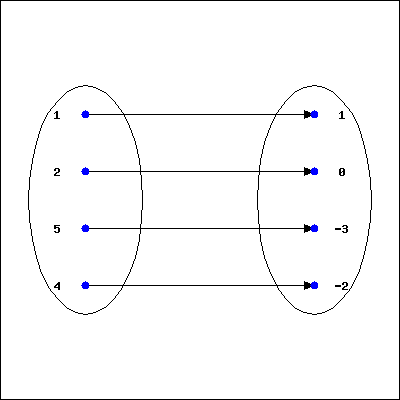
If we wanted to list several ordered pairs of a relation, we could simply list them. The following is an example of a relation:
\begin{equation*}
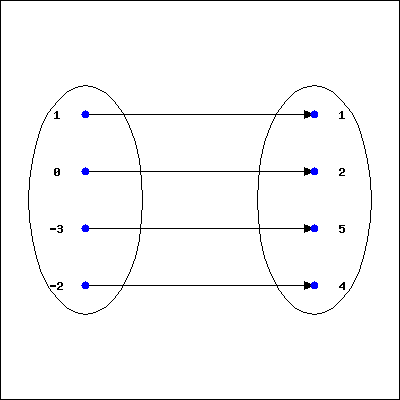
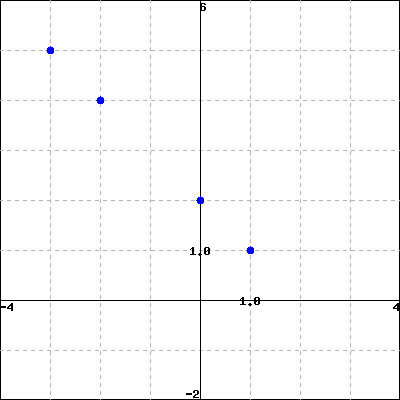
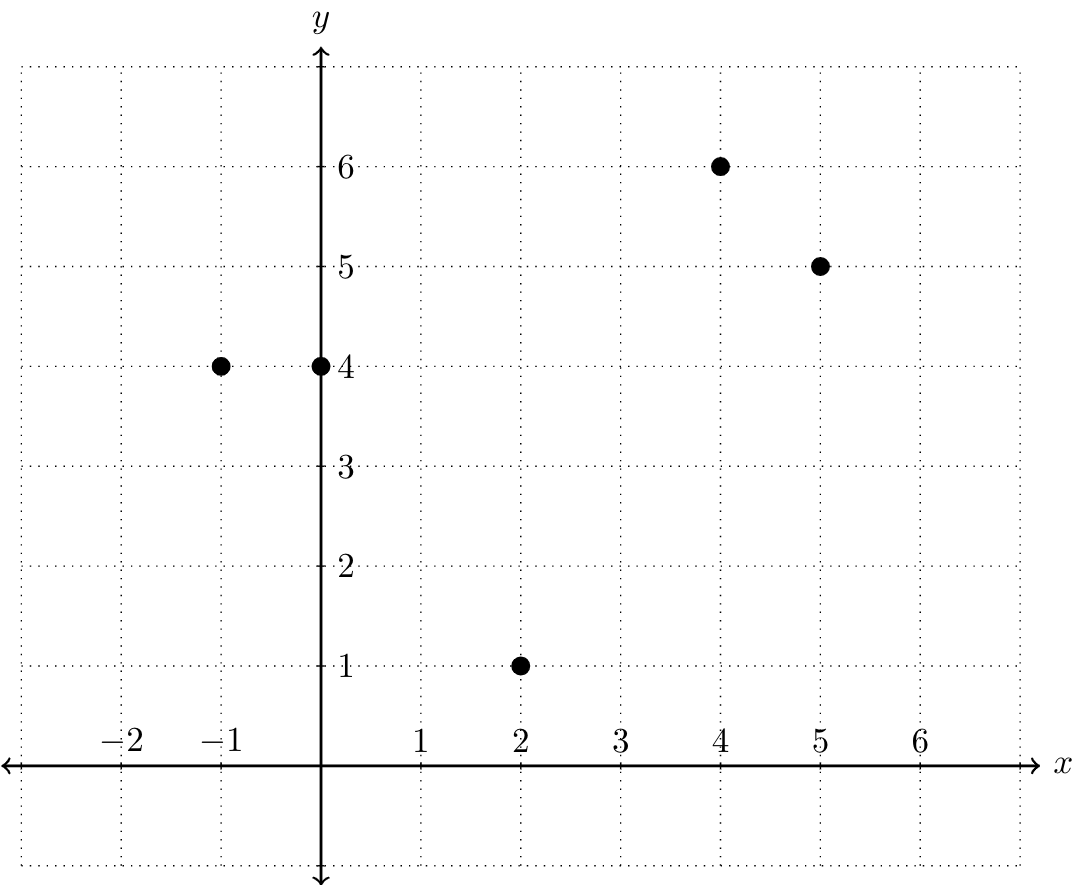
\big\{(4,6), \ (2,1), \ (0,4), \ (5,5), \ (-1,4)\big\}
\end{equation*}
Note 2.33.
The brackets "
\(\{ \ \}\)" are used to indicate a list of mathematical objects. In this course, you will see brackets used to indicate a set of ordered pairs for a relation, as well as sets of numbers.
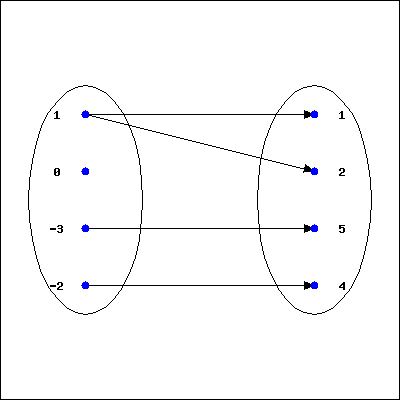
Two ways that we can represent a relation that are more organized than a list of ordered pairs are with tables and arrow diagrams. The table and arrow diagram for this relation are shown below.
| \(x\) |
\(y\) |
| \(4\) |
\(6\) |
| \(2\) |
\(1\) |
| \(0\) |
\(4\) |
| \(5\) |
\(5\) |
| \(-1\) |
\(4\) |
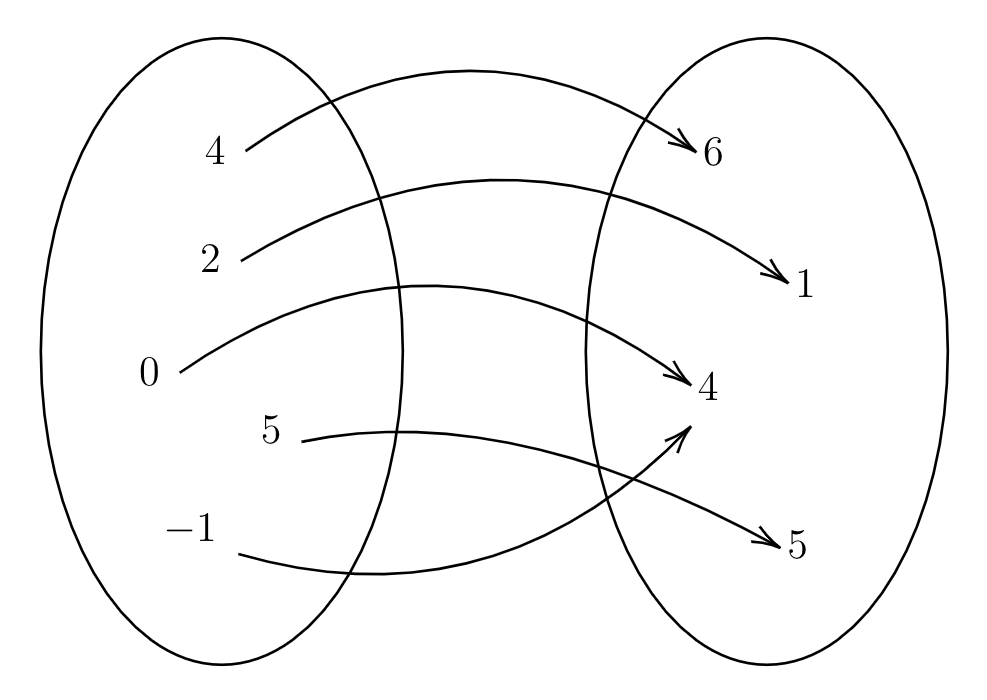
Arrow diagrams are less common than the other representations in this section, but are particularly useful when talking about functions, which will be discussed in Chapter 4.
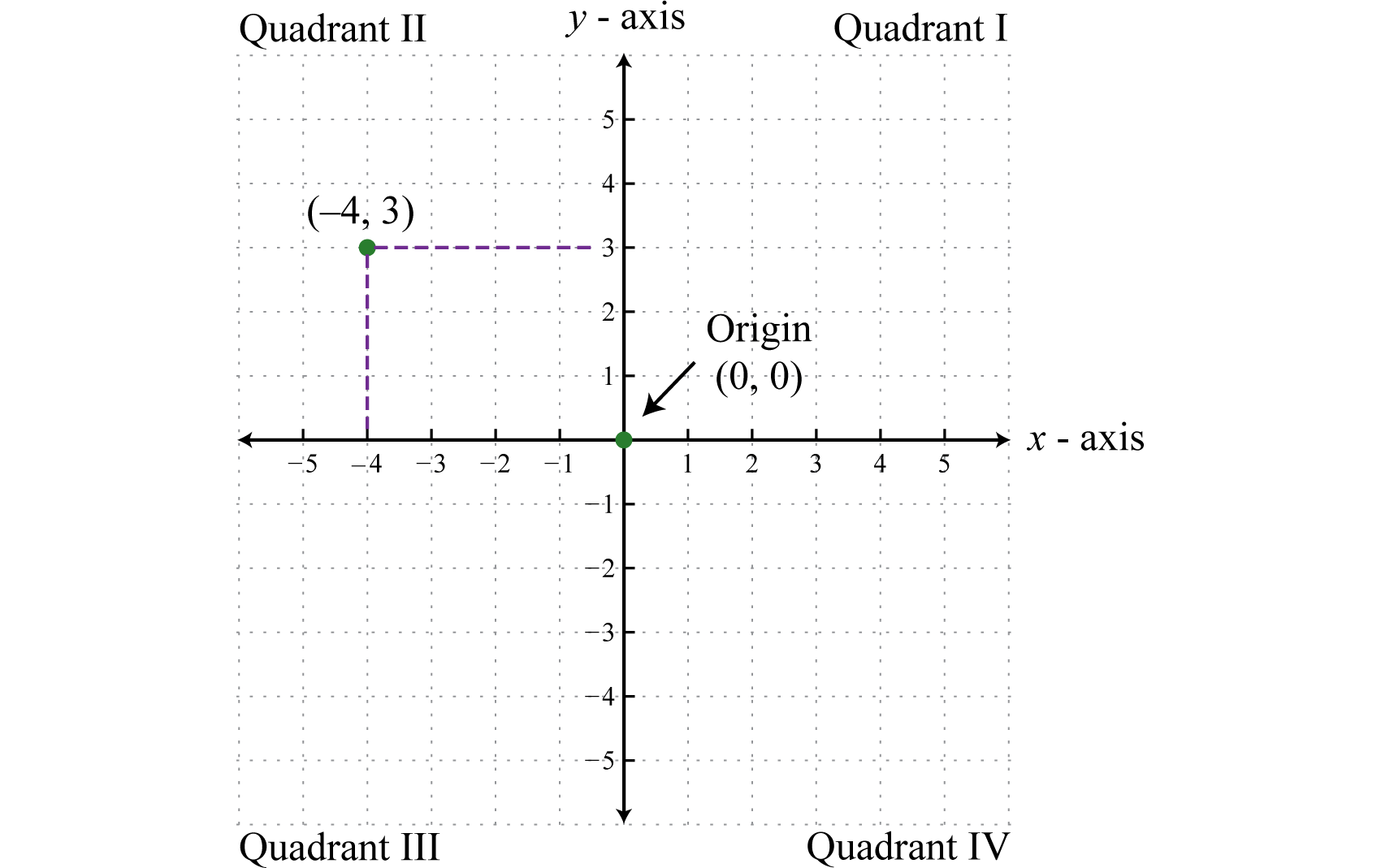
The last (and perhaps most important) representation of a relation that we will discuss is a graph. For relations between sets of numbers, graphs are a visual way to represent the relationship between the numbers on a coordinate plane. The rectangular coordinate system consists of two real number lines that intersect at a right angle. The horizontal number line is often referred to as the
\(x\)-axis, and the vertical number line is often referred to as the
\(y\)-axis. These two number lines define a flat surface called a
plane. The intersection of the two axes is known as the
origin, which corresponds to the point
\((0, 0)\text{.}\)
The
\(x\)- and
\(y\)-axes break the plane into four regions called
quadrants, named using Roman numerals I, II, III, and IV, as pictured. The ordered pair
\((x, y)\) represents the position of points relative to the origin. For example, the ordered pair
\((-4, 3)\) represents the position
\(4\) units to the left of the origin, and
\(3\) units above in the second quadrant.
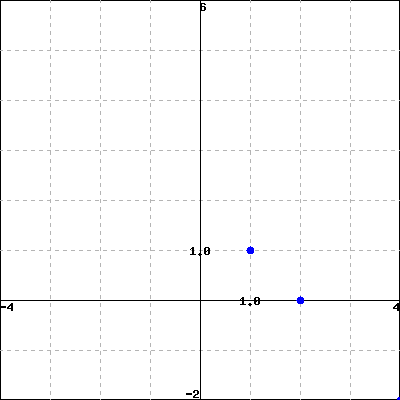
Returning to our previous example, the relation would be represented by the following graph:
Let’s explore another relation: consider the absolute value, denoted
\(|x|\text{.}\) The absolute value takes an input
\(x\) and tells us its distance from zero. For instance,
\(|5|=5\text{,}\) \(|-7|=7\text{,}\) and
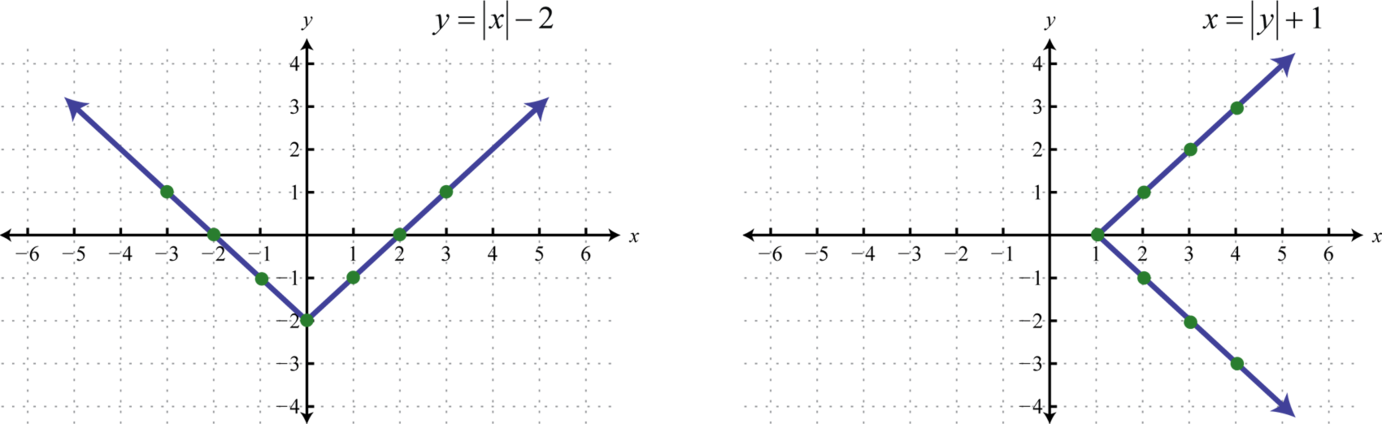
\(|-112|=112\text{.}\) Now let’s consider the algebraic equations
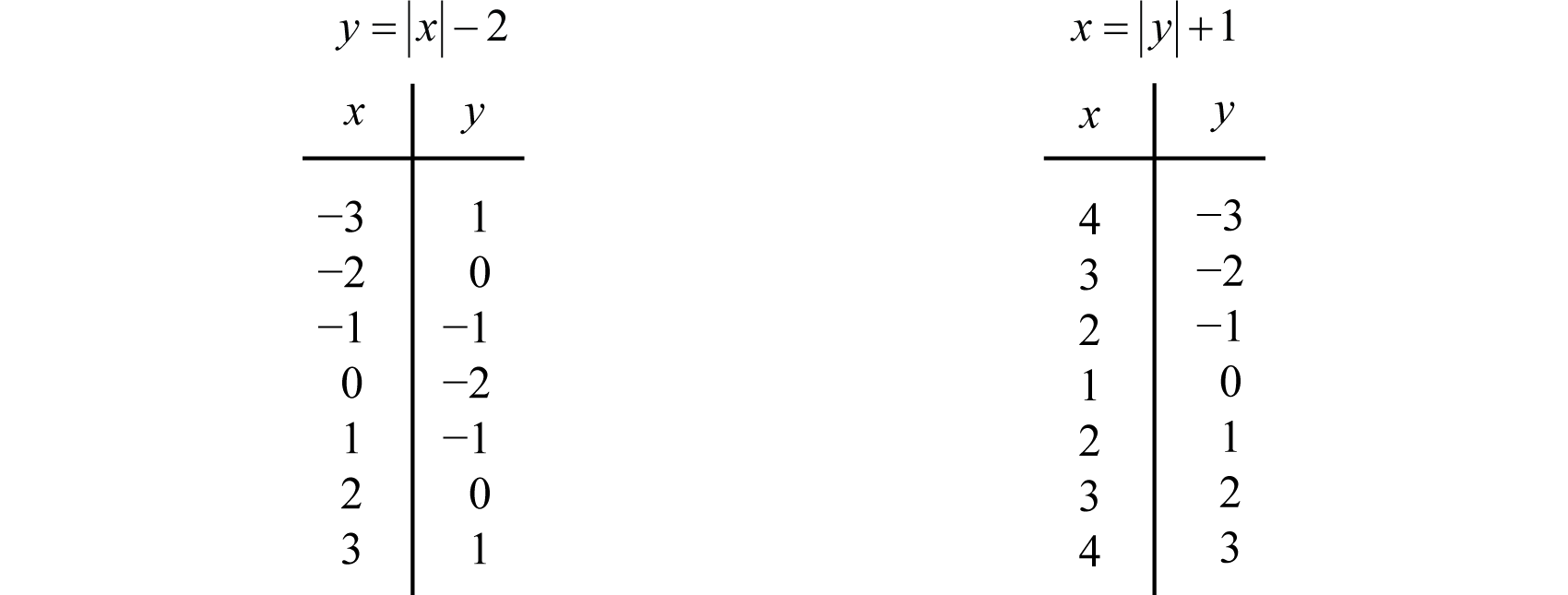
\(y=|x|-2\) and
\(x=|y|+1\text{.}\) Both these equations define relations between
\(x\) and
\(y\) involving the absolute values. The tables below show some of the ordered pairs for each of these relations.
Solutions to Absolute Value Equations
As ordered pairs, we can list these solutions as well.
\begin{align*}
y\amp=|x|-2\text{ has solutions }{(-3,1),(-2,0),(-1,-1),(0,-2),(1,-1),(2,0),(3,1)} \\
x\amp =|y|+1\text{ has solutions }{(4,-3),(3,-2),(2,-1),(1,0),(2,1),(3,2),(4,3)}
\end{align*}
We can visually display any relation of this type on a coordinate plane by plotting the points, or ordered pairs.
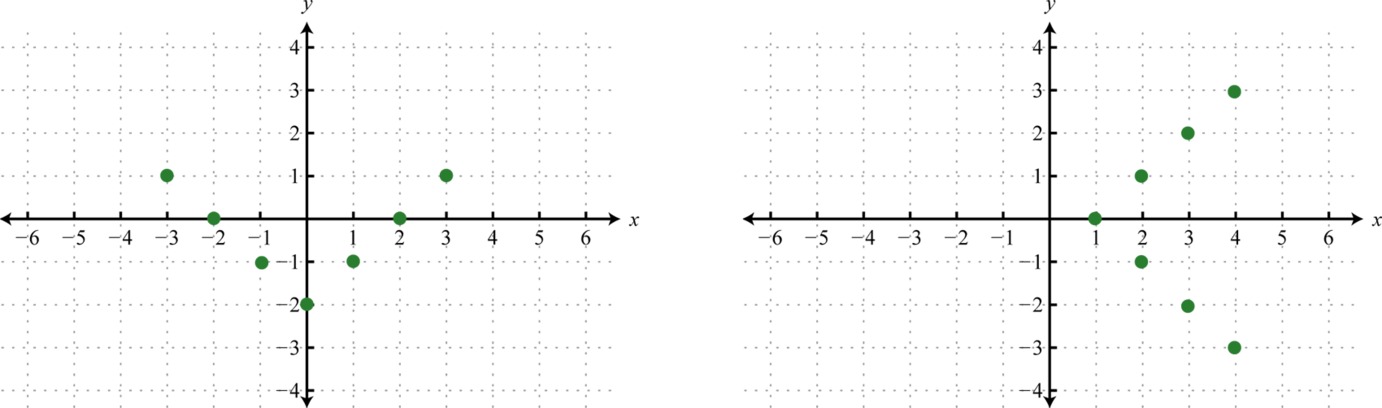
The solution sets of each equation will form a relation consisting of infinitely many ordered pairs. We can use the given ordered pair solutions to estimate all of the other ordered pairs by drawing a line through the given points. Here we put an arrow on the ends of our lines to indicate that this set of ordered pairs continues without bounds.