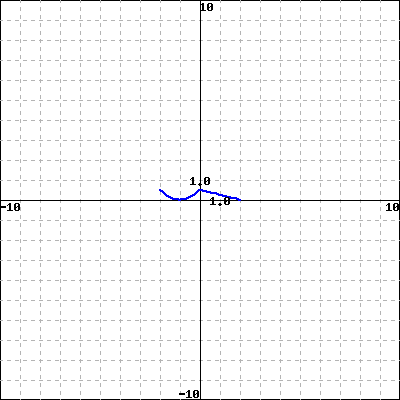
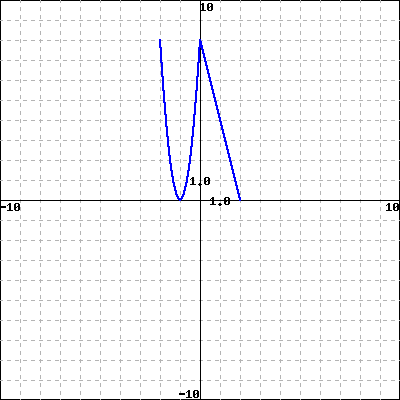
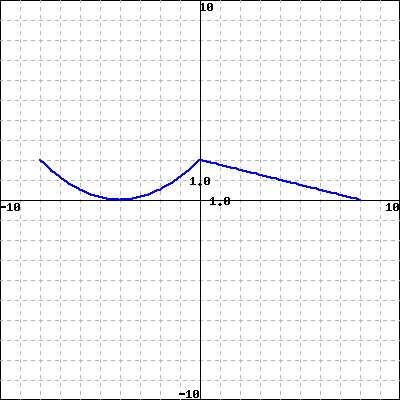
We can fill in the table by evaluating each of the given functions at the values of
\(x\) in the table.
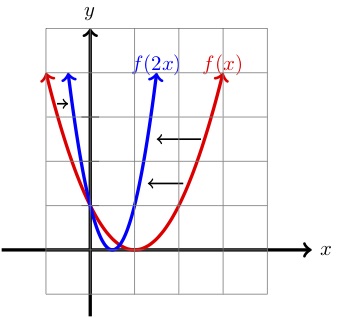
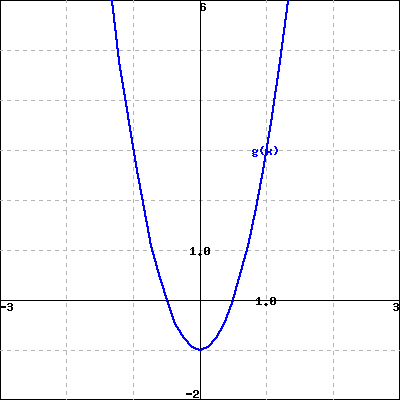
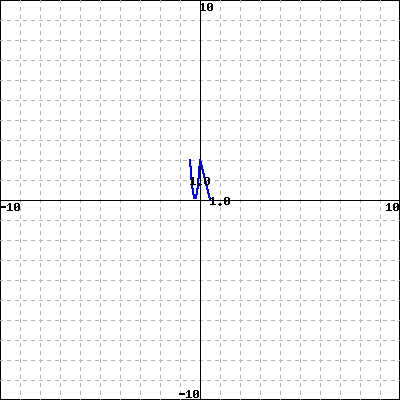
a) We see that the graph of
\(g(x)\) looks like it has been flattened towards
\(y\)-axis. Which description best fits this concept?
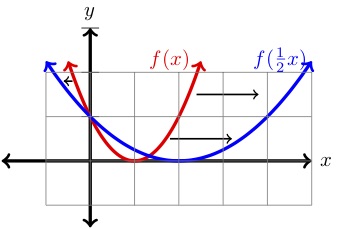
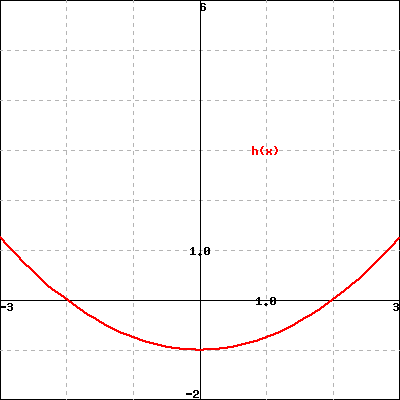
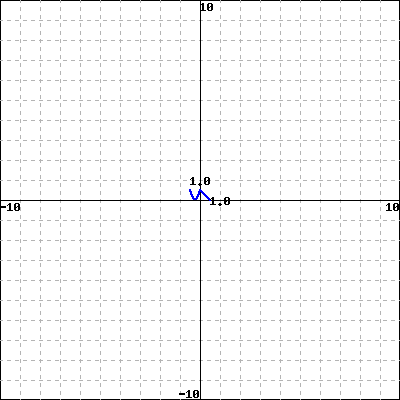
b) We see the the graph of
\(h(x)\) looks like it has been stretched away from
\(y\)-axis. Which description best fits this concept?
c) To come up with the formulas, let’s use what happened with
\(g(x)\) and
\(h(x)\) to help figure out the general rule.
We know that
\(g(x)=f(2x)\) resulted in a horizontal compression and
\(h(x)=f(.5x)=f\left(\dfrac{1}{2}x\right)\) resulted in a horizontal stretch. Think about the expressions
\(f(bx)\) and
\(f\left(\dfrac{1}{b}x\right)\text{,}\) where
\(b>1\text{.}\) Which of these do you think will give a horizontal stretch and which will give a horizontal compression, based on what you see above?