The London Eye is a huge Ferris wheel in London, England. At time \(t=0\text{,}\) an individual boards the Ferris wheel. Let \(h = f(t) \) be the height of the individual above ground (in meters) after \(t\) minutes. Given the graph of \(h = f(t) \) below, find an equation for \(h = f(t)\text{.}\)
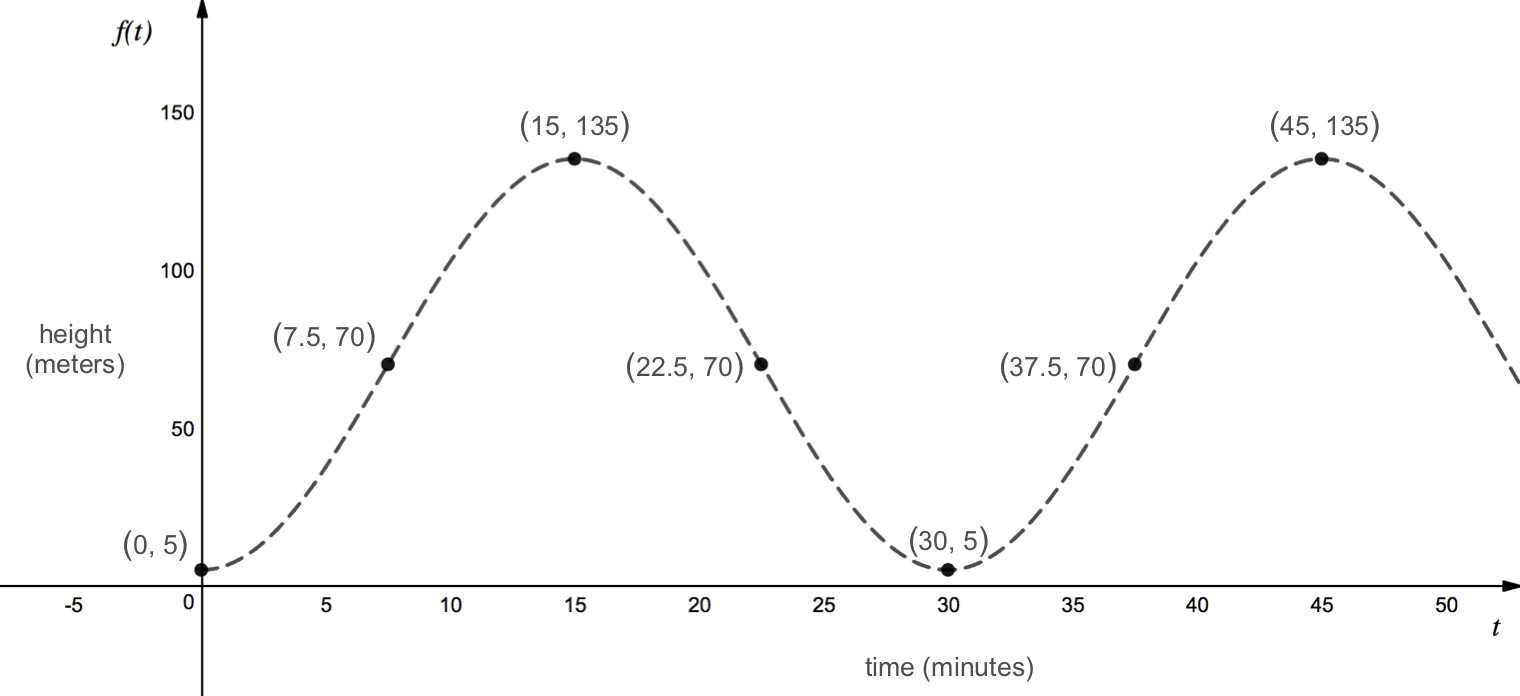
London Eye Graph
Solution.
First, we need to determine what sinusoidal function to use. Since the graph of the function crosses the \(y\)-axis at its minimum value, then we should use a generalized cosine equation, so our function will be of the form \(f(t) = A\cos(B(t-h))+k \text{.}\) Since the function crosses \(y\)-axis at its minimum value, then \(A\) will be negative. Moreover, since there is no horizontal shift, then \(h = 0\text{.}\) To find \(A, B\text{,}\) and \(k\text{,}\) we need to find the amplitude, period, and midline.
As shown on the graph, the period of the function is 30 minutes. Therefore, the \(B\) value of the function is
\begin{equation*}
|B| = \frac{2\pi}{P} = \frac{2\pi}{30} = \frac{\pi}{15}
\end{equation*}
Again, we assume that \(B\) is positive, so
\begin{equation*}
B=\frac{\pi}{15}
\end{equation*}
The maximum value of the function is 135 meters and the minimum value is 5 meters. The midline is halfway in between these two values and can be found by averaging them:
\begin{equation*}
\frac{135+5}{2} = \frac{140}{2} = 70 \text{ meters}
\end{equation*}
Thus, the midline of the function is the line \(y=70\) meters, and
\begin{equation*}
k=70
\end{equation*}
The amplitude of the function is the distance between the maximum value and the midline which is \(135-70=65\) meters. Therefore,
\begin{equation*}
A=-65
\end{equation*}
Putting this all together, the height of the individual \(t\) minutes after getting on the ride is given by
\begin{equation*}
f(t) = -65\cos\left(\frac{\pi}{15}t\right) + 70.
\end{equation*}
To check our solution, we can use a graphing calculator to graph the function we came up with and confirm that it matches the graph shown above.

