Section 5.2 Arc Length

Subsection 5.2.1 Arc Length

In the previous section, we used the radius of a circle, \(r\text{,}\) and an angle, \(\theta\) to define polar coordinates. In this section, we use these variables to find the length of arcs on circles.
An arc is a portion of (the outer edge of) a circle.
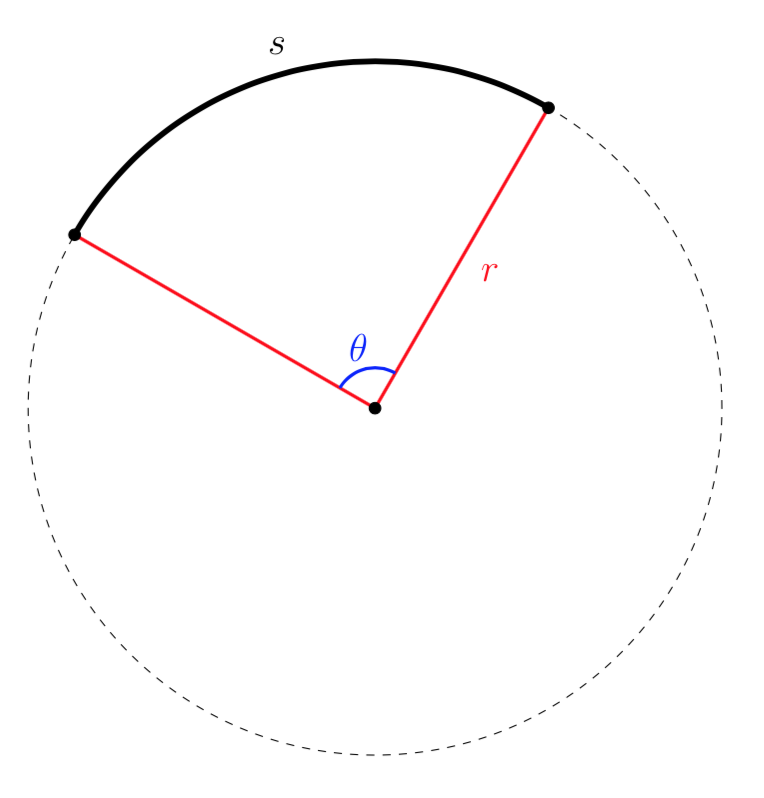
Arc length is defined as the length of an arc, \(s\text{,}\) along a circle of radius \(r\) subtended (drawn out) by an angle \(\theta\text{.}\)
described in detail following the image
arc length
The length of the arc around an entire circle is called the circumference of the circle. The circumference of a circle is
\begin{equation*} C=2\pi r \end{equation*}
To find the length of an arc along a circle of radius \(r\text{,}\) we can think of the arc as a portion of the circumference of the circle. Consider the following example.

Example 5.17.

Find the length of an arc on a circle of radius 2 subtended by an angle of 45 degrees.
Solution.
Let’s start by drawing a picture of the arc and labeling the known information.
We want to find the arc length, \(s\text{,}\) of an arc corresponding to an angle of 45 degrees on a circle of radius 2.
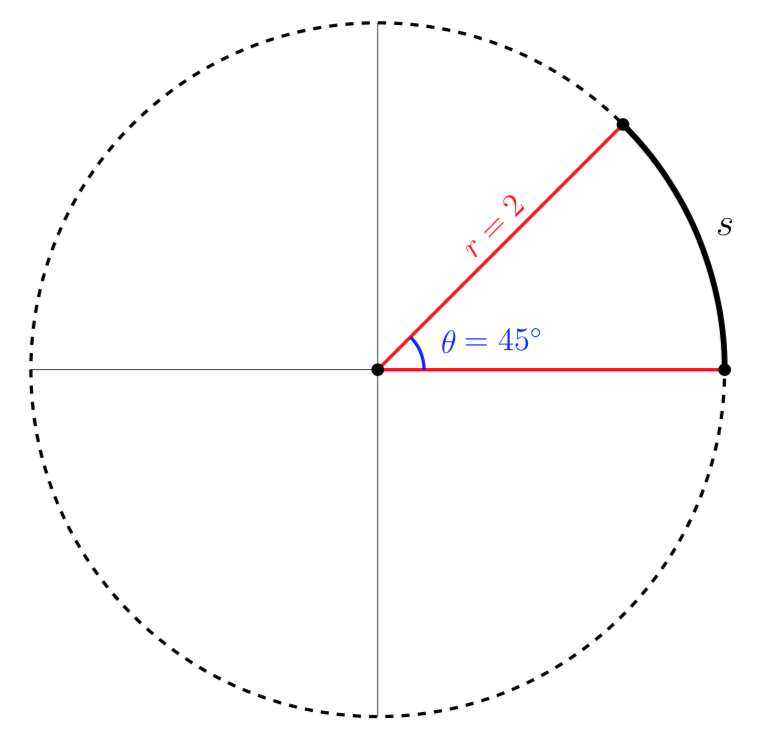
described in detail following the image
arc length example 1
To find the arc length, we can think about the arc as a portion of the circle’s circumference. The circumference of the circle is
\begin{equation*} C = 2\pi r = 2\pi \cdot 2 = 4\pi \end{equation*}
Since the arc corresponding to \(45^\circ\) is one-eighth of the full circumference of the circle, the arc length is
\begin{equation*} s = 4\pi \cdot \frac{1}{8} = \frac{4\pi}{8} = \frac{\pi}{2} \end{equation*}
Recall that we defined radians as an angle measurement that arises by looking at angles as a fraction of the unit circle. Since the radius of the unit circle is 1, the circumference of the unit circle is \(2\pi\text{.}\) This is why there are \(2\pi\) radians in one complete trip around a circle. Thus, arc lengths on the unit circle correspond to the angle measures (in radians) that those arcs subtend.
For example, consider an arc subtended by an angle of \(\pi/2\) radians on the unit circle. Since the circumference of the unit circle is \(2\pi\) and the arc is one-fourth of the circumference, the arc length is
\begin{equation*} 2\pi \cdot \frac{1}{4} = \frac{2\pi}{4} = \frac{\pi}{2} \end{equation*}
This corresponds exactly to the angle subtended by the arc, \(\pi/2\text{.}\)
What if the circle has radius \(r\text{?}\) If the circle is subtended by an angle of \(\theta\) radians, then the arc makes up a fraction of \(\frac{\theta}{2\pi}\) of the whole circumference. Since the circumference is \(2\pi r\text{,}\) we can compute the arc length as follows.

Arc Length Formula.

For a circle of radius \(r\) subtended by an angle of \(\theta\) radians, the length \(s\) of the corresponding arc is
\begin{equation*} s=2\pi r\cdot\frac{\theta}{2\pi} \end{equation*}
or simply
\begin{equation*} s=r\theta \end{equation*}

Exercises 5.2.2 Exercises

1. Computing Arc Length.

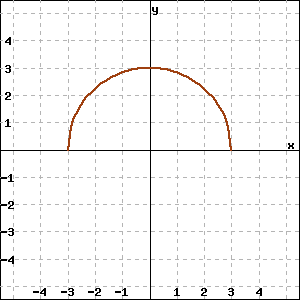
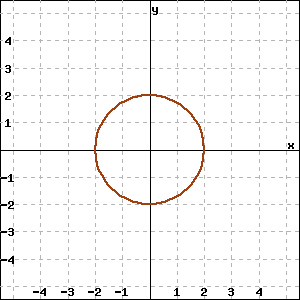
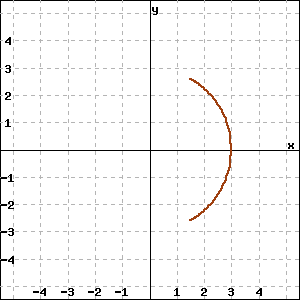
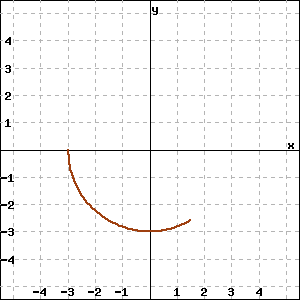
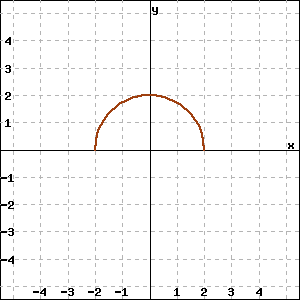
(a) Which of the following represents the graph of the arc given by \(r=3\) and \(0 \leq \theta \leq 2\pi\) ?
A B C D
(b) The length of the arc given above is units.
Hint.
Note that the angles \(0 \le \theta \le 2\pi\) represents a full rotation.

2. Computing Arc Length.

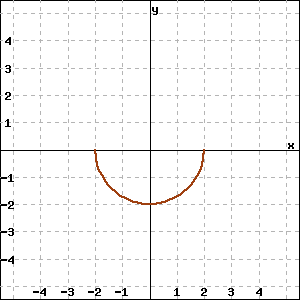
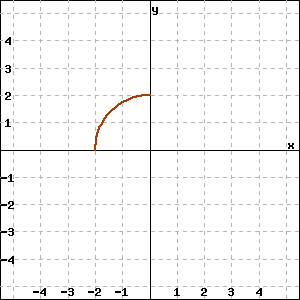
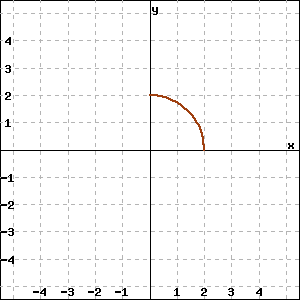
(a) Which of the following represents the graph of the arc given by \(r=2\) and \(0 \leq \theta \leq \pi/2\) ?
A B C D
(b) The length of the arc given above is units.
Hint.
Note that the angles \(0 \le \theta \le \frac{\pi}{2}\) represents a quarter rotation starting at \(0\text{.}\)

3. Computing Arc Length.

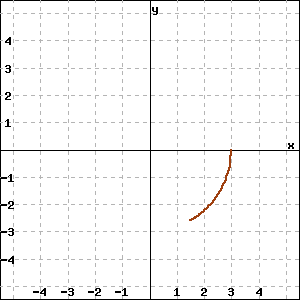
(a) Which of the following represents the graph of the arc given by \(r=3\) and \(-\pi/3 \leq \theta \leq 0\) ?
A B C D
(b) The length of the arc given above is units.
Hint.
Note that \(-\frac{\pi}{3}\) refers to a clockwise rotation by \(\frac{\pi}{3}\) from \(0\text{.}\)

4. Arc Length on the Unit Circle.

Find the length of the arc on the unit circle that is defined by the given angle.
(a) \(\pi/5\) radians
(b) \(4\) radians
(c) \(1.1\) radians
(d) \(32^\circ\)
Hint.
Recall that for formula for arc length is \(s = r\cdot \theta\) where \(\theta\) is in radians. What is the radius of the unit circle?

5. Computing Arc Length.

Find the length of the arc on the circle of the given radius, defined by the given angle.
[(a)]
5 radians on a circle of radius 3
\(120^\circ\) on a circle of radius 7
1 radian on a circle of radius \(1/3\)
1 radian on a circle of radius \(r\)
\(A\) radians on a circle of radius \(r\)
Hint.
Recall the formula for arc length is \(s=r\cdot \theta\) where \(\theta\) is a radian measure.

6. Computing Arc Length Between Two Angles.

Find the length of the arc between the angles \(11\pi/3\) radians and \(6\pi/2\) radians, on a circle of radius 5.5.
Hint.
How can we find the amount of radians between \(11\pi/3\) and \(6\pi/2\text{?}\)

7. Computing Arc Length on a Clock.

The clock on the Elizabeth Tower (more commonly known as "Big Ben") has a minute hand which is 14 feet long, and a 9 foot long hour hand.
(a) Suppose that at 10:50 pm, a butterfly lands on the minute hand, halfway between the tip and the center of the clock, and a mosquito lands on the end of the minute hand. The butterfly takes off at 11:15 pm, and the mosquito takes off at 11:20 pm. How many feet did the butterfly and mosquito travel while on the clock? (Hint: Start by drawing a picture of the situation.)
The butterfly traveled feet.
The mosquito traveled feet.
(b) If, also at 10:50 pm, a ladybug lands on the end of the hour hand, and takes off at 11:30 pm, how many feet did the ladybug travel while on the clock? feet.
Hint.
a) Start by drawing a sketch of the situation. What fractional part of the circle does the minute hand travel from 10:50 pm to 11:15 pm? What about to 11:20 pm? How can we use this to find the angle traveled? Note we need the radian measure to apply the arc length formula.
b) What fractional part of the clock does the hour hand travel from 10:50 pm to 11:30 pm? How can we use this to find the angle traveled? Note that we need the radian measure to apply the arc length formula.

8. Application of Arc Length.

(a) The distance between Paris, France, and Rio de Janeiro, Brazil is 5681 miles. If lines were drawn from Paris and Rio to the center of the earth, those lines would meet at an angle of \(82.53^{\circ}\text{.}\) Use this information to approximate the radius of the earth.
Using this information, we can estimate that the radius of the earth is miles.
(b) The distance between Moscow, Russia, and Istanbul, Turkey is 1077 miles. If lines were drawn from Moscow and Istanbul to the center of the earth, those lines would meet at an angle of \(16.17^{\circ}\text{.}\) Use this information to approximate the radius of the earth.
Using this information, we can estimate that the radius of the earth is miles.
Compare your two answers. Do you think this would be considered a good approximation? Why or why not?
Hint.
a) Start by drawing a sketch of the situation. Recall the formula for arc length.
b) Follow the same methods as part a).