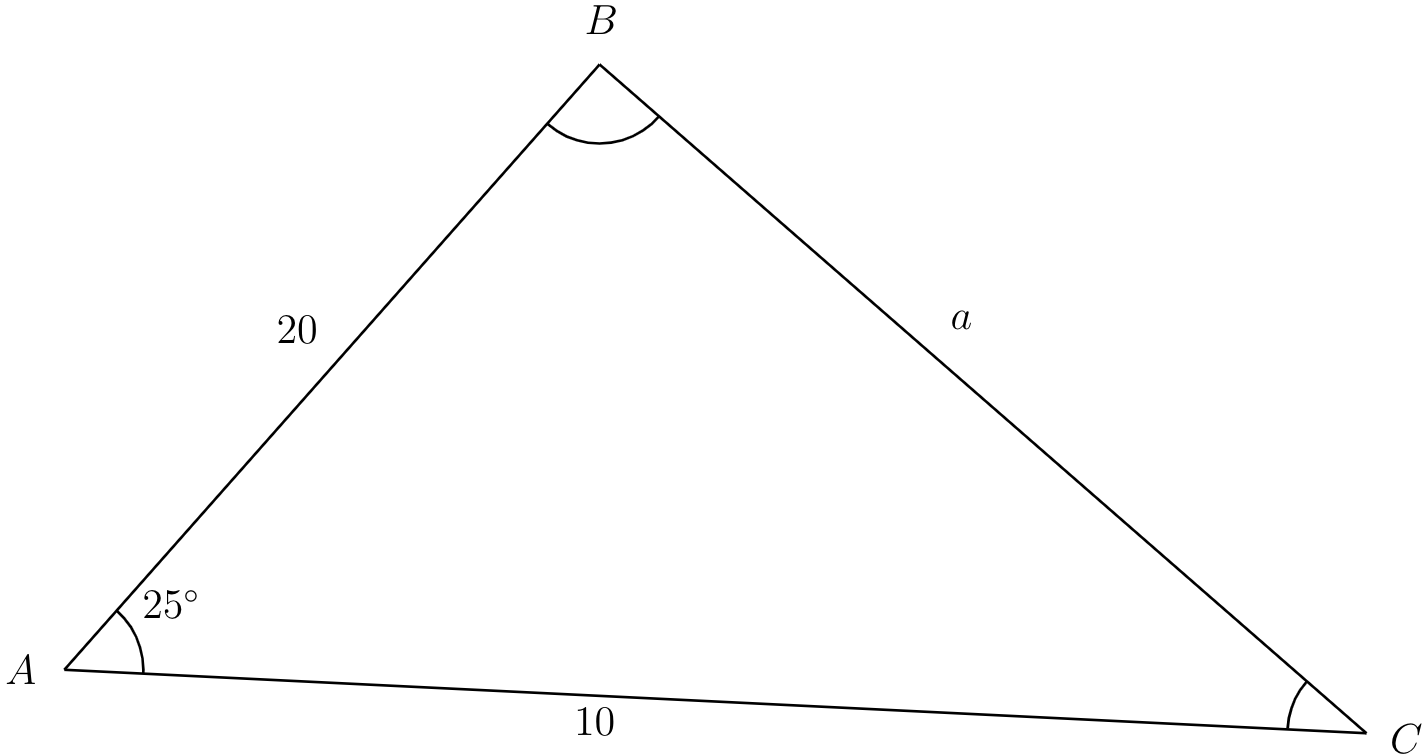
In choosing which pair of ratios from the Law of Sines to use, we always want to pick a pair where we know three of the four pieces of information in the equation.
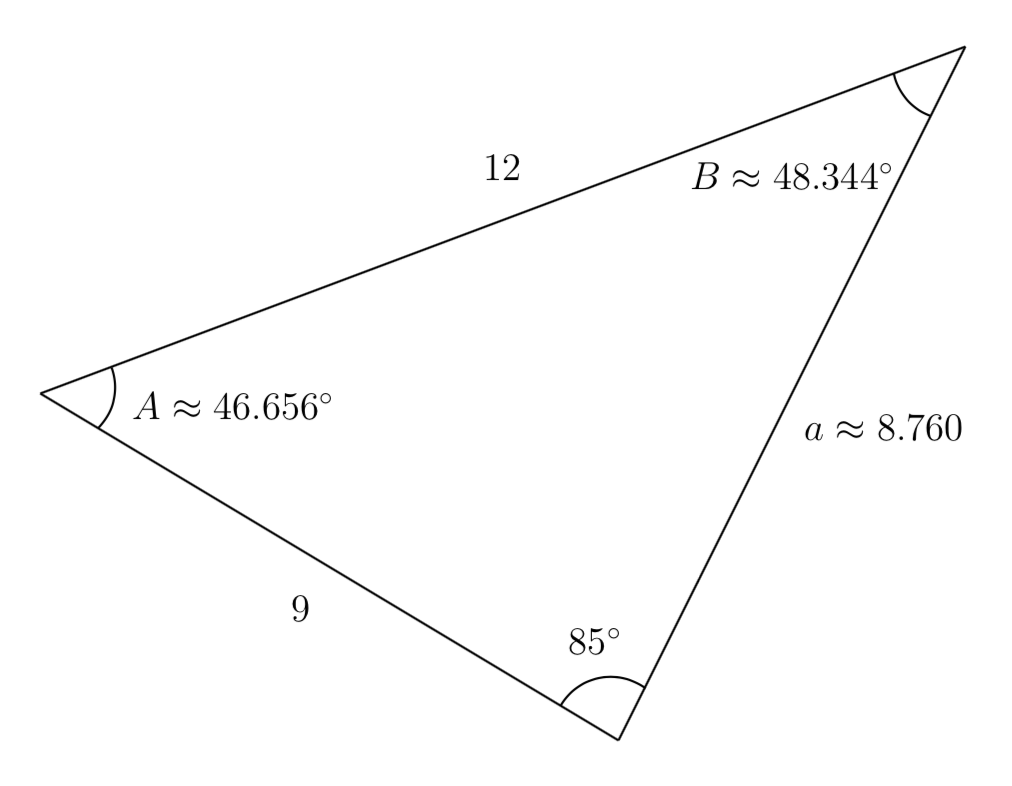
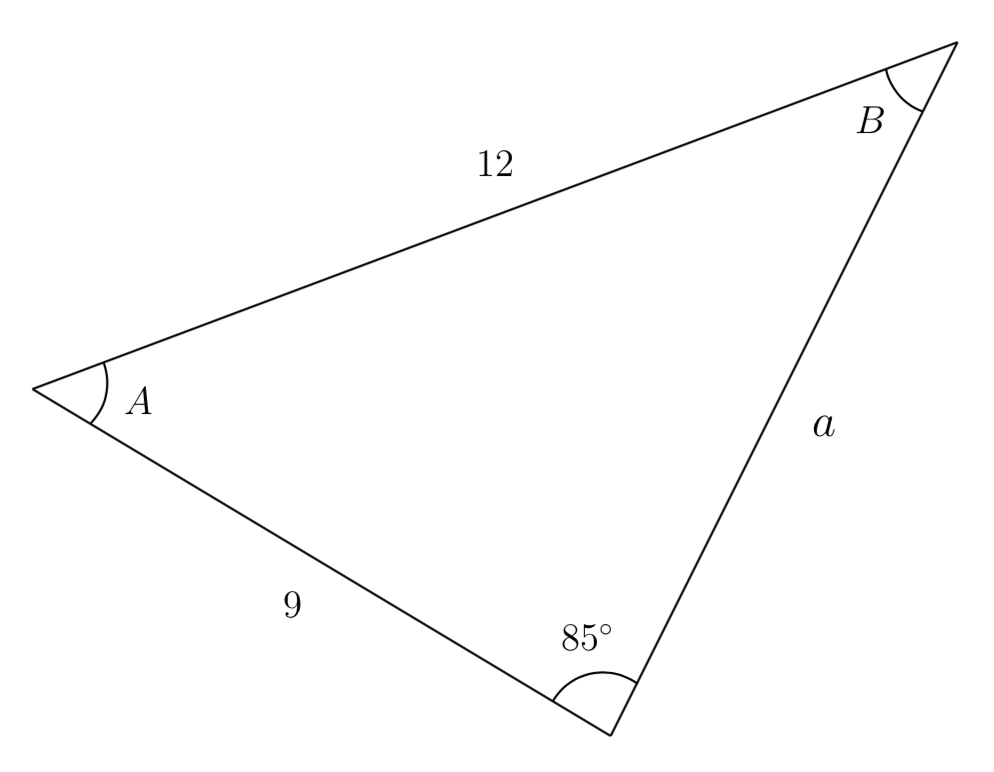
In this case, we know the angle \(85^\circ\) and its corresponding side, so we will use the ratio \(\sin(85^\circ)/12\text{.}\) Since our only other known information is the side with length 9, we will use that side and solve for its corresponding angle. Using the Law of Sines, we get the equation
\begin{equation*}
\frac{\sin(85^\circ)}{12} = \frac{\sin(B)}{9}
\end{equation*}
To solve for \(B\text{,}\) we can multiply both sides of the equation by \(9\) to get that
\begin{equation*}
9 \cdot \frac{\sin(50^\circ)}{10} = \sin(B)
\end{equation*}
We can now use the inverse sine function to solve for \(B\text{.}\) Remember that when we use the inverse sine function, there are two possible answers. Using a calculator, we get that
\begin{equation*}
B = \sin^{-1}\left(\frac{9\sin(85^\circ)}{12}\right) \approx 48.344^\circ
\end{equation*}
To solve for the other possible solution, we can use symmetry to get that
\begin{equation*}
B \approx 180^\circ - 48.344^\circ = 131.656^\circ
\end{equation*}
If \(B \approx 131.656^\circ\text{,}\) then \(A \approx 180^\circ - 85^\circ - 131.656^\circ = -36.656^\circ\text{,}\) which does not make sense. Therefore, we can disregard this second possible solution and conclude that the only possible solution for this angle is
\begin{equation*}
B \approx 48.344^\circ
\end{equation*}
Now that we have two angles, we can solve for the third one. Since all of the angles must add up to \(180\) degrees, we have that
\begin{equation*}
A \approx 180^\circ - 85^\circ - 48.344^\circ = 46.656^\circ
\end{equation*}
Now that we know \(A\text{,}\) we can proceed as in earlier examples to find the unknown side \(a\text{.}\) Using the Law of Sines, we get that
\begin{equation*}
\frac{\sin(85^\circ)}{12} = \frac{\sin(46.656^\circ)}{a}
\end{equation*}
Solving for \(a\text{,}\) we get that
\begin{equation*}
a = \frac{12\sin(46.646^\circ)}{\sin(85^\circ)} \approx 8.760
\end{equation*}
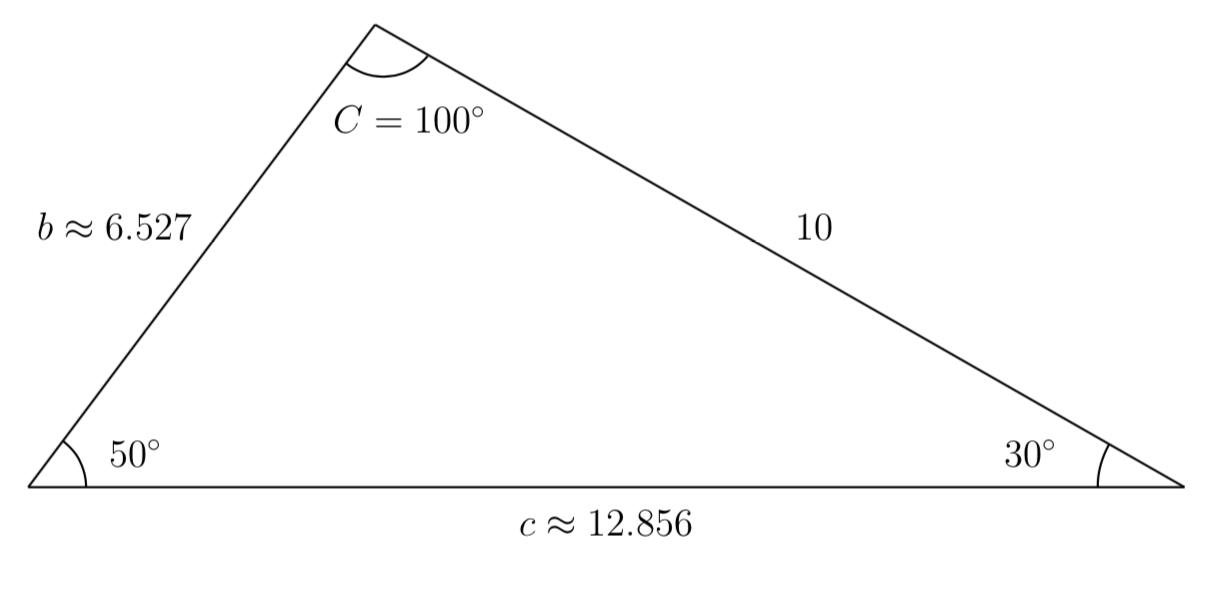
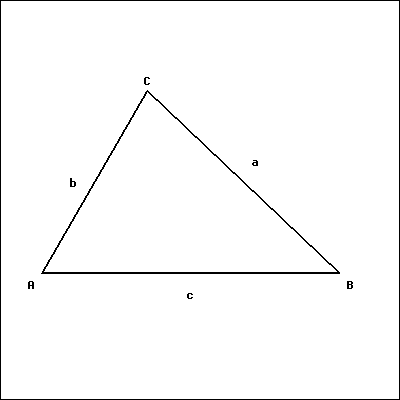
We have now solved for all of the unknown sides and angles of the triangle, as shown below.