Section 5.6 Combining Transformations

Nearing the end of this chapter, we have now discussed several transformations which can be performed on a function. Since we now have a solid grasp on each of these transformations, let’s apply multiple transformations to a function and study the outcome.

Subsection 5.6.1 Order Matters

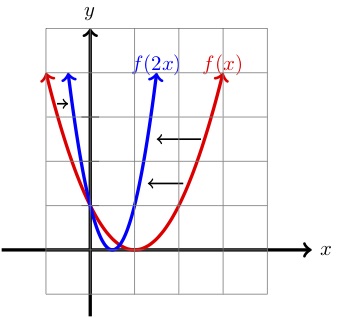
Consider \(f(x)=(x-1)^2\text{.}\) We know from a previous section that the graph of \(f(x)\) is the graph of \(x^2\) shifted \(1\) unit to the right.
described in detail following the image
Horizontal Compression
Figure 5.49.
As we know from the previous section, \(f(2x)\) is a horizontal compression by a factor of \(2 \text{.}\) However, here is where you need to be careful. When combining transformations, order matters.
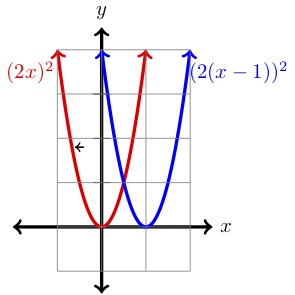
The function \(f(2x)=(2x-1)^2\) should really be thought of as \(f(2x)=(2(x-\frac{1}{2}))^2\) and is the result of starting with \(x^2\) and applying
  1. horizontal compression by a factor of \(2 \)
  2. horizontal shift right by \(\frac{1}{2}\)
in this order.
described in detail following the image
Horizontal Compression
Figure 5.50.

Subsection 5.6.2 Which Order to Use

As discussed thus far, in general, the order is important with transformations. However, if the transformations are vertical and horizontal changes then it does not matter whether the horizontal or vertical transformations are handled first. In general, we can follow the following guide:

Order of Transformations.

Suppose that \(f(x)\) is our function we are applying transformations to. Once written in the form
\begin{equation*} a\cdot f\big(b\cdot (x+h)\big)+k \end{equation*}
the order of transformations is:
  1. horizontal stretch or compress by a factor of \(\abs{b}\) or \(\abs{\dfrac{1}{b}}\) (if \(b\lt 0\) then also reflect about \(y\)-axis)
  2. shift horizontally left/ right by \(\abs{h} \)
  3. vertically stretch or compress by a factor of \(\abs{a}\) or \(\abs{\dfrac{1}{a}}\) (if \(a\lt 0\) then also reflect about \(x\)-axis)
  4. shift vertically up/ down by \(\abs{k} \)

Example 5.51.

Describe the function
\begin{equation*} 5\cdot \Big(f(-3x-6)-1\Big) \end{equation*}
as a list of transformations done to \(f(x)\) in the appropriate order.
Solution.
First, let’s rewrite the function in the form given above:
\begin{align*} 5\cdot \Big(f(-3x-6)-1\Big)\amp = 5f(-3x-6)-5 \ \ \text{we distributed in the 5}\\ \amp = 5f\big(-3(x+2)\big)-5 \ \ \text{we factored out the -3} \end{align*}
Now that the function is written in the desired order, we may list off the transformations in the correct order using the order discussed above:
  1. horizontal compress by \(3\) and reflect about the \(y\)-axis
  2. shift horizontally left by \(2 \)
  3. vertically stretch by \(5\)
  4. shift vertically down by \(5 \)

Exercises 5.6.3 Exercises

1. Graphs of Transformations.

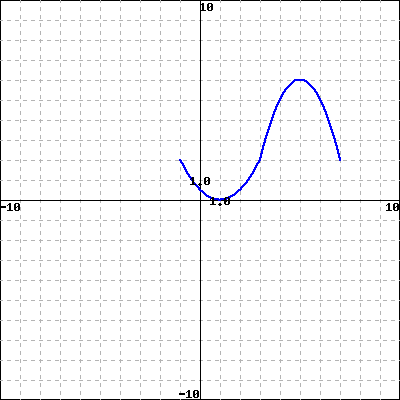
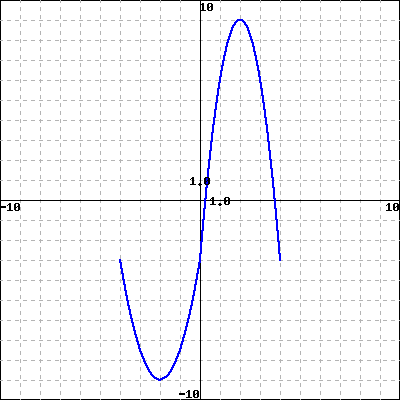
Let \(f(x)\) be given by the (large) graph to the right. On a piece of paper, graph and label each equation listed below. Then, match each formula with its graph from the list A-F below. Pay careful attention to the axes in the graph on the right, and on the graphs below. In all pictures, each tick mark represents a length of 1 unit. \(y = f(x+0.2)\) \(y = 5 f(x)\) \(y=0.2 f(5 x)\) \(y = f(5 x)\)
\(y = f(x)\)
A B C
D E F
(Click on a graph to enlarge it)
Hint.
For each of the graphs, the following information may be useful. It would be a good idea to try to identify the transformation(s) first and chose the graph that has those transformation(s) applied to the original. You may want to pick a couple of key points on the graph to follow to make this choice.
For \(k>0\text{,}\) when compared to the graph of \(f(x)\text{,}\)
- the graph of \(y=f(x)+k\) is shifted up by \(k\text{.}\)
- the graph of \(y=f(x)-k\) is shifted down by \(k\text{.}\)
For \(h>0\text{,}\) when compared to the graph of \(f(x)\text{,}\)
- the graph of \(y=f(x+h)\) is shifted left by \(h\text{.}\)
- the graph of \(y=f(x-h)\) is shifted right by \(h\text{.}\)
When compared to the graph of \(f(x)\text{,}\)
- the graph of \(y=-f(x)\) is reflected over the \(x\)-axis.
- the graph of \(y=f(-x)\) is reflected over the \(y\)-axis.
- the graph of \(y=f(bx)\) is horizontally compressed by a factor of \(b\) when \(b>1\text{.}\)
- the graph of \(y=f(bx)\) is horizontally stretched by a factor of \(\dfrac{1}{b}\) when \(0\lt b\lt 1\text{.}\)
- the graph of \(y=af(x)\) is vertically stretched by a factor of \(a\) when \(a>1\text{.}\)
- the graph of \(y=af(x)\) is vertically compressed by a factor of \(\dfrac{1}{a}\) when \(0\lt a\lt 1\text{.}\)

2. Vertical Transformations.

a) Suppose the point \((-1,1)\) is on the graph of a function \(f(x)\text{.}\)
i) What point would be on the graph \(g(x)\) given by first shifting \(f(x)\) up by 5 unit, then stretching it vertically by a factor of 5?
ii) What point would be on the graph \(h(x)\) given by first stretching \(f(x)\) vertically by a factor of 5, then shifting it up by 5 unit?
b) Did changing the order of the transformations change the point?
c) There are two formulas indicating shifting \(f(x)\) up by 5 and stretching vertically by a factor of 5: \(5 f(x)+5\) and \(5(f(x)+5)\text{.}\) Try to determine which of these is \(g(x)\) and which is \(h(x)\text{.}\) Hint: Think about order of operations.
\(g(x) =\)
\(h(x) =\)
Hint.
a) Make sure you apply the transformations in the indicated order. It may be helpful to do them one at a time.
b) Compare the points you got in part a).
c) Vertical transformations follow our intuition, so think about what transformation you would think to apply first for each given expression.

3. Horizontal Transformations.

a) Suppose the point \((-1,1)\) is on the graph of a function \(f(x)\text{.}\)
i) What point would be on the graph \(g(x)\) given by first shifting \(f(x)\) left by 1 unit, then compressing it horizontally by a factor of 4?
ii) What point would be on the graph \(h(x)\) given by first compressing \(f(x)\) horizontally by a factor of 4, then shifting it left by 1 unit?
b) Did changing the order of the transformations change the point?
c) There are two formulas indicating shifting \(f(x)\) left by 1 and compressing horizontally by a factor of 4. Try to fill out the following blanks to make the two equations.
\(g(x) = f(\) \(x +\) \()\)
\(h(x) = f(\)\((x +\))\()\)
Hint.
a) Make sure you apply the transformations in the indicated order. It may be helpful to do them one at a time.
b) Compare the points you got in part a).
c) Horizontal transformations follow the opposite of our intuition, so think about what transformation you would think to apply first for each given expression. The order of operations should be reversed from that.

4. Points on Transformations.

Suppose the point \((7,-9)\) is on the graph of a function \(f(x)\text{.}\) What point must be on the graph of each of the following functions?
a) \(f(-x)+6\)
b) \(f(10 x - 4)\)
c) \(\dfrac{1}{10}(f(x)+9)\)
d) \(5 f\left(\dfrac{1}{6}(x+8)\right)-3\)
Hint.
Determine the transformation(s) applied to the original function. Use that information to help you determine what happens to the point after each transformation. Remember that order matters in some cases!
It may be helpful to recall the following information.
For \(k>0\text{,}\) when compared to the graph of \(f(x)\text{,}\)
- the graph of \(y=f(x)+k\) is shifted up by \(k\text{.}\)
- the graph of \(y=f(x)-k\) is shifted down by \(k\text{.}\)
For \(h>0\text{,}\) when compared to the graph of \(f(x)\text{,}\)
- the graph of \(y=f(x+h)\) is shifted left by \(h\text{.}\)
- the graph of \(y=f(x-h)\) is shifted right by \(h\text{.}\)
When compared to the graph of \(f(x)\text{,}\)
- the graph of \(y=-f(x)\) is reflected over the \(x\)-axis.
- the graph of \(y=f(-x)\) is reflected over the \(y\)-axis.
- the graph of \(y=f(bx)\) is horizontally compressed by a factor of \(b\) when \(b>1\text{.}\)
- the graph of \(y=f(bx)\) is horizontally stretched by a factor of \(\dfrac{1}{b}\) when \(0\lt b\lt 1\text{.}\)
- the graph of \(y=af(x)\) is vertically stretched by a factor of \(a\) when \(a>1\text{.}\)
- the graph of \(y=af(x)\) is vertically compressed by a factor of \(\dfrac{1}{a}\) when \(0\lt a\lt 1\text{.}\)

5. Identifying Transformations.

Describe the graphs of the following as the result of applying shifts, reflections, stretches, and/or compressions to the graph of \(y=m(x)\text{.}\)
a) \(y= m\left(4 x\right)+ 9\)
The graph of \(m(x)\) has been shifted
by and
by a factor of .
b) \(y = 2 m(x)- 9\)
Transformations have been applied to the graph of \(m(x)\) in the following order:
1) The graph of \(m(x)\) has been
by .
2) The graph of \(m(x)\) has been
by .
c) \(y=-(m\left(5(x - 2)\right) + 12)\)
Transformations have been applied to the graph of \(m(x)\) in the following order:
1) The graph of \(m(x)\) has been
by .
2) The graph of \(m(x)\) has been
by .
3) The graph of \(m(x)\) has been
by .
4) The graph of \(m(x)\) has been
.
d) \(y=5 m\left(-5 x+ 4\right) + 4\)
Transformations have been applied to the graph of \(m(x)\) in the following order:
1) The graph of \(m(x)\) has been
by .
2) The graph of \(m(x)\) has been
.
3) The graph of \(m(x)\) has been
by .
4) The graph of \(m(x)\) has been
by .
5) The graph of \(m(x)\) has been
by .
Hint.
It may be helpful to recall the following information. Don’t forget that the order matters in some cases!
For \(k>0\text{,}\) when compared to the graph of \(f(x)\text{,}\)
- the graph of \(y=f(x)+k\) is shifted up by \(k\text{.}\)
- the graph of \(y=f(x)-k\) is shifted down by \(k\text{.}\)
For \(h>0\text{,}\) when compared to the graph of \(f(x)\text{,}\)
- the graph of \(y=f(x+h)\) is shifted left by \(h\text{.}\)
- the graph of \(y=f(x-h)\) is shifted right by \(h\text{.}\)
When compared to the graph of \(f(x)\text{,}\)
- the graph of \(y=-f(x)\) is reflected over the \(x\)-axis.
- the graph of \(y=f(-x)\) is reflected over the \(y\)-axis.
- the graph of \(y=f(bx)\) is horizontally compressed by a factor of \(b\) when \(b>1\text{.}\)
- the graph of \(y=f(bx)\) is horizontally stretched by a factor of \(\dfrac{1}{b}\) when \(0\lt b\lt 1\text{.}\)
- the graph of \(y=af(x)\) is vertically stretched by a factor of \(a\) when \(a>1\text{.}\)
- the graph of \(y=af(x)\) is vertically compressed by a factor of \(\dfrac{1}{a}\) when \(0\lt a\lt 1\text{.}\)

6. Vertical Transformations.

a) Suppose the point \((-1,1)\) is on the graph of a function \(f(x)\text{.}\)
i) What point would be on the graph \(g(x)\) given by first shifting \(f(x)\) up by 3 unit, then stretching it vertically by a factor of 4?
ii) What point would be on the graph \(h(x)\) given by first stretching \(f(x)\) vertically by a factor of 4, then shifting it up by 3 unit?
b) Did changing the order of the transformations change the point?
c) There are two formulas indicating shifting \(f(x)\) up by 3 and stretching vertically by a factor of 4: \(4 f(x)+3\) and \(4(f(x)+3)\text{.}\) Try to determine which of these is \(g(x)\) and which is \(h(x)\text{.}\) Hint: Think about order of operations.
\(g(x) =\)
\(h(x) =\)
Hint.
a) Make sure you apply the transformations in the indicated order. It may be helpful to do them one at a time.
b) Compare the points you got in part a).
c) Vertical transformations follow our intuition, so think about what transformation you would think to apply first for each given expression.

7. Graphs of Transformations.

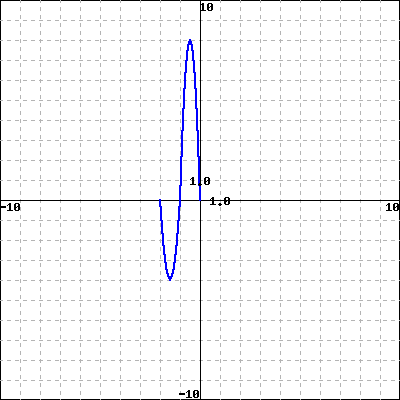
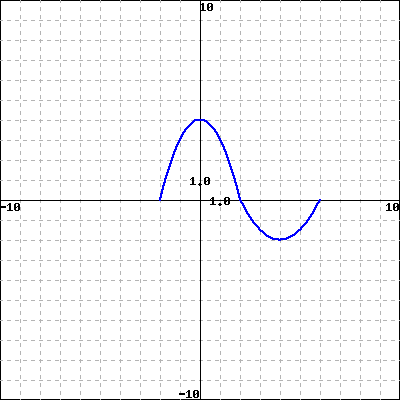
Let \(f(x)\) be given by the (large) graph to the right. On a piece of paper, graph and label each equation listed below. Then, match each formula with its graph from the list A-F below. Pay careful attention to the axes in the graph on the right, and on the graphs below. In all pictures, each tick mark represents a length of 1 unit. \(y =f(x-3)+2\) \(y = f(-x+2)\) \(y = 2 f(4 x+4)\) \(y = 3 f(x)-3\)
\(y = f(x)\)
A B C
D E F
(Click on a graph to enlarge it)
Hint.
Determine the transformation(s) taking place for each equation and choose the appropriate graph. It may be helpful to pick out some key points to follow to make the correct decision. The following information will be useful as well.

For \(k>0\text{,}\) when compared to the graph of \(f(x)\text{,}\)
- the graph of \(y=f(x)+k\) is shifted up by \(k\text{.}\)
- the graph of \(y=f(x)-k\) is shifted down by \(k\text{.}\)
For \(h>0\text{,}\) when compared to the graph of \(f(x)\text{,}\)
- the graph of \(y=f(x+h)\) is shifted left by \(h\text{.}\)
- the graph of \(y=f(x-h)\) is shifted right by \(h\text{.}\)
When compared to the graph of \(f(x)\text{,}\)
- the graph of \(y=-f(x)\) is reflected over the \(x\)-axis.
- the graph of \(y=f(-x)\) is reflected over the \(y\)-axis.
- the graph of \(y=f(bx)\) is horizontally compressed by a factor of \(b\) when \(b>1\text{.}\)
- the graph of \(y=f(bx)\) is horizontally stretched by a factor of \(\dfrac{1}{b}\) when \(0\lt b\lt 1\text{.}\)
- the graph of \(y=af(x)\) is vertically stretched by a factor of \(a\) when \(a>1\text{.}\)
- the graph of \(y=af(x)\) is vertically compressed by a factor of \(\dfrac{1}{a}\) when \(0\lt a\lt 1\text{.}\)