Section 2.8 Modeling Linear Equations

Up to this point, we have learned how to create graphs that reflect linear equations and how to construct linear equations given graphs. In this section, we will introduce two characteristics that pairs of lines can have so that we can continue to construct linear equations with various properties.

Subsection 2.8.1 Parallel and Perpendicular Lines

Parallel lines are lines in the same plane that never intersect. Two different lines in the same plane are parallel if their slopes are the same; in symbols, if the slope of the first line is \(m_1\) and the slope of a different line is \(m_2\text{,}\) then the slopes are parallel if \(m_1=m_2\text{.}\)

Example 2.48.

Find an equation of the line passing through \((4,1)\) and parallel to \(x-2y=-2\text{.}\)
Solution.
To find the slope of the given line, solve for \(y\text{.}\)
\begin{equation*} \begin{aligned} x-2y\amp =-2\\ -2y\amp = -x-2\\ y\amp =\frac{-x-2}{-2}\\ y\amp = \frac{-x}{-2}-\frac{2}{-2}\\ y\amp =\frac{1}{2}x+1 \end{aligned} \end{equation*}
Here the given line has slope \(m_1=\frac{1}{2}\text{.}\) The line we are constructing is parallel to this line and will therefore have the same slope, so \(m_2=\frac{1}{2}\text{.}\) Since we are given a point and we now have the slope, we will choose to use point-slope form of a linear equations to determine the slope-intercept form of the equation.
Our point is \((4,1)\) and our slope is \(m=\frac{1}{2}\text{.}\)
\begin{equation*} \begin{aligned} y-y_1 \amp= m(x-x_1) \\ y-1 \amp= \dfrac{1}{2}(x-4) \end{aligned} \end{equation*}
The equation of the line is given by \(y-1 = \dfrac{1}{2}(x-4)\text{.}\)

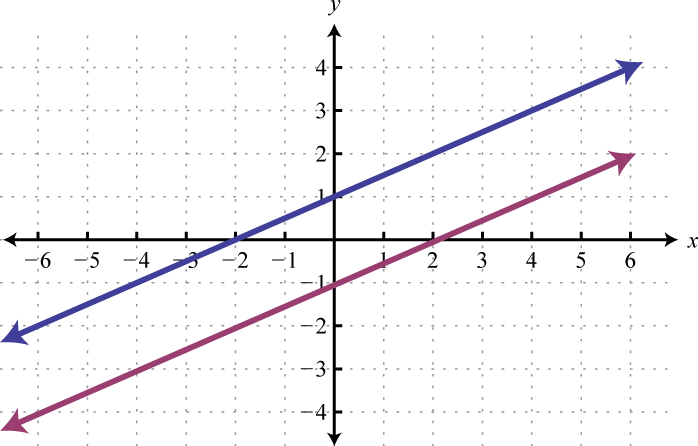
It is important to have a geometric understanding of this question. The line we were given, \(x-2y=-2\text{,}\) is shown in blue. The line we constructed, \(y-1=\frac{1}{2}(x-4)\text{,}\) is shown in magenta. notice that the slope is the same at the given line, but they are distinct lines (that is, they do not have the same \(y\)-intercept).
described in detail following the image
Geometric Understanding
Perpendicular lines are lines in the same plane that intersect at right angles (90 degrees). Two nonvertical lines, in the same plane with slopes \(m_1\) and \(m_2\text{,}\) are perpendicular if the product of their slopes is \(-1\text{,}\) \(m_1\cdot m_2=-1\text{.}\) We can solve for \(m_1\) and obtain \(m_1=-\frac{1}{m_2}\text{.}\) In this form, we see that perpendicular lines have slopes that are opposite reciprocals. In general, given non-zero real numbers \(a\) and \(b\text{,}\) if the slope of the first line is given by \(m_1=\frac{a}{b}\text{,}\) then the slope of the perpendicular line is \(m_2=-\frac{b}{a}\text{.}\)
For example, the opposite reciprocal of \(m_1=-\frac{3}{5}\) is \(m_2=\frac{5}{3}\text{.}\) We can verify that two slopes produce perpendicular lines if their product is \(-1\text{.}\)
\begin{gather*} m_1\cdot m_2=-\frac{3}{5}\cdot\frac{5}{3}=-\frac{15}{15}=-1 \end{gather*}

Example 2.49.

Find an equation of the line passing through \((-5,-2)\) and perpendicular to the graph of \(x+4y=4\text{.}\)
Solution.
To find the slope of the given line, solve for \(y\text{.}\)
\begin{equation*} \begin{aligned} x+4y\amp =4\\ 4y\amp = -x+4\\ y\amp = \frac{-x+4}{4}\\ y\amp = -\frac{x}{4}+\frac{4}{4}\\ y\amp = -\frac{1}{4}x+1 \end{aligned} \end{equation*}
The given line has slope \(m_1=-\frac{1}{4}\text{.}\) Since we are constructing a line that is perpendicular to this line, their slopes should be opposite reciprocals, and thus the line we are constructing should have a slope of \(m_2=+\frac{4}{1}=4\text{.}\) Now we can substitute the slope, \(m_2=4\text{,}\) and the given point, \((-5,-2)\text{,}\) into point-slope form:
\begin{equation*} \begin{aligned} y-y_1\amp =m(x-x_1)\\ y-(-2)\amp = 4(x-(-5))\\ y+2\amp = 4(x+5) \end{aligned} \end{equation*}
The equation of the perpendicular line is given by \(y+2=4(x+5)\text{.}\)
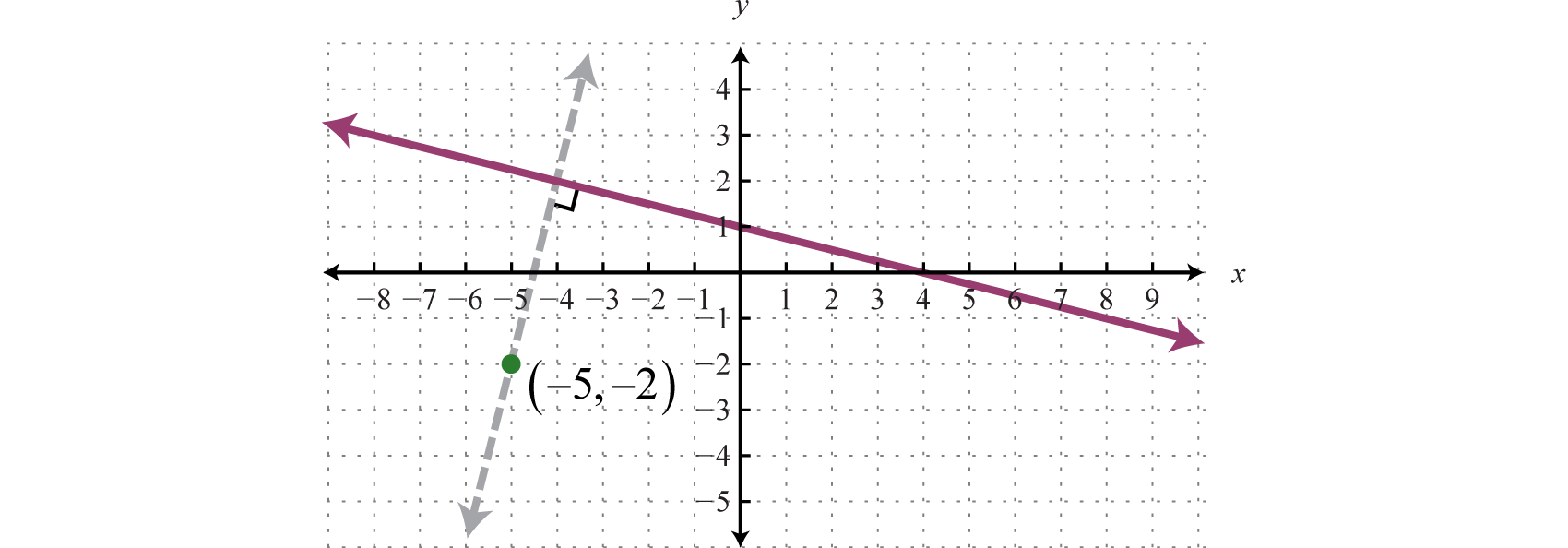
Geometrically, we see that the graph of \(y=4x+18\text{,}\) shown as the dashed line in the graph, passes through \((-5,-2)\) and is perpendicular to the graph of \(y=-\frac{1}{4}x+1\text{.}\)
described in detail following the image
Quadrants of the Plane

Example 2.50.

Find an equation of the line passing through \((-5,-1)\) and perpendicular to \(\frac{1}{3}x-\frac{1}{2}y=-2\text{.}\)
Solution.
To find the slope of the given line, we solve for \(y\text{:}\)
\begin{equation*} \begin{aligned} \frac{1}{3}x-\frac{1}{2}y \amp= -2 \\ 6\left(\frac{1}{3}x-\frac{1}{2}y\right) \amp= 6(-2) \\ 2x - 3y \amp= -12 \\ -3y \amp= -2x - 12 \\ y \amp= \dfrac{2}{3}x + 4 \end{aligned} \end{equation*}
The given line has slope \(m_1=\frac{2}{3}\text{,}\) therefore the line we are constructing must have a slope of \(m_2=-\frac{3}{2}\text{.}\) Using this and the point \((-5,-1)\text{,}\) we can use point-slope form to write the following equation:
\begin{equation*} \begin{aligned} y-(-1) \amp= -\frac{3}{2}(x-(-5)) \\ y+1 \amp- -\frac{3}{2}(x+5) \end{aligned} \end{equation*}

Exercises 2.8.2 Exercises

1. Parellel, Perpendicular, or Neither?

This is similar to Problem 2 from your 2.8 worksheet.
1.) Are the lines below perpendicular, parallel, or neither?
\begin{equation*} y = 2 x - 7 \qquad y = -\frac{1}{2} x + 2 \end{equation*}
2.) Are the lines below perpendicular, parallel, or neither?
\begin{equation*} y = 2 x + 1 \qquad y = 2 x + 8 \end{equation*}

2. Parellel, Perpendicular, or Neither?

This is similar to Problem 2 from your Section 2.8 worksheet.
Determine whether each pair of lines is parallel, perpendicular, or neither.
a) \(\dfrac{2}{3}x+4 y = -5\) and \(-12 y - 2 x = -108\)
b) \(14 y + 56 = 4 x\) and \(\dfrac{21}{2}y=3 x - \dfrac{84}{2}\)
Hint.
To determine whether lines are parallel or perpendicular, you need to determine the slope of the lines.
A line is not parallel to itself.

3. Constructing Linear Equations.

This is similar to Problem 3 from your Section 2.8 worksheet.
Write an equation of the line that satisfies the given conditions. Enter your answer in slope-intercept form.
Through \((-3,7)\text{,}\) parallel to the graph of \(-5 x+y=3\text{.}\)
\(y=\) (Make sure to use a lowercase x as your variable.)
Hint.
What is the slope of \(-5 x+y=3\text{?}\) What is the relationship between the slope of this line and the line you’re constructing?
Once you determine the slope of the line you’re constructing, you have the slope of the line and a point on that line. How can you construct the equation that represents that line?

4. Constructing Linear Equations.

This is similar to Problem 3 from your Section 2.8 worksheet.
Write an equation of the line that satisfies the given conditions. Enter your answer in slope-intercept form.
Through \((6,2)\text{,}\) perpendicular to the graph of \(-4 x+y=3\text{.}\)
\(y=\)
Hint.
What is the slope of \(-4 x+y=3\text{?}\) What is the relationship between the slope of this line and the line you’re constructing?
Once you determine the slope of the line you’re constructing, you have the slope of the line and a point on that line. How can you construct the equation that represents that line?

5. Constructing Linear Equations.

This is similar to Problem 3 from your Section 2.8 worksheet.
Write an equation of the line that satisfies the given conditions. Enter your answer in slope-intercept form.
Through \((-6,-4)\text{,}\) perpendicular to the graph of \(x + 3 y=3\text{.}\)
\(y=\)
Hint.
What is the slope of \(x + 3 y=3\text{?}\) What is the relationship between the slope of this line and the line you’re constructing?
Once you determine the slope of the line you’re constructing, you have the slope of the line and a point on that line. How can you construct the equation that represents that line?

6. Constructing Linear Equations.

This is similar to Problem 3 from your Section 2.8 worksheet.
Write an equation of the line that satisfies the given conditions. Enter your answer in slope-intercept form.
Through \((-10,3)\text{,}\) parallel to the graph of \(-\frac{1}{9}x-y=-10\text{.}\)
\(y=\) (Make sure to use a lowercase x as your variable.)
Hint.
What is the slope of \(-\frac{1}{9}x-y=-10\text{?}\) What is the relationship between the slope of this line and the line you’re constructing?
Once you determine the slope of the line you’re constructing, you have the slope of the line and a point on that line. How can you construct the equation that represents that line?

7. Constructing Linear Equations.

This is similar to Problem 3 from your Section 2.8 worksheet.
Write an equation of the line that satisfies the given conditions. Enter your answer in slope-intercept form.
Through \((10,4)\text{,}\) parallel to the graph of \(y - 10=5\text{.}\)
\(y=\) (Make sure to use a lowercase x as your variable.)
Hint.
What is the slope of \(y - 10=5\text{?}\) What is the relationship between the slope of this line and the line you’re constructing?
What kind of line is \(y - 10=5\text{?}\)

8. Constructing Linear Equations.

This is similar to Problem 3 from your Section 2.8 worksheet.
Write an equation of the line that satisfies the given conditions. Enter your answer in slope-intercept form.
Through \((-9,-3)\text{,}\) perpendicular to the graph of \(x-5=-1\text{.}\)
\(y=\) (Make sure to use a lowercase x as your variable.)
Hint.
What is the slope of \(x-5=-1\text{?}\) What is the relationship between the slope of this line and the line you’re constructing?
What kind of line is \(x-5=-1\text{?}\)