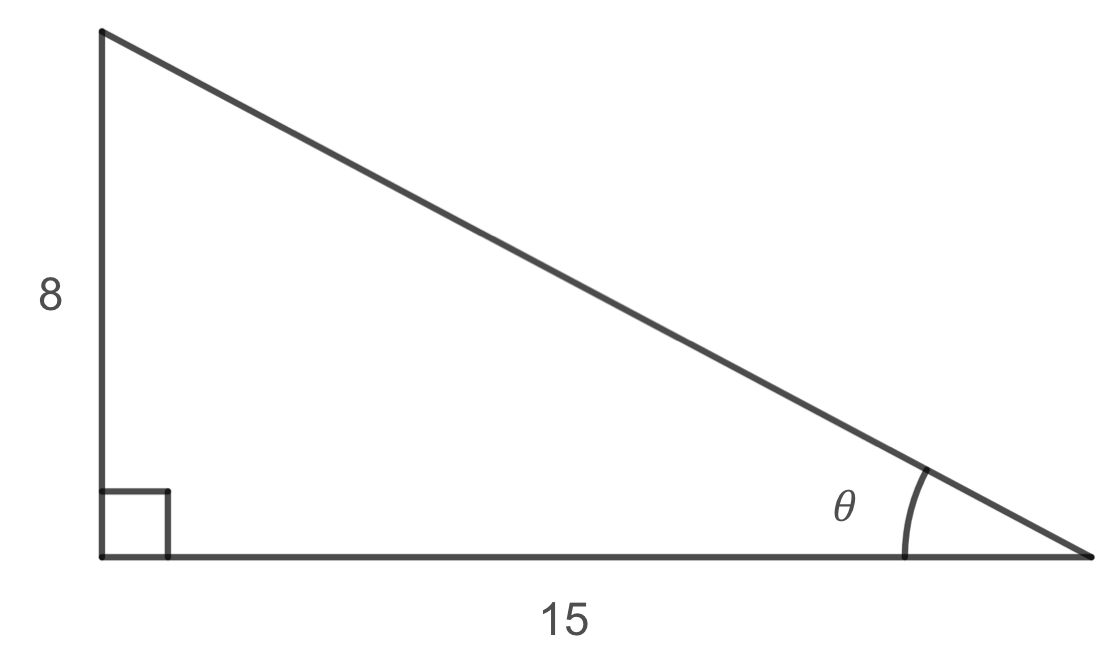
To find values for reciprocal trigonometric functions, we must first find values for
\(\cos(\theta)\text{,}\) \(\sin(\theta)\text{,}\) and
\(\tan(\theta)\text{.}\) We must also find the length of the hypotenuse. Letting the variable
\(c\) represent the length of the hypotenuse and using the Pythagorean Theorem, we get that
\begin{align*}
c^2 \amp= 8^2 + 15^2 \\
c^2 \amp= 64 + 225 \\
c^2 \amp= 289 \\
c \amp= \pm \sqrt{289} \\
c \amp= 17
\end{align*}
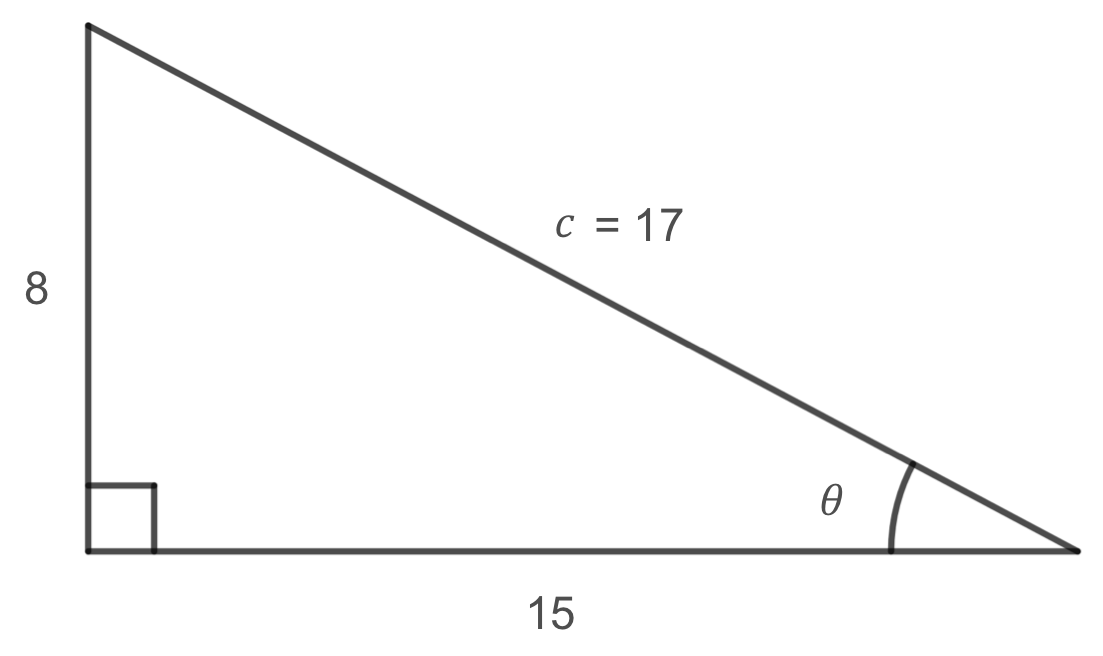
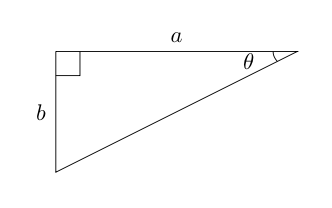
triangle for reciprocal trig example with hypotenuse labeled
Now solving for \(\cos(\theta)\text{,}\) \(\sin(\theta)\text{,}\) and \(\tan(\theta)\text{,}\) we get that
\begin{align*}
\cos(\theta) \amp= \frac{15}{17} \\
\\
\sin(\theta) \amp= \frac{8}{17} \\
\\
\tan(\theta) \amp= \frac{8}{15}
\end{align*}
Finally, solving for the reciprocal trigonometric functions, we get
\begin{align*}
\sec(\theta) \amp= \frac{1}{\cos(\theta)} = \frac{17}{15} \\
\\
\csc(\theta) \amp= \frac{1}{\sin(\theta)} = \frac{17}{8} \\
\\
\cot(\theta) \amp= \frac{1}{\tan(\theta)} = \frac{15}{8}
\end{align*}