Section 8.3 Long-Run Behavior of Rational Functions

A rational function is the quotient of two polynomials. (As with rational numbers, the word rational refers to a ratio.)

Rational Functions.

A rational function is one of the form
\begin{equation*} f(x)=\frac{P(x)}{Q(x)} \end{equation*}
where \(P(x)\) and \(Q(x)\) are polynomials and \(Q(x)\neq 0\text{.}\)
The graphs of rational functions can be quite different from the graphs of polynomials.

Example 8.21.

Queueing theory is used to predict your waiting time in a line, or queue. For example, suppose the attendant at a toll booth can process \(6\) vehicles per minute. The average total time spent by a motorist negotiating the toll booth depends on the rate, \(r\text{,}\) at which vehicles arrive, according to the formula
\begin{equation*} T=g(r)=\frac{12-r}{12(6-r)}. \end{equation*}
  1. What is the average time spent at the toll booth if vehicles arrive at a rate of \(3\) vehicles per minute?
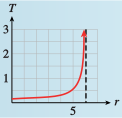
  2. Graph the function on the domain \([0, 6)\text{.}\)
Solution.
  1. If the vehicles arrive at a rate of \(3\) vehicles per minute, then \(r=3\) so
    \begin{equation*} g(3)=\dfrac{12-3}{12(6-3)}=\dfrac{9}{36}=0.25 \end{equation*}
    T he average total time is \(0.25\) minutes, or \(15\) seconds.
  2. described in detail following the image
    rational function

Example 8.22.

EarthCare decides to sell T-shirts to raise money. The company makes an initial investment of $100 to pay for the design of the T-shirt and to set up the printing process. After that, the T-shirts cost $5 each for labor and materials.
  1. Express the average cost per T-shirt as a function of the number of T-shirts EarthCare produces.
  2. Make a table of values for the function.
  3. Graph the function and explain what it tells you about the cost of the T-shirts.
Solution.
  1. If EarthCare produces \(x\) T-shirts, the total costs will be \(100 + 5x\) dollars. To find the average cost per T-shirt, we divide the total cost by the number of T-shirts produced, to get
    \begin{equation*} C = g(x) = \frac{100 + 5x}{x}. \end{equation*}
  2. We evaluate the function for several values of \(x\text{,}\) as shown in the table
    \(x\) \(1\) \(2\) \(4\) \(5\) \(10\) \(20\)
    \(C\) \(105\) \(55\) \(40\) \(25\) \(15\) \(10\)
    If EarthCare makes only one T-shirt, its cost is $105. But if more than one T-shirt is made, the cost of the original $100 investment is distributed among them. For example, the average cost per T-shirt for \(\alert{2}\) T-shirts is
    \begin{equation*} \frac{100 + 5(\alert{2})}{\alert{2}}=55 \end{equation*}
    and the average cost for \(\alert{5}\) T-shirts is
    \begin{equation*} \frac{100 + 5(\alert{5})}{\alert{5}}=25. \end{equation*}
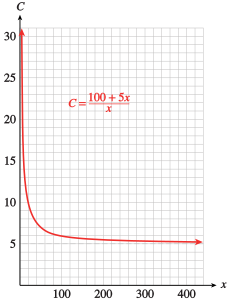
  3. The graph is shown in FigureΒ 8.23. You can use a graphing utility with the window
    \begin{align*} \text{Xmin} \amp = 0 \amp\amp \text{Xmax} = 470 \\ \text{Ymin} \amp = 0 \amp\amp \text{Ymax} = 30. \end{align*}
    to verify the graph.
    described in detail following the image
    graph of average cost of production
    Figure 8.23.
    The graph shows that as the number of T-shirts increases, the average cost per shirt continues to decrease, but not as rapidly as at first. Eventually the average cost levels off and approaches $5 per T-shirt. For example, if EarthCare produces \(\alert{400}\) T-shirts, the average cost per shirt is
    \begin{equation*} \frac{100+5(\alert{400})}{\alert{400}}=5.25. \end{equation*}
The horizontal line \(C = 5\) on the graph of \(C = \displaystyle{\frac{100 + 5x}{x}}\) is a horizontal asymptote . As \(x\) increases, the graph approaches the line \(C = 5\text{.}\) The average price per T-shirt will always be slightly more than $5. Horizontal asymptotes are also important in sketching the graphs of rational functions.

Example 8.24.

Delbert prepares a \(20\%\) saturated glucose solution of by mixing \(2\) mL of saturated glucose with \(8\) mL of water. If he adds \(x\) ml of saturated glucose to the solution, its concentration is given by
\begin{equation*} C(x) = \frac{2 + x}{8+x}. \end{equation*}
  1. How many milliliters of saturated glucose should Delbert add to increase the concentration to \(50\%\text{?}\)
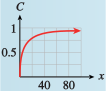
  2. Graph the function on the domain \([0, 100]\text{.}\)
  3. What is the horizontal asymptote of the graph? What does it tell you about the solution?
Solution.
  1. To obtain a concentration of \(50\%\text{,}\) we solve \(C(x)=0.50\text{:}\)
    \begin{equation*} \begin{aligned} C(x) \amp= 0.50 \\ \dfrac{2+x}{8+x} \amp= 0.50 \\ 2+x \amp= 0.50(8+x) \\ 2+x \amp= 4 + 0.50x \\ 0.5x \amp= 2 \\ x \amp= 4 \end{aligned} \end{equation*}
    He needs to add \(4\) ml.
  2. described in detail following the image
    rational function
  3. \(C=1\text{.}\) As Delbert adds more glucose to the mixture, its concentration increases toward \(100\%\text{.}\)

Subsection 8.3.1 Long Run Behavior for Rational Functions

Recall in the start of this chapter we discussed the long run behavior of polynomial functions. Recall too that given a polynomial
\begin{equation*} f(x)=a_nx^n+a_{n-1}x^{n-1}+\cdots + a_1x+a_0 \end{equation*}
the leading term of \(f(x) \) is the term \(a_nx^n \text{.}\)

Long Run Behavior.

Suppose that \(f(x)=\frac{P(x)}{Q(x)}\) is a rational function. Let \(ax^n\) be the leading term of \(P(x)\) and \(bx^m \) be the leading term of \(Q(x)\text{.}\) Then the long run behavior of \(f(x)\) is the same as the long run behavior of the power function
\begin{equation*} \frac{ax^n}{bx^m}=\frac{a}{b}x^{n-m}. \end{equation*}
If the resulting power function happens to be a constant function (so \(n=m\) above) then the rational function has a horizontal asymptote at \(y=\frac{a}{b}\text{.}\)

Example 8.25.

Identify the long run behavior of the rational function
\begin{equation*} f(x)=\frac{-2x^7+4x^2-1}{x^3+8x}. \end{equation*}
Solution.
First, we note that the leading term of the numerator is \(-2x^7\) and the leading term of the denominator is \(x^3\text{.}\) So, the long run behavior of \(f \) is given by
\begin{equation*} \frac{-2x^7}{x^3}=-2x^4. \end{equation*}
We know that the long run behavior of \(x^4\) is
\begin{equation*} x^4\to \infty\ \text{as}\ x\to\pm\infty. \end{equation*}
Since the graph of \(-2x^4\) is the graph of \(x^4 \) stretched vertically by a factor of \(2\) and then reflected about the \(x\)-axis, get that the long run behavior of \(-2x^4\) is
\begin{equation*} -2x^4\to -\infty\ \text{as}\ x\to\pm\infty. \end{equation*}
Thus, the long run behavior of \(f(x) \) is
\begin{equation*} f(x)\to -\infty\ \text{as}\ x\to\pm\infty. \end{equation*}

Exercises 8.3.2 Exercises

1. Adding and Subtracting Rational Functions.

Write each of the following as a single fraction:
a) \(\dfrac{u}{u^{5}}+\dfrac{1}{u^2}\)
b) \(\dfrac{x}{(x+3)(x-3)}-\dfrac{4}{x-3}\)
Hint.
For each of these, we want to make the fractions have a common denominator so we can add (or subtract) them.
a) The second term’s denominator has \(u\) to a smaller power, so we will need to multiply the numerator and denominator of the second term by what will make the two denominators match. Once you have a common denominator, add the two terms.
b) Again, the second term’s denominator is missing something: in this case, it is missing a factor of \((x+3)\text{.}\) So, we multiply the numerator and denominator of the second term by what will make the two denominators match. Once you have a common denominator, subtract appropriately. Pay special attention to carrying the negative sign!

2. Identifying Rational Functions.

Determine whether the following functions are rational functions. If so, write what \(p(x)\) and \(q(x)\) are if we write the rational function in the form \(p(x)/q(x)\text{,}\) where \(p\) and \(q\) are polynomials. If not, enter "NONE" in the provided blank.
a) \(f(x) = 2 x^3+7\)
\(p(x) =\)
\(q(x) =\)
b) \(g(x) = \dfrac{2^x+1}{2^x-2}\)
\(p(x) =\)
\(q(x) =\)
c) \(f(x) = \dfrac{x^2}{2-x} - \dfrac{1}{x-2}\)
\(p(x) =\)
\(q(x) =\)
d) \(g(x) = \dfrac{\sqrt{x}+7}{\sqrt{x}}\)
\(p(x) =\)
\(q(x) =\)
Hint.
Recall a rational function is a function of the form
\begin{equation*} y=\frac{p(x)}{q(x)}, \end{equation*}
where \(p(x)\) and \(q(x)\) are polynomials and \(q(x)\neq 0\text{.}\) A polynomial is a sum of terms of the form \(y=kx^p\text{,}\) where \(k\) is any constant and \(p\) is a non-negative whole number.
In order to answer this for each part, you may need to use common denominators to combine the terms.

3. Determining Long-Run Behavior.

For each rational function below, select the long-run behavior of the numerator and of the denominator. Then, determine the long-run behavior of the rational function.
a) \(f(x) = \dfrac{2 x^2-4x+4}{2 x^2+5 x-10}\)
Long-run behavior of numerator:
As \(x\) goes to \(+\infty\text{,}\) the numerator of \(f(x)\) goes to .
As \(x\) goes to \(-\infty\text{,}\) the numerator of \(f(x)\) goes to .
Long-run behavior of denominator:
As \(x\) goes to \(+\infty\text{,}\) the denominator of \(f(x)\) goes to .
As \(x\) goes to \(-\infty\text{,}\) the denominator of \(f(x)\) goes to .
Long-run behavior of rational function:
As \(x\) goes to \(+\infty\text{,}\) \(f(x)\) goes to .
As \(x\) goes to \(-\infty\text{,}\) \(f(x)\) goes to .
b) \(g(x) = \dfrac{x^3-3x^2}{x^2+4 }\)
Long-run behavior of numerator:
As \(x\) goes to \(+\infty\text{,}\) the numerator of \(g(x)\) goes to .
As \(x\) goes to \(-\infty\text{,}\) the numerator of \(g(x)\) goes to .
Long-run behavior of denominator:
As \(x\) goes to \(+\infty\text{,}\) the denominator of \(g(x)\) goes to .
As \(x\) goes to \(-\infty\text{,}\) the denominator of \(g(x)\) goes to .
Long-run behavior of rational function:
As \(x\) goes to \(+\infty\text{,}\) \(g(x)\) goes to .
As \(x\) goes to \(-\infty\text{,}\) \(g(x)\) goes to .
c) \(h(x) = \dfrac{2 x}{x^4-2 x^3-1}\)
Long-run behavior of numerator:
As \(x\) goes to \(+\infty\text{,}\) the numerator of \(h(x)\) goes to .
As \(x\) goes to \(-\infty\text{,}\) the numerator of \(h(x)\) goes to .
Long-run behavior of denominator:
As \(x\) goes to \(+\infty\text{,}\) the denominator of \(h(x)\) goes to .
As \(x\) goes to \(-\infty\text{,}\) the denominator of \(h(x)\) goes to .
Long-run behavior of rational function:
As \(x\) goes to \(+\infty\text{,}\) \(h(x)\) goes to .
As \(x\) goes to \(-\infty\text{,}\) \(h(x)\) goes to .
Hint.
Recall the long-run behavior of a polynomial function is the same as the long-run behavior of its leading term. To find the leading term of the numerator and denominator, consider each polynomial individually. Find the leading term of the numerator and denominator, respectively, to determine the long-run behavior of each.
To find the long-run behavior of the rational function, divide the leading term of the numerator and the leading term of the denominator. Once simplified, this results in a power function. Use what you know about long-run behavior of power functions to answer the question. The following link may be useful: https://mathbooks.unl.edu/PreCalculus/Integer-Exponents.html

4. Determining Long-Run Behavior.

Evaluate the following limits of rational functions:
a) \(\displaystyle \lim_{x\to \infty} (8+x^{-2}) =\)
b) \(\displaystyle \lim_{x\to -\infty} \dfrac{3x^{2}+8 x^5}{2x^{6}+4} =\)
c) \(\displaystyle \lim_{x\to \infty} \left(\dfrac{5 x^3}{x^3+2x^2} +1\right) =\)
Hint.
Finding the limit of a function as \(x\to\infty\) or \(x\to-\infty\) is the same as considering the long-run behavior.
To find the long-run behavior of the rational function, divide the leading term of the numerator and the leading term of the denominator. Once simplified, this results in a power function. Use what you know about long-run behavior of power functions to answer the question. The following link may be useful: https://mathbooks.unl.edu/PreCalculus/Integer-Exponents.html
Another way to tackle this problem is to plug in large positive or negative numbers to see where the function values go.

5. Identifying Asymptotes.

Identify any horizontal asymptotes of the following functions. If there are no horizontal asymptotes, enter NONE in the answer blank.
a) \(f(x) = \dfrac{2 x^{2}+1}{x^{2}+2}\)
Is there a horizontal asymptote?
What is it? \(y=\)
b) \(g(x) = \dfrac{5 x^{4}+2x}{2 x^{2}+x+1}\)
Is there a horizontal asymptote?
What is it? \(y=\)
c) \(h(x) = \dfrac{x}{x^{2}+5}\)
Is there a horizontal asymptote?
What is it? \(y=\)
Hint.
Recall a function has a horizontal asymptote \(y=k\text{,}\) for some constant \(k\) if the long-run behavior approaches the value \(k\text{.}\) In other words, if as \(x\to \infty\) or \(x\to-\infty\text{,}\) \(f(x)\) approaches \(k\text{,}\) then the line \(y=k\) is a horizontal asymptote.
To answer this question, find the long-run behavior of each function. If you get a constant number, there’s a horizontal asymptote.

6. Interpretting Rational Functions.

Frederick is trying to perfect a lemonade recipe. He is varying the amount of sugar water he adds to see what tastes best, and he knows he wants to put some sugar water in the mixture. So far, his recipe calls for 7 cups of lemon juice, and \(x\) cups of sugar water. Let \(L(x)\) be the fraction of cups in the final mixture that is sugar water.
a) Find a formula for \(L(x)\text{.}\)
\(L(x) =\)
b) What domain makes sense for \(L(x)\) in the context of the problem?
Domain:
c) Find and interpret all \(x\) values such that \(L(x)=0.5\text{.}\)
\(x\)-values:
Interpretation:
  • This is the number of cups of sugar water in the mixture at any point.
  • This is the number of cups of lemonade Frederick is making using 0.5 cups of sugar water.
  • This is how many cups of sugar water Frederick needs to use to get 0.5 cups of lemonade.
  • This is the number of cups of sugar water at which the ratio between cups of lemon juice and sugar water is exactly half.
d) Evaluate and interpret \(\displaystyle \lim_{x\to\infty} L(x)\text{.}\)
\(\displaystyle \lim_{x\to\infty} L(x) =\)
  • As Frederick adds more and more sugar water to the mixture, he essentially makes only 1 cup of lemonade.
  • As Frederick adds more and more lemon juice to the mixture, the lemonade is essentially all lemon juice.
  • As Frederick makes more and more lemonade, he only really needs to use 1 cup of sugar water in the mixture.
  • As Frederick adds more and more sugar water to the mixture, the lemonade is essentially all sugar water.
Hint.
a) We want an expression that will tell us what the ratio, or fraction, of the final mixture is sugar water. If we let \(x\) be the number of cups of sugar water, then the total cups (including the lemon juice) is \(x+6\) cups. What expression would give the ratio of sugar water in the final mixture?
b) We want the interval of possible values that \(x\) could take on (i.e., the possible numbers of cups of sugar water in the final mixture). If Frederick doesn’t add any sugar water to the mixture, then it is just lemon juice. However, any amount of sugar water added (even though it might be really bitter) will make this lemonade.
c) We set \(L(x) = \dfrac{1}{2}\) and solve for \(x\text{.}\) To interpret, think about what the units are for the input and output values.
d) Recall this means looking at the long-run behavior of \(L(x)\) as \(x\to\infty\text{.}\) The long-run behavior gives an output value the function is approaching. To interpret, think about what it means for \(x\) to go to \(\infty\) in this case.