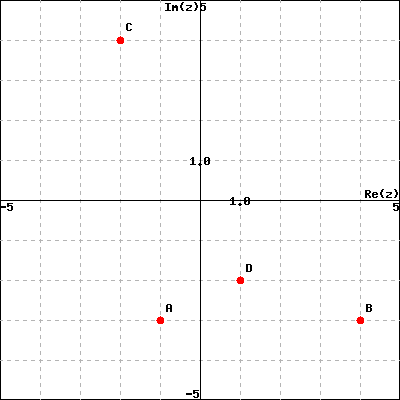
Section 5.3 Complex Numbers

All the mathematical work you have done so far has involved using real numbers. In this section, we will work with a new set of numbers called the complex numbers . It should be noted that the real numbers are actually a special case of the complex numbers. This will be explained in more detail later in this section.

Subsection 5.3.1 Motivation

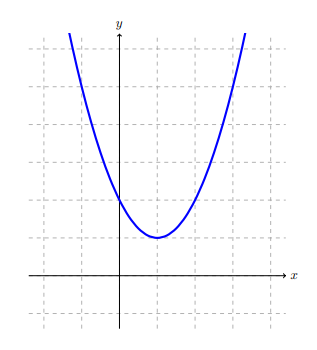
Let’s start by providing some background as to where complex numbers arise from. Suppose that we want to solve for the \(x\)-intercepts of \(f(x) = x^2 -2x + 2\text{.}\) We can use the quadratic formula to obtain the \(x\)-intercepts, and when doing so, we obtain the following expression:
\begin{equation*} x = \frac{-(-2) \pm \sqrt{(-2)^2-4(1)(2)}}{2(1)} = \frac{2 \pm \sqrt{-4}}{2}\text{.} \end{equation*}
Notice that \(\sqrt{-4}\) is not a real number because there are no real numbers whose square is negative. As a result, \(f(x) = x^2 -2x + 2\) has no real \(x\)-intercepts. We can also verify this graphically since the graph of \(f(x) = x^2 - 2x + 2\) never crosses the \(x\)-axis.
described in detail following the image
No real solutions.

Subsection 5.3.2 Imaginary Numbers

Even though the square root of a negative number is not a real number, there are many instances when we would like to be able to use it (e.g., finding the solutions to \(x^2-2x+2 = 0\)). So, we need to define a new set of numbers that are not real numbers.

Imaginary Numbers.

An imaginary number is of the form
\begin{equation*} \sqrt{-a} = \sqrt{a}\sqrt{-1} = \sqrt{a}i \end{equation*}
where \(a > 0\) is a real number and \(i\) is an imaginary unit. Here, \(i\) is defined as \(i = \sqrt{-1}\) or \(i^2 = -1\text{.}\)

Note 5.18.

Unless stated otherwise, the letter \(i\) is used to represent a constant, not a variable!
Let’s refer back to the motivational example introduced earlier in this section. The value \(\sqrt{-4}\) can be expressed as follows:
\begin{align*} \sqrt{-4} \amp= \sqrt{4(-1)}\\ \amp= \sqrt{4}\sqrt{-1} \\ \amp= \sqrt{4}i \\ \amp= 2i \end{align*}
Here are more examples of imaginary numbers \(5i\text{,}\) \(\frac{2}{3}i\text{,}\) \(-24i\text{,}\) and \(\sqrt{15}i\text{.}\)

Subsection 5.3.3 Complex Numbers

Recall that when solving for the \(x\)-intercepts of \(f(x) = x^2 -2x + 2\text{,}\) we obtained the following values for \(x\) with the quadratic formula:
\begin{equation*} x = \frac{2\pm \sqrt{-4}}{2}\text{.} \end{equation*}
Using our new established knowledge of imaginary numbers, we find that
\begin{equation*} x = \frac{2\pm 2i}{2} \end{equation*}
which implies that \(x = 1 + i\) or \(x = 1 - i\text{.}\) These \(x\)-values are examples of complex numbers .

Complex Numbers.

A complex number is of the form
\begin{equation*} z = a + bi \end{equation*}
where \(a\) and \(b\) are real numbers. Here, \(a\) is called the real part and \(b\) is called the imaginary part.

Note 5.19.

From this definition, we can observe that all real numbers are actually complex numbers with imaginary part equal to \(0\text{.}\) Moreover, imaginary numbers are actually complex numbers with real part equal to \(0\text{;}\) these numbers are called pure imaginary numbers
The real and imaginary parts of a complex number can never be combined. Here is a result that tells us when two complex numbers are equal.

Equality of Complex Numbers.

Two complex numbers \(z = a+bi\) and \(w = c+di\) are equal if and only if \(a = c\) and \(b = d\text{.}\)

Subsection 5.3.4 Arithmetic of Complex Numbers

Like real numbers, we can add, subtract, multiply, and divide complex numbers.

Sum and Difference of Complex Numbers.

Consider two complex number \(z = a+bi\) and \(w = c+di\text{.}\) Then their sum is given by
\begin{equation*} z+w = (a+bi) + (c+di) = (a+c) + (b+d)i\text{,} \end{equation*}
and their difference is given by
\begin{equation*} z-w = (a+bi) - (c+di) = (a-c) + (b-d)i\text{.} \end{equation*}

Example 5.20.

Compute \((4+5i) + (8-6i)\) and \((2-3i) - (5+2i)\text{.}\)
Solution.
\begin{align*} (4+5i) + (8-6i) \amp= (4+8) + (5-6)i\\ \amp= 12 + (-1)i\\ \amp= 12 - i \end{align*}
and
\begin{align*} (2-3i) - (5+2i) \amp= (2-5) - (-3+2)i\\ \amp= (-3) - (-1)i \\ \amp= -3 + i \end{align*}
When taking the product of two complex numbers, you should always remember that
\begin{equation*} i^2 = -1\text{.} \end{equation*}
Finding the product of two pure imaginary numbers is relatively straightforward.

Product of Pure Imaginary Numbers.

Consider two pure imaginary numbers \(z = ai\) and \(w = bi\text{.}\) Then their product is given by
\begin{equation*} zw = (ai)(bi) = (ab)i^2 = -ab\text{.} \end{equation*}
Finding the product of two complex numbers is slightly different since we need to use the distributive property.

Product of Complex Numbers.

Consider two complex numbers \(z = a+bi\) and \(w = c+di\text{.}\) Then their product is given by
\begin{equation*} zw = (a+bi)(c+di) = (ac - bd) + (ad + bc)i\text{.} \end{equation*}

Example 5.21.

Compute \((3i)(4i)\) and \((2+3i)(-3-2i)\text{.}\)
Solution.
\begin{align*} (3i)(4i) \amp= (3\cdot 4)i^2 \\ \amp= 12(-1)\\ \amp= -12 \end{align*}
and
\begin{align*} (2+3i)(-3-2i) \amp= (2(-3) - 3(-2)) + (2(-2) + 3(-3))i\\ \amp= (-6 + 6) + (-4-9)i\\ \amp= 0 - 13i\\ \amp= -13i \end{align*}
WARNING: The following property is true with real numbers, but it is not true with complex numbers:
\begin{equation*} \sqrt{ab} = \sqrt{a}\sqrt{b}\text{.} \end{equation*}
Here is a counter-example: let \(a = b = -2\text{.}\) Then,
\begin{equation*} \sqrt{ab} = \sqrt{(-2)(-2)} = \sqrt{4} = 2\text{,} \end{equation*}
but
\begin{align*} \sqrt{a}\sqrt{b} \amp= \sqrt{-2}\sqrt{-2}\\ \amp= (\sqrt{2}i)(\sqrt{2}i)\\ \amp= (\sqrt{2})^2i^2\\ \amp = 2(-1) = -2. \end{align*}
Hence,
\begin{equation*} \sqrt{ab} \neq \sqrt{a}\sqrt{b} \end{equation*}
(especially when \(a\text{,}\) \(b\) are both negative).
Finding the quotient of two complex numbers requires us to use the technique of rationalizing the denominator. We will consider two different types of quotients: division by a pure imaginary number and division by a complex number.

Division by a Pure Imaginary Number.

Consider a complex number \(z = a+bi\) and a pure imaginary number \(w = ci\text{.}\) Then,
\begin{equation*} \frac{z}{w} = \frac{a+bi}{ci} = \frac{a+bi}{ci}\cdot \frac{i}{i} = \frac{(a+bi)i}{ci^2} = \frac{-b + ai}{-c} = \frac{b - ai}{c}\text{.} \end{equation*}
When dividing by a complex number, we rationalize the denominator by multiplying the complex conjugate.

Complex Conjugate.

For any complex number \(z = a + bi\text{,}\) the number
\begin{equation*} \bar{z} = a - bi \end{equation*}
is called the complex conjugate of \(z\text{.}\)
The product of a complex number and its conjugate is a real number. That is,
\begin{equation*} z\bar{z} = (a+bi)(a-bi) = a^2 -abi + abi - b^2i^2 = a^2 - b^2(-1) = a^2 + b^2\text{.} \end{equation*}

Quotient of Two Complex Numbers.

Consider two complex numbers \(z = a+bi\) and \(w = c + di\text{.}\) Then,
\begin{equation*} \frac{z}{w} = \frac{a+bi}{c+di} = \frac{a+bi}{c+di} \cdot \frac{c-di}{c-di} \end{equation*}
\begin{equation*} = \frac{ac+bd}{c^2+d^2} + \frac{bc-ad}{c^2+d^2}i\text{.} \end{equation*}

Example 5.22.

Compute \(\frac{8+9i}{2i}\) and \(\frac{4-2i}{2+3i}\text{.}\)
Solution.
\begin{align*} \frac{8+9i}{2i} \amp= \frac{8+9i}{2i}\cdot\frac{i}{i} \\ \amp= \frac{(8+9i)i}{2i^2}\\ \amp= \frac{8i + 9i^2}{2(-1)}\\ \amp= \frac{8i + 9(-1)}{-2}\\ \amp= \frac{-9+8i}{-2}\\ \amp= \frac{9-8i}{2} \end{align*}
and
\begin{align*} \frac{4-2i}{2+3i} \amp= \frac{4-2i}{2+3i}\cdot \frac{2-3i}{2-3i} \\ \amp= \frac{(4-2i)(2+3i)}{(2)^2 + (3)^2}\\ \amp= \frac{(4(2)-(-2)(3)) + (4(3)+(-2)(2))i}{13}\\ \amp= \frac{(8+6)+(12-4)i}{13}\\ \amp= \frac{14+8i}{13}\\ \amp= \frac{14}{13}+\frac{8}{13}i \end{align*}

Subsection 5.3.5 Graphing Complex Numbers

Like real numbers, we can also graph complex numbers. In order to plot a complex number, we will utilize a plane called the complex plane . The complex plane has two axes: a horizontal axis (which we will call the real axis) to plot the real part, and a vertical axis (which we will call the imaginary axis) to plot the imaginary part. In addition, the point where the real and imaginary axes cross is called the origin, and it is denoted by \((0,0)\text{.}\)
described in detail following the image
No real solutions.

Plotting a Complex Number.

To plot a complex number \(z = a + bi\text{,}\) we move \(a\) units in the horizontal direction and then we move \(b\) units in the vertical direction. Here, \(\text{Re}(z) = a\) and \(\text{Im}(z) = b\text{.}\)

Example 5.23.

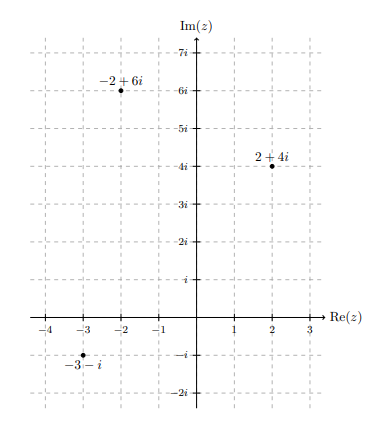
Plot the complex numbers \(2+4i\text{,}\) \(-2+6i\text{,}\) and \(-3-i\) in the complex plane
Solution.
To plot \(2+4i\text{,}\) we move \(2\) units to the right from the origin, and then we move \(4\) units up. To plot \(-2+6i\text{,}\) we move \(2\) units to the left from the origin, and then we move \(6\) units up. To plot \(-3-i\text{,}\) we move \(3\) units to the left from the origin, and then we move \(1\) unit down.
described in detail following the image
No real solutions.

Note 5.24.

Whenever we plot a complex number \(z = a + bi\text{,}\) we sometimes use the notation \((a,b)\) to denote a point in the complex plane. In this context, \((a,b)\) represents a single complex number whose real part is \(a\) and imaginary part is \(b\text{.}\)
We can also measure the distance a point in the complex plane is from the origin by using the Pythagorean theorem. This distance is called the modulus .

Modulus of a Complex Number.

The modulus of a complex number \(z = a + bi\) is given by
\begin{equation*} |z| = \sqrt{a^2+b^2} \end{equation*}
Observe that \(|z| \geq 0\text{.}\)

Example 5.25.

Compute the modulus of \(z = 3 + 4i\) and \(w = -1 + i\text{.}\)
Solution.
If \(z = 3+4i\text{,}\) then \(a=3\) and \(b=4\text{.}\) Hence,
\begin{equation*} |z| = \sqrt{3^2 + 4^2} = \sqrt{25} = 5 \end{equation*}
Similarly, if \(w=-1+i\text{,}\) then \(a=-1\) and \(b = 1\text{.}\) Hence,
\begin{equation*} |w| = \sqrt{(-1)^2 + 1^2} = \sqrt{1 + 1} = \sqrt{2} \end{equation*}

Example 5.26.

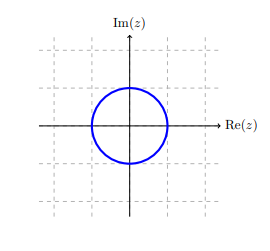
Plot all points in the complex plane that satisfy the equation \(|z| = 1\text{.}\)
Solution.
The points in the complex plane that satisfy the equation \(|z| = 1\) all have a distance of \(1\) unit from the origin. This means that all these points lie on a circle of radius \(1\) centered at the origin.
described in detail following the image
No real solutions.

Subsection 5.3.6 Complex Numbers and Trigonometry

Now that we have familiarized ourselves with complex numbers, we are ready to make some connections to trigonometry. In the previous subsection, we talked about how to plot a complex number \(z = a+bi\) as a point \((a,b)\) in the complex plane. Moreover, we talked about how the point \((a,b)\) has a distance of \(|z|=\sqrt{a^2+b^2}\) from the origin. We can use our knowledge of polar coordinates to express a complex number in terms of the trigonometric functions \(\sin(\theta)\) and \(\cos(\theta)\text{.}\) Recall that when converting a Cartesian coordinate \((x,y)\) to a polar coordinate \((r,\theta)\text{,}\) we used the following formulas:
\begin{equation*} r^2 = x^2+y^2 \end{equation*}
\begin{equation*} \cos(\theta) = \frac{x}{r} \end{equation*}
\begin{equation*} \sin(\theta) = \frac{y}{r} \end{equation*}
\begin{equation*} \tan(\theta) = \frac{y}{x}, \ x \neq 0 \end{equation*}
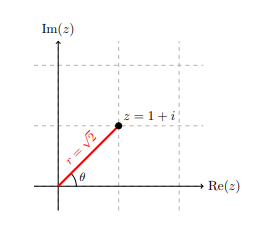
The process of finding the polar form of a complex number is analogous. Let’s consider a motivational example. Suppose that we have the complex number \(z = 1 + i\text{.}\) We can plot \(z\) as follows in the complex plane.
described in detail following the image
No real solutions.
The modulus of \(z\) is clearly given by
\begin{equation*} |z| = \sqrt{2} \end{equation*}
For convenience, put \(r = |z|\text{.}\) Observe that the ray drawn from the origin to the point \((1,1)\) makes an angle \(\theta\) from the real axis. Then, we can use right triangle trigonometry to write \(a\) and \(b\) as follows:
\begin{equation*} a = r\cos(\theta) = \sqrt{2}\cos(\theta)=1 \end{equation*}
\begin{equation*} b = r\sin(\theta) = \sqrt{2}\sin(\theta)=1 \end{equation*}
and
\begin{equation*} \tan(\theta) = \frac{b}{a} = 1 \end{equation*}
Since \(\tan(\theta) = 1\) and \(a\text{,}\) \(b > 0\text{,}\) the unit circle tells us that \(\theta = \frac{\pi}{4}\text{.}\) This means that
\begin{equation*} a = \sqrt{2}\cos(\frac{\pi}{4}) \end{equation*}
and
\begin{equation*} b = \sqrt{2}\sin(\frac{\pi}{4}) \end{equation*}
Putting things together, the polar form of \(z = 1 + i\) is given by
\begin{equation*} z = \sqrt{2}\cos(\frac{\pi}{4}) + \sqrt{2}\sin(\frac{\pi}{4})i = \sqrt{2}\big(\cos(\frac{\pi}{4}) + i\sin(\frac{\pi}{4})) \end{equation*}

Polar Form for a Complex Number.

The complex number \(z = a+bi\) in polar form is given by
\begin{equation*} z = r(\cos(\theta) + i\sin(\theta)) \end{equation*}
Here, \(r = \sqrt{a^2+b^2}\text{,}\) \(a = r\cos(\theta)\text{,}\) \(b = r\sin(\theta)\text{,}\) and \(\tan(\theta) = \frac{b}{a}\) (assuming that \(a \neq 0\)). Moreover, \(0 \leq \theta \le 2\pi\) is called the argument of the complex number and \(r\) is its modulus.

Subsection 5.3.7 Products and Quotients in Polar Form

A key reason for working with complex numbers in polar form is that it makes computing the product and quotient of complex numbers more manageable.

Product in Polar Form.

If \(z = r(\cos(\alpha)+i\sin(\alpha))\) and \(w = R(\cos(\beta)+i\sin(\beta))\text{,}\) then
\begin{equation*} zw = rR(\cos(\alpha+\beta) + i\sin(\alpha+\beta)) \end{equation*}
Observe that the formula for computing the product of two complex numbers in polar form requires us to simply multiply their moduli and add their arguments. Here’s a quick verification of how to obtain the formula for the product using the sum identities for sine and cosine:
\begin{align*} zw \amp= r(\cos(\alpha)+i\sin(\alpha))\cdot R(\cos(\beta)+i\sin(\beta))\\ \amp= rR(\cos(\alpha)\cos(\beta)-\sin(\alpha)\sin(\beta)) + i(\sin(\beta)\cos(\alpha)+\sin(\alpha)\cos(\beta))\\ \amp = rR(\cos(\alpha+\beta)+i\sin(\alpha+\beta)) \end{align*}

Example 5.27.

Use polar form to compute the product of \(z=1+i\) and \(w =-1-i\text{.}\)
Solution.
You should verify that \(z = \sqrt{2}(\cos(\frac{\pi}{4}) + i\sin(\frac{\pi}{4}))\) and \(w = \sqrt{2}(\cos(\frac{5\pi}{4})+i\sin(\frac{5\pi}{4}))\text{.}\) Then,
\begin{align*} zw \amp= (\sqrt{2})(\sqrt{2})(\cos(\frac{\pi}{4}+\frac{5\pi}{4})+i\sin(\frac{\pi}{4}+\frac{5\pi}{4}))\\ \amp= 2(\cos(\frac{6\pi}{4})+i\sin(\frac{6\pi}{4}))\\ \amp= 2(\cos(\frac{3\pi}{2})+i\sin(\frac{3\pi}{2}))\\ \amp= 2(0+i(-1))\\ \amp= -2i \end{align*}

Quotient in Polar Form.

If \(z = r(\cos(\alpha)+i\sin(\alpha))\) and \(w = R(\cos(\beta)+i\sin(\beta))\text{,}\) then
\begin{equation*} \frac{z}{w}= \frac{r}{R}(\cos(\alpha-\beta) + i\sin(\alpha-\beta)) \end{equation*}
You should verify that the formula used to compute the quotient of complex numbers in polar form is obtained with the difference identities for sine and cosine.

Example 5.28.

Use polar form to compute the quotient of \(z=1+i\) and \(w =-1-i\text{.}\)
Solution.
You should verify that \(z = \sqrt{2}(\cos(\frac{\pi}{4}) + i\sin(\frac{\pi}{4}))\) and \(w = \sqrt{2}(\cos(\frac{5\pi}{4})+i\sin(\frac{5\pi}{4}))\text{.}\) Then,
\begin{align*} \frac{z}{w} \amp= \frac{\sqrt{2}}{\sqrt{2}}(\cos(\frac{\pi}{4}-\frac{5\pi}{4})+i\sin(\frac{\pi}{4}-\frac{5\pi}{4}))\\ \amp= (\cos(-\frac{4\pi}{4})+i\sin(-\frac{4\pi}{4}))\\ \amp= (\cos(-\pi)+i\sin(-\pi)\\ \amp= (-1+i(0))\\ \amp= -1 \end{align*}

Subsection 5.3.8 Powers and Roots of Complex Numbers

We can also use polar form to compute the powers and roots of a complex number with feasibility. For example, if \(z = r(\cos(\theta)+i\sin(\theta))\text{,}\) then using the double-angle formulas we find that
\begin{align*} z^2 \amp= (r(\cos(\theta)+i\sin(\theta))^2\\ \amp= r^2\big((\cos^2(\theta)-\sin^2(\theta))+i(2\sin(\theta)\cos(\theta))\big) \\ \amp= r^2\big(\cos(2\theta)+i\sin(2\theta)\big) \end{align*}
Hence,
\begin{equation*} z^2 = r^2\big(\cos(2\theta)+i\sin(2\theta)\big) \end{equation*}
In general, for any positive integer \(n\text{,}\) a complex number raised to the \(n\)-th power is given by the following theorem.

De Moivre’s Theorem.

If \(z = r(\cos(\theta)+i\sin(\theta))\) is a complex number in polar form and \(n\) is a positive integer, then
\begin{equation*} z^n = r^n\big(\cos(n\theta)+i\sin(n\theta)\big) \end{equation*}

Example 5.29.

Let \(z = \sqrt{3}+i\text{.}\) Compute \(z^4\text{.}\)
Solution.
You should verify that \(z = 2\big(\cos(\frac{\pi}{6}) + i\sin(\frac{\pi}{6})\big)\text{.}\) Using De Moivre’s Theorem, we find that
\begin{align*} z^4 \amp= 2^4\big(\cos(4\cdot\frac{\pi}{6}) + i\sin(4\cdot \frac{\pi}{6})\big)\\ \amp= 16\big(\cos(\frac{2\pi}{3})+i\sin(\frac{2\pi}{3})\big)\\ \amp= 16\big(-\frac{1}{2} + i\cdot\frac{\sqrt{3}}{2}\big)\\ \amp= -8 + 8\sqrt{3}i \end{align*}
De Moivre’s Theorem can also be used for fractional values of \(n\text{,}\) and this allows us to compute the roots of complex numbers. For example, let \(n = \frac{1}{2}\) and \(z = r(\cos(\theta)+i\sin(\theta))\text{.}\) Then, De Moivre’s Theorem gives
\begin{equation*} z^\frac{1}{2} = r^\frac{1}{2}\big(\cos(\frac{1}{2}\theta)+i\sin(\frac{1}{2}\theta)\big) \end{equation*}
Recall that every number (whether it’s real or complex) has two square roots. In the case of complex numbers, we find the other root by adding a multiple of \(2\pi\) to the argument of \(z\text{.}\) So, the polar form of \(z\) can also be given by
\begin{equation*} z = r\big(\cos(\theta + 2\pi)+i\sin(\theta+2\pi)\big) \end{equation*}
Using De Moivre’s Theorem, the second square root of \(z\) is then given by
\begin{equation*} r^\frac{1}{2}\big(\cos(\frac{\theta}{2}+\pi) + i\sin(\frac{\theta}{2}+\pi)\big) \end{equation*}

Roots of a Complex Number.

A complex number \(z = r(\cos(\theta)+i\sin(\theta))\) in polar form has \(n\) complex \(n\)-th roots given by
\begin{equation*} z_k = r^\frac{1}{n}\bigg(\cos\big(\frac{\theta+2\pi k}{n}\big)+i\sin\big(\frac{\theta+2\pi k}{n}\big)\bigg) \end{equation*}
where \(k = 0\text{,}\) \(1\text{,}\) \(2\text{,}\) ..., \(n-1\text{.}\)

Example 5.30.

Find the square roots of \(z = i\text{.}\)
Solution.
You should verify that \(z = \sin(\frac{\pi}{2})i\text{,}\) \(\theta = \frac{\pi}{2}\text{,}\) \(r = 1\text{.}\) and \(n = 2\text{.}\) Then,
\begin{align*} z_0 \amp= (1)^\frac{1}{2}\bigg(\cos\big(\frac{\frac{\pi}{2}+2\pi(0)}{2}\big) + i\sin\big(\frac{\frac{\pi}{2}+2\pi(0)}{2}\big)\bigg)\\ \amp= \cos(\frac{\pi}{4})+i\sin(\frac{\pi}{4})\\ \amp= \frac{1}{\sqrt{2}} + i\cdot\frac{1}{\sqrt{2}}\\ \amp= \frac{1}{\sqrt{2}}(1+i) \end{align*}
and
\begin{align*} z_1 \amp= (1)^\frac{1}{2}\bigg(\cos\big(\frac{\frac{\pi}{2}+2\pi(1)}{2}\big) + i\sin\big(\frac{\frac{\pi}{2}+2\pi(1)}{2}\big)\bigg)\\ \amp= \cos(\frac{5\pi}{4})+i\sin(\frac{5\pi}{4})\\ \amp= -\frac{1}{\sqrt{2}} + i\cdot\bigg(- \frac{1}{\sqrt{2}} \bigg)\\ \amp= -\frac{1}{\sqrt{2}}(1+i) \end{align*}
Hence, the square roots of \(z=i\) are given by \(\pm \frac{1}{\sqrt{2}}(1+i)\text{.}\)

Exercises 5.3.9 Exercises

1. Using the Quadratic Formula.

Use the Quadratic Formula to solve for the zeros of the following quadratic polynomials: (Enter the zeros in a comma-separated list; use \(i\) for \(\sqrt{-1}\text{.}\))
(a) \(-7 x^2 + 4 x - 7 = 0\)
Zeros:
(b) \(4 x^2 - 2 x + 9 = 0\)
Zeros:
Hint.
Recall the Quadratic Formula, and use it to find two zeros for each polynomial.

2. Standard Operations.

Let \(z = (-5+i)\) and \(w = (-2-4i)\text{.}\) Compute the following (enter in the form \(a + bi\) where \(a\) and \(b\) are real numbers):
(a) \(z + w =\) \(+\) \(i\)
(b) \(z - w =\) \(+\) \(i\)
(c) \(zw =\) \(+\) \(i\)
(d) \(\dfrac{z}{w} =\) \(+\) \(i\)
Hint.
Recall arithmetic with complex numbers (some involves the use of the complex conjugate).

4. Complex Powers.

Let \(z = \sqrt{3} + i\text{.}\)
(a) Compute the modulus of \(z\text{.}\)
(b) Compute the argument of \(z\text{.}\)
(c) Write \(z\) in polar form. \((\cos(\) \() + i\sin(\) \())\)
(d) Use DeMoivre’s Theorem to compute \(z^5\text{.}\)
Hint.
Recall the definitions of the modulus and argument of a complex number and that DeMoivre’s Theorem states: \((r(\cos(\theta) + i\sin(\theta)))^n = r^n(\cos(n\theta) + i\sin(n\theta))\text{.}\)

5. Complex Roots.

Let \(z = \sqrt{3} - i\text{.}\)
(a) Compute the modulus of \(z\text{.}\)
(b) Compute the argument of \(z\text{.}\)
(c) Write \(z\) in polar form. \((\cos(\) \() + i\sin(\) \())\)
(d) Find the square roots of \(z\text{.}\) (Enter answers separated by commas.)
Hint.
Recall the definitions of the modulus and argument of a complex number and that DeMoivre’s Theorem states: \((r(\cos(\theta) + i\sin(\theta)))^n = r^n(\cos(n\theta) + i\sin(n\theta))\text{.}\)