Section 1.2 Function Notation, Input and Output

Subsection 1.2.1 Reviewing Inputs and Outputs

Recall that a function is a rule that takes inputs and assigns to each input exactly one output. We say the output is a function of the input.

Example 1.35.

Is the number of letters a function of a word?
Solution.
First, identify what is the input and what is the output. You can write down the following table as an example.
Input: Word Output: Number of Letters
I 1
Love 4
Math 4
Class 5
In this case, the number of letters is a function of the word, since for each input (word) has exactly one output (number of letters).
When we do have a function we use a mathematical shortcut to talk about it. We write \(output = f(input)\) and we can use any letter to represent the function, the input or the output. For example, to indicate that a quantity \(y\) is a function of quantity \(x\text{,}\) we write \(y = f(x)\) and say β€œ\(y\) equals \(f\) of \(x\)”. Note: \(f(x)\) represents the output of the function \(f\text{,}\) when \(x\) is the input.

Subsection 1.2.2 Evaluating Functions at a Given Input

Recall that finding the value of the output variable that corresponds to a particular value of the input variable is called evaluating the function .
If a function is described by an equation, we substitute the given input value into the equation (replacing the input variable) to find the corresponding output, or function value.
Sometimes, you will see \(y=f(x)=3x+2\) (or some other expression on the right) which may cause discomfort since there’s a lot happening. However, this is a helpful tool to clarify what label we’re giving the outputs, in this case \(y\) is the output label. In the following example, you will see the use of \(H=f(s)\) and you can easily intepret the output as "H"eight with the input being "s"econds.

Example 1.36.

The function \(H\) is defined by \(H=f(s) = \dfrac{(s+3)^2}{s}\text{.}\) Evaluate the function at the following values.
  1. \(\displaystyle s=6\)
  2. \(\displaystyle s=-1\)
Solution.
  1. \(f(\alert{6})=\dfrac{(\alert{6}+3)^2}{\alert{6}}= \dfrac{9^2}{6}=\dfrac{81}{6}=\dfrac{27}{2}\text{.}\) Thus, \(f(6)=\dfrac{27}{2}\text{.}\)
  2. \(f(\alert{-1})=\dfrac{(\alert{-1}+3)^2}{\alert{-1}}= \dfrac{2^2}{-1}=-4\text{.}\) Thus, \(f(-1)=-4\text{.}\)

Example 1.37.

Complete the table displaying ordered pairs for the function \(f(x) = 5 - x^3\text{.}\) Evaluate the function to find the corresponding \(f(x)\)-value for each value of \(x\text{.}\)
\(x\) \(f(x)\)
\(-2\) \(\) \(f(\alert{-2})=5-(\alert{-2})^3=~\)
\(0\) \(\) \(f(\alert{0})=5-\alert{0}^3=\)
\(1\) \(\) \(f(\alert{1})=5-\alert{1}^3=\)
\(3\) \(\) \(f(\alert{3})=5-\alert{3}^3=\)
Solution.
\(x\) \(f(x)\)
\(-2\) \(\alert{13} \)
\(0\) \(\alert{5}\)
\(1\) \(\alert{4}\)
\(3\) \(\alert{-22}\)
To simplify the notation, we sometimes use the same letter for the output variable and for the name of the function. In the next example, \(C\) is used in this way.
Sometimes we need to evaluate a function at an algebraic expression rather than at a specific number.

Example 1.38.

TrailGear manufactures backpacks at a cost of
\begin{equation*} C(x) = 3000 + 20x \end{equation*}
for \(x\) backpacks. The company finds that the monthly demand for backpacks increases by 50% during the summer. The backpacks are produced at several small co-ops in different states.
  1. If each co-op usually produces \(b\) backpacks per month, how many should it produce during the summer months?
  2. What cost should the company expect for producing backpacks during the summer?
Solution.
  1. An increase of 50% means an additional 50% of the current production level, \(b\text{.}\) Therefore, a co-op that produced \(b\) backpacks per month during the winter should increase production to \(b + 0.5b\text{,}\) or \(1.5b\) backpacks per month in the summer.
  2. The cost of producing \(1.5b\) backpacks will be
    \begin{equation*} C(\alert{1.5b}) = 3000 + 20(\alert{1.5b}) = 3000 + 30b \end{equation*}

Example 1.39.

A spherical balloon has a radius of 10 centimeters.
  1. If we increase the radius by \(h\) centimeters, what will the new volume be?
  2. If \(h = 2\text{,}\) how much did the volume increase?
Solution.
  1. The new radius is \(10+h\text{,}\) so the new volume is \(V(10 + h) = \dfrac{4}{3}\pi(10 + h)^3 \text{ cm}^3\)
  2. We are looking for the difference between \(V(10+2)\) and \(V(10)\text{:}\)
    \begin{equation*} V(10+2)-V(10)=\frac{4}{3}\pi(10+2)^3-\frac{4}{3}\pi(10)^3\approx 3049.44 \end{equation*}
    The volume increased by approximately \(3049.44 \text{ cm}^3\)
The beauty of using the \(f(x)\) notation is you can input things that are not numbers. The next example will show you the beauty of this!

Example 1.40.

Evaluate the function \(f(x)=4x^2 - x + 5\) for the following expressions.
  1. \(\displaystyle x = 2h\)
  2. \(\displaystyle x = a + 3\)
Solution.
  1. \(\begin{aligned} f(\alert{2h}) \amp= 4(\alert{2h})^2-(\alert{2h}) + 5\\ \amp= 4(4h^2)-2h+5\\ \amp= 16h^2 - 2h + 5\\ \end{aligned}\)
  2. \(\begin{aligned} f(\alert{a+3}) \amp= 4(\alert{a+3})^2-(\alert{a+3})+5\\ \amp= 4(a^2+6a+9)-a-3+5\\ \amp= 4a^2+24a+36 - a + 2\\ \amp= 4a^2+23a + 38\\ \end{aligned}\)

Caution 1.41.

In ExampleΒ 1.40, notice that
\begin{equation*} f(2h) \ne 2 f(h) \end{equation*}
and
\begin{equation*} f(a + 3) \ne f(a) + f(3). \end{equation*}
To compute \(f(a) + f(3)\text{,}\) we must first compute \(f(a)\) and \(f(3)\text{,}\) then add them:
\begin{gather} f(a)+f(3) = (4a^2-a+5)+(4\cdot 3^2-3+5) \tag{1.1}\\ = 4a^2 - a + 43. \tag{1.2} \end{gather}
In general, it is not true that \(f(a + b) = f(a) + f(b)\text{.}\) Remember that the parentheses in the expression \(f(x)\) do not indicate multiplication, so the distributive law does not apply to the expression \(f(a + b)\text{.}\)

Example 1.42.

Subsection 1.2.3 Interpreting the Inputs and Outputs of a Function

In applied problems, the inputs and outputs of a function come with their own units. Working with these units will allow you to make reasonable interpretations for both the inputs and the outputs of a function. Consider the following example.

Example 1.43.

Let \(f(t)\) be the total number of reported flu cases at UNL by the \(t^{th}\) day of the semester. Then the units of the inputs are β€œdays” and the units of the outputs are β€œflu cases”.
Solution.
  • What does \(f(103)\) mean?
    \(f(103)\) gives the number of flu cases by the 103rd day of the semester.
  • What does \(f(50)\) mean?
    \(f(15)\) gives the number of flu cases by the 50th day of the semester.
  • What does \(f(15) = 73\) mean?
    \(f(15)=73\) means that there were 73 flu cases by the 15th day of the semester.
  • What is the practical meaning of \(x\) in the statement \(f(x) = 56\text{?}\)
    In the equation \(f(x) = 56\text{,}\) \(x\) would give the day(s) by which there were 56 flu cases.

Subsection 1.2.4 Solving Functions for a Given Output

So far, we have been going one direction with replacing the input variable \(x\text{.}\) But, we are also able to do the opposite! What if we begin with the output value and want to find the input that gives us that. A full discussion of solving functions for a given output will be given in a later chapter. However, it is useful at this point to consider an example.

Example 1.44.

Consider the function \(f\) defined by the following table.
\(x\) -2 -1 0 1 2
\(f(x)\) 4 5 6 1 2
What value of \(x\) will satisfy \(f(x)=6\text{?}\)
Solution.
By inspecting the table we see that \(f(x)=6\) when \(x=0\text{.}\)

Exercises 1.2.5 Exercises

1. Evaluating Functions.

Let \(c(y)=y^{2}+\left(-4\right)y\text{,}\) \(p(z)=z^{2}+3\text{,}\) and \(q(x)=\frac{x+2}{2x-1}\text{.}\)
Indicate the input and the output in each case.
a) Evaluate \(c(1/4)\text{.}\)
Input:
Output:
b) Solve \(c(y)=0\text{.}\)
Input:
Output:
c) Calculate \(p(\sqrt{2})\text{.}\)
Input:
Output:
d) Solve \(p(z)=11\text{.}\)
Input:
Output:
e) Evaluate \(q(0)\text{.}\)
Input:
Output:
f) Solve \(q(x)=3\text{.}\)
Input:
Output:
Hint.
For all of these parts, the input is what you would plug into the function and the output is what you get after evaluation. If you are given the input, you need to plug it into the function. If you are given the output, you need to set the equation equal to the given value.

2. Evaluating Functions.

Let \(g(x) = x\mathopen{}\left(x^{2}-5\right)\text{.}\) Find equations for the following.
a) \(g(x+4)\)
b) \(g(x^{2})\)
c) \(g(\frac{1}{x+2})\)
Hint.
a) We can view \(x+4\) as the input for the function \(g=x\mathopen{}\left(x^{2}-5\right)\) when trying to find an equation. We want to plug in \(x+4\text{.}\)
b) Similarly, we can view \(x^{2}\) as the input for the function \(g=x\mathopen{}\left(x^{2}-5\right)\text{,}\) so we want to plug it into the function.
c) Similarly, we can view \(\frac{1}{x+2}\) as the input for the function \(g=x\mathopen{}\left(x^{2}-5\right)\text{,}\) so we want to plug it into the function.

3. Interpreting Functions.

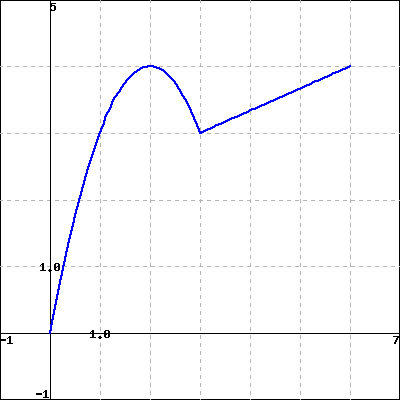
On a windy day, Lucy was holding a balloon, but she accidentally let it go. The height of the balloon in feet \(t\) seconds after Lucy released it is given by \(h(t)\text{.}\) The graph of \(h(t)\) appears below.
a) How high was the balloon after 4 seconds? Please include in your answer.
b) When, approximately, is the balloon 3 feet above the ground?
seconds
c) Solve \(h(t) = 2\text{.}\) Please include in your answer.
Hint.
a) We want to find how high the balloon is after 4 seconds, so we need to look at where the function is when \(t=4\text{.}\) We notice that this falls on the linear part of the graph. You can approximate this value from the graph or you could try to find the equation of the line and evaluate it at \(t=4\text{.}\)
b) We want to look at the graph when the output is 3 to find what times the balloon is 3 ft above the ground.
c) Similarly to part b), we want to look at the graph when the output is 2. You should approximate this value the best you can. Don’t forget to include units.

4. Interpreting Functions.

Suppose the price of a school lunch at Sunny Elementary School is based on the annual income of a student’s family. A student from a family of four whose annual family income is between $ 70000 and $ 75000 will pay $ 5.00 plus 0.01 % of their family income over $ 70000.
a) Find the price of a school lunch for a child from a family of four whose family income is $ 74000.
b) Find a formula for \(P(x)\text{,}\) the price of a school lunch for a child from a family of four whose annual income is \(x\text{,}\) where \(70000 \leq x\leq 75000\text{.}\)
\(P(x)=\)
c) Evaluate \(P(70000)\) and select the most appropriate interpretation.
  • It is the number of school lunches a child from a family of four whose annual income is 70000 must buy.
  • It is the price of a school lunch for a child from a family of four whose annual income is 70000.
  • Is it the price of school lunches for a month for a child from a family of four whose annual income is 70000.
Hint.
a) To find how much it costs for a school lunch for a child from a family of four whose income is 74000, we need to take 5.00 plus 0.01 % of the family income over 70000. The family makes 4000 over 70000, so we want to take 0.01 % of that and add it to 5.00.
b) Using a similar process to what we did in part a), we want to find a function \(P(x)\) that gives us the price of a school lunch for a child whose family makes \(x\) dollars a year (with \(70000 \leq x \leq 75000\)). We want to take 5.00 plus 0.01 % of the family income over 70000. Note that the family makes \(x-70000\) dollars over 70000.
c) We can use our equation from part b) to evaluate \(P(70000)\) at \(x=70000\text{.}\)
To interpret this, think about what the input and output units are in the context.

5. Finding Input Values.

Let \(f(x)=\frac{-2 x+1}{5 x - 2}\text{.}\) Then \(f(x)=.3\) when \(x\)=.
Hint.
Hint
To solve \(f(x)=.3\text{,}\) clear the fraction.

6. Finding Solutions to Functions.

A national park records data regarding the total fox population \(F\) over a 12 month period, where \(t = 0\) means January 1, \(t = 1\) means February 1, and so on. Below is the table of values they recorded:
t, month 0 1 2 3 4 5 6 7 8 9 10 11
F, foxes 150 143 125 100 75 57 50 57 75 100 125 143
(a) Is \(t\) a function of \(F\text{?}\)
(b) Let \(g(t) = F\) denote the fox population in month \(t\text{.}\) Find all solution(s) to the equation \(g(t) = 57\text{.}\) If there is more than one solution, give your answer as a comma separated list of numbers.
\(t =\)