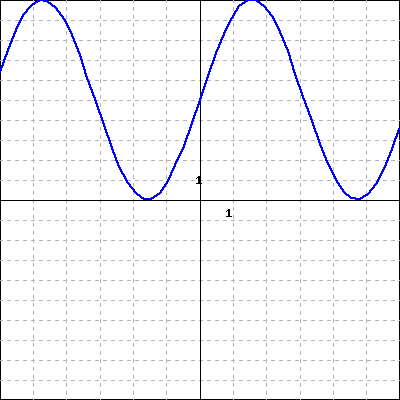
Section 2.2 Generalized Sinusoidal Functions

In this section, we explore how transformations of trigonometric functions affect properties of trigonometric functions such as midline, amplitude, and period.

Subsection 2.2.1 Properties of Generalizes Sinusoidal Functions

Recall from Section 2.1 that if we apply function transformations to the sine function, then the resulting function is of the form \(f(x) = A\sin(B(x-h))+k \text{.}\) Similarly, if we apply function transformations to the cosine function, then the resulting function is of the form \(g(x) = A\cos(B(x-h))+k \text{.}\) We call a function of either of these two forms a generalized sinusoidal function.
Given an equation in the form
\begin{equation*} f(x) = A\sin(B(x+h))+k \hspace{.25in} \text{ or } \hspace{.25in} g(x) = A\cos(B(x-h))+k \end{equation*}
\(|A| \ \) is the vertical stretch/compression and the amplitude of the function.
\(|B| \ \) is the horizontal stretch/compression and is related to the period of the function, \(P\text{,}\) by the formula
\begin{equation*} P=\frac{2\pi}{|B|} \end{equation*}
\(k \ \) is the vertical shift (up if \(k \gt 0\text{,}\) down if \(k \lt 0\)) and determines the midline of the function.
\(h \ \) is the horizontal shift of the function (left if \(h \gt 0\text{,}\) right if \(h \lt 0\)).

Example 2.13.

Determine the midline, amplitude, and period of the function
\begin{equation*} f(t)=2\cos\left(\frac{\pi}{4}(t-3)\right)+1 \end{equation*}
Solution.
Using the relationships above, the stretch/compression factor is \(B=\pi/4=\pi/4\text{.}\) Therefore, the period of the function is
\begin{equation*} P = \frac{2\pi}{|B|} = \frac{2\pi}{\pi/4} = 2\pi \cdot \frac{4}{\pi} = 8. \end{equation*}
The vertical stretch/compression factor is \(|A|=|2|=2\text{,}\) so the amplitude of the function is 2.
Finally, the vertical shift of the function is \(k=1\text{,}\) so the midline of the function is
\begin{equation*} y=1. \end{equation*}
One important feature of the graph when the horizontal shift is zero is what happens when the function crosses the vertical (\(y\)) axis. A function of the form \(f(x)=A\sin(Bx)+k\) will cross the \(y\)-axis at its midline and curve up, while a function of the form \(g(x)=A\cos(Bx)+k\) will cross the \(y\)-axis at its maximum and curve down.
We can use the properties of generalized sinusoidal functions to help us graph them, as seen in the examples below.

Example 2.14.

Sketch a graph of the function
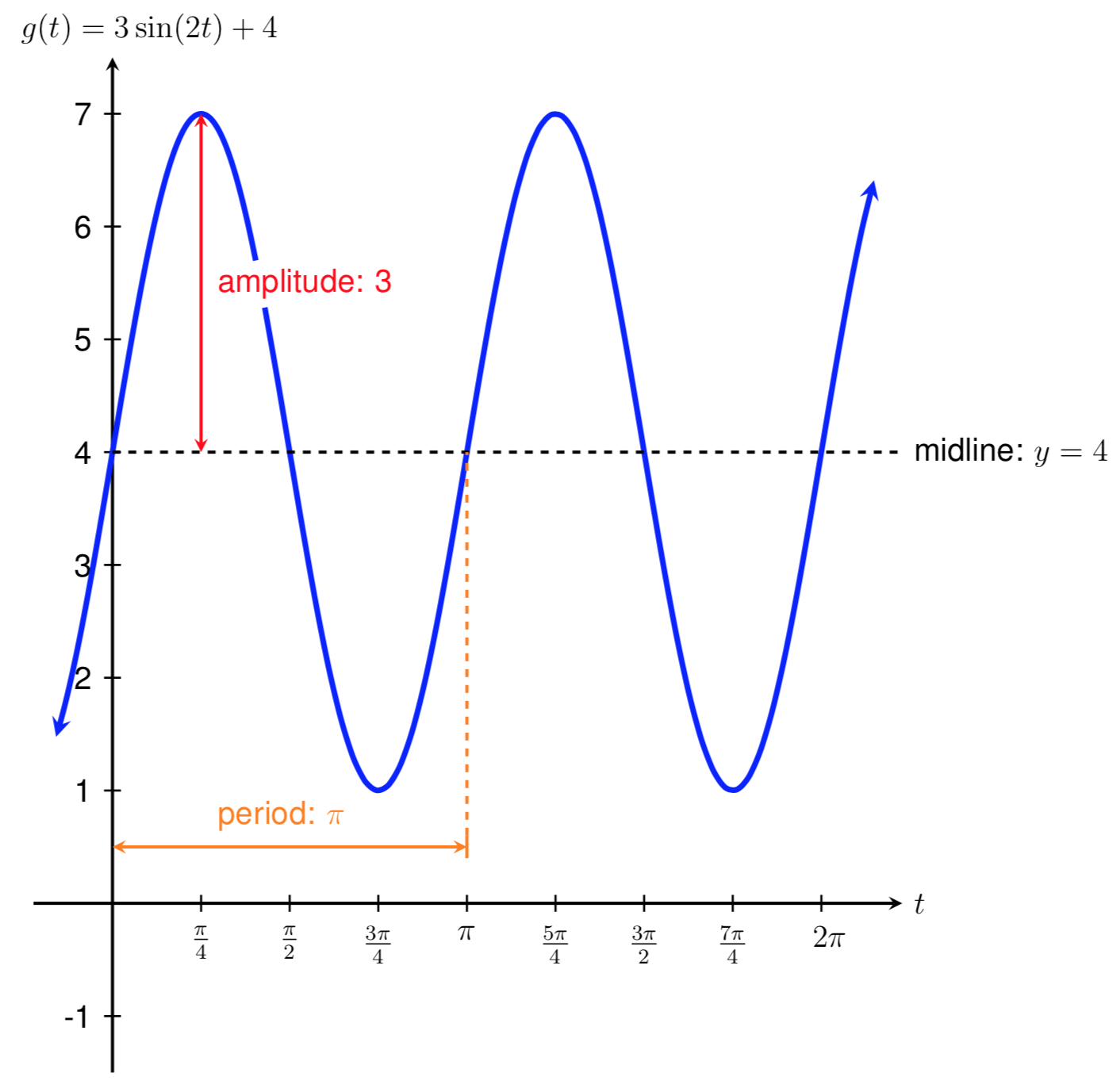
\begin{equation*} g(x)=3\sin(2x)+4 \end{equation*}
Solution.
To begin, let’s find the period, midline, and amplitude of the function.
Using the relationships above, the stretch/compression factor is \(B=2\text{.}\) Therefore, the period is
\begin{equation*} P = \frac{2\pi}{|B|} = \frac{2\pi}{2} = \pi. \end{equation*}
The vertical stretch/compression factor is \(|A|=|3|=3\text{,}\) so the amplitude is 3.
Finally, the vertical shift of the function is \(k=4\text{,}\) so the midline of the function is
\begin{equation*} y=4. \end{equation*}
To graph \(g(x)\text{,}\) it will also be helpful to know the function’s starting behavior, which is its behavior at the \(y\)-axis. Using our knowledge of the graph of \(f(x)=\sin(x)\text{,}\) discussed in a previous section 1.3, we know that at the \(y\)-axis, the the sine "wave" is at its midline, and curves up as we move to the right on the graph. Since there is no horizontal shift or vertical reflection in \(g(x)\text{,}\) then this is also the behavior of \(g(x)\) at the \(y\)-axis.
It will also be helpful to identify the maximum and minimum of \(g(x)\text{.}\) Since the midline is \(y=4\) and the amplitude is \(3,\) then the maximum is 7 and the minimum is 1.
Since our midline is at \(y=4\) and this is where \(g(x)\) "starts", then at the \(y\)-axis, our function is at \(y=4\text{.}\) The wave curves up to our maximum of 7, then curves down to our minimum of 1, and finally returns back to the starting position at \(x=\pi\) since this is our period. This is graphed below.
described in detail following the image
graph of 3sin(2x)+4
Note that the graph of \(g(x)=3\sin(x)+4\) involves a vertical stretch of 3, a vertical shift up by 4, and a horizontal compression by a factor of \(2\) from the original graph of \(f(x)=\sin(x)\text{,}\) which makes sense based on our discussion of function transformations in the previous section 2.1.

Example 2.15.

Sketch a graph of the function
\begin{equation*} g(x)= -2\cos(.5x)-1 \end{equation*}
Solution.
To begin, let’s find the period, midline, and amplitude of the function.
Using the relationships above, the stretch/compression factor is \(B=0.5\text{.}\) Therefore, the period is
\begin{equation*} P = \frac{2\pi}{|B|} = \frac{2\pi}{.5} = 4\pi. \end{equation*}
The vertical stretch/compression factor is \(|A|=|-2|=2\text{,}\) so the amplitude is 2.
Finally, the vertical shift of the function is \(k=-1\text{,}\) so the midline of the function is
\begin{equation*} y=-1\text{.} \end{equation*}
Again, to graph \(g(x)\text{,}\) it will also be helpful to know the function’s starting behavior. Since there is no horizontal shift, we consider our starting behavior to be at the \(y\)-axis. Using our knowledge of the graph of \(f(x)=\cos(x)\text{,}\) discussed in a previous section 1.3, we know that at the \(y\)-axis, the the cosine "wave" is at its maximum and curves down as we move to the right. Since the cosine function is multiplied by \(-2\text{,}\) then there is a reflection across the \(y\)-axis of \(\cos(x)\text{.}\) So, at the \(y\)-axis, \(g(x)\) is at its minimum and curves up as we move to the right.
It will also be helpful to identify the maximum and minimum of \(g(x)\text{.}\) Since the midline is \(y=-1\) and the amplitude is 2, then the maximum is 1 and the minimum is -3.
Since our maximum is at \(y=1\) and this is where \(g(x)\) "starts", then at the \(y\)-axis, our function is at \(y=1\text{.}\) The wave curves down to our minimum of -3 and curves back up to our maximum of 1 at \(x=4\pi\text{.}\) This is graphed below.
described in detail following the image
graph of -2cos(.5x)-1
Figure 2.16.
Note that the graph of \(g(x)=-2\cos(.5x)-1\) involves vertical stretch of 2 and a reflection across the \(y\)-axis, a vertical shift down of 1, and a horizontal stretch by a factor of 2 from our original graph of \(y=\cos(x)\text{,}\) which makes sense based on our discussion of function transformations in the previous section 2.1.

Example 2.17.

Sketch a graph of the function
\begin{equation*} g(x)=-.5\sin(\pi(x-1))+2 \end{equation*}
Solution.
To begin, let’s find the period, midline, and amplitude of the function.
Using the relationships above, the stretch/compression factor is \(B=\pi\text{.}\) Therefore, the period is
\begin{equation*} P = \frac{2\pi}{|B|} = \frac{2\pi}{\pi} = 2. \end{equation*}
The vertical stretch/compression factor is \(|A|=|-.5|=.5\text{,}\) so the amplitude is .5.
Finally, the vertical shift of the function is \(k=2\text{,}\) so the midline of the function is
\begin{equation*} y=2. \end{equation*}
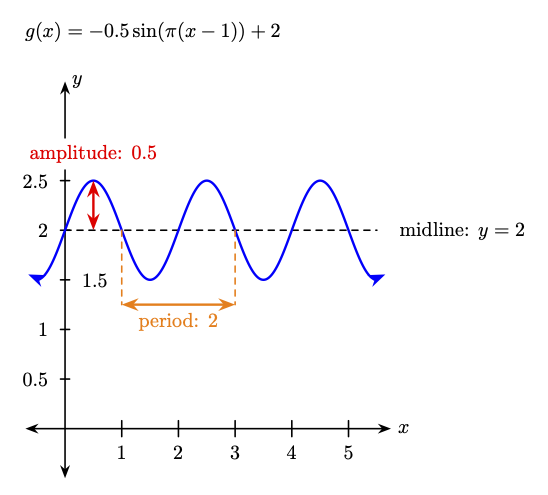
First we identify the starting behavior of \(g(x)\text{.}\) Here we must be careful because we have a horizontal shift to the right by 1 unit, so we consider our starting behavior at \(x=1\) instead of at the \(y\)-axis. We know that the graph of \(\sin(x)\) starts at the midline and curves up, and since we have a vertical reflection, this means that \(g(x)\) starts at the midline and curves down as we move to the right at \(x=1\text{.}\)
We also need to identify the maximum and minimum of \(g(x)\text{.}\) Since the midline is \(y=2\) and the amplitude is .5, then the maximum is 2.5 and the minimum is 1.5.
Because there is a horizontal shift to the right by 1 unit, then the graph of \(g(x)\) is at the midline at \(x=1\text{,}\) decreases to the minimum of 1.5, and then increases until it reaches its maximum of 2.5, and returns to the midline at \(x=3\text{,}\) after one period has passed. This is graphed below.
described in detail following the image
graph of -.sin(pi(x-1))+2
Note that the graph of \(g(x)=-.5\sin(\pi(x-1))+2\) involves vertical compression by a factor of 2, a reflection across the \(y\)-axis, a vertical shift up by 2 units, and a horizontal compression by a factor of \(\pi\) from our original graph of \(y=\cos(x)\text{,}\) which makes sense based on our discussion of function transformations in the previous section 2.1.
We can also use the relationship between transformations and the properties of trigonometric functions to write equations for generalized sinusoidal functions.

Example 2.18.

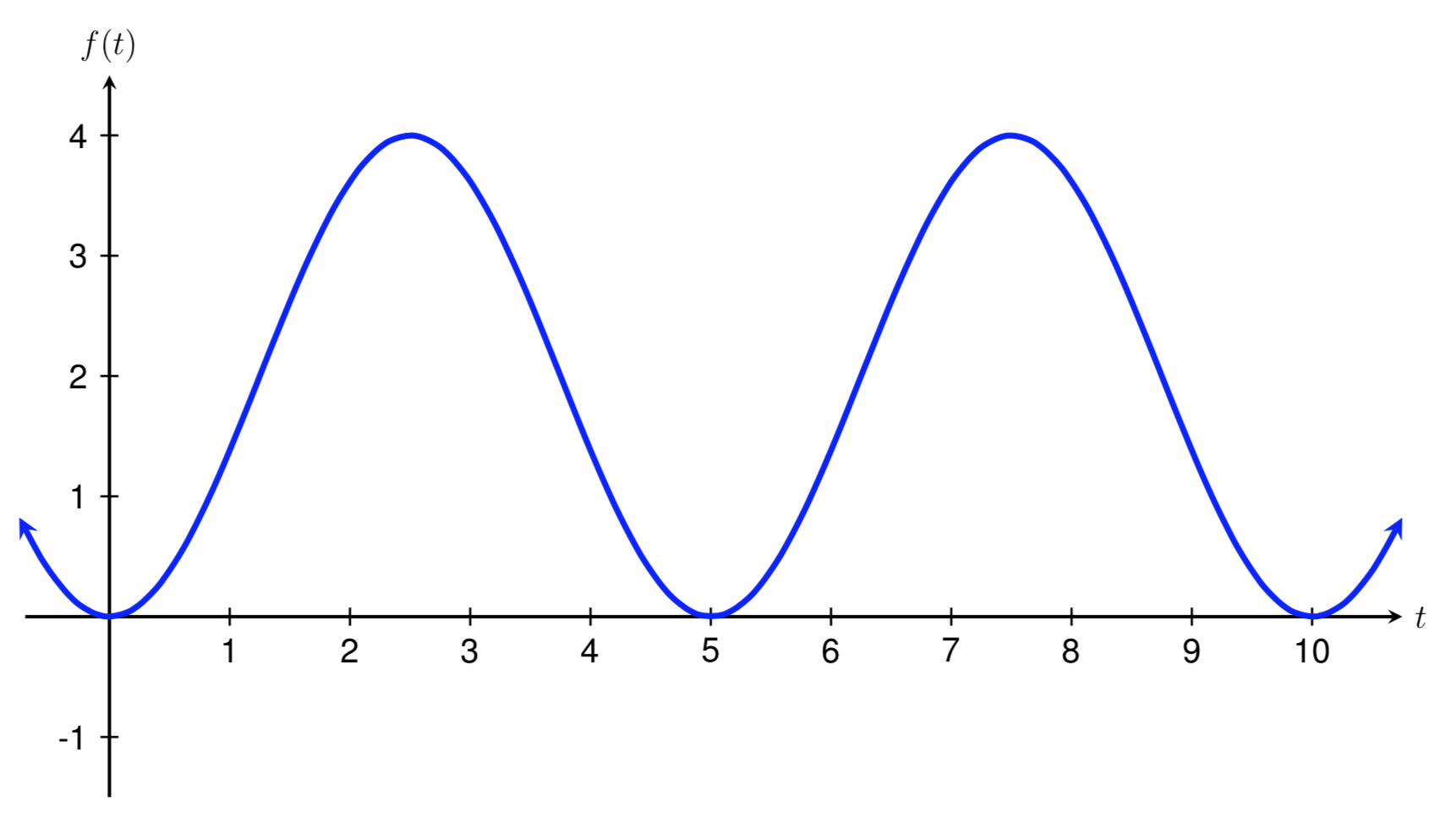
Find a formula for the sinusoidal function graphed below.
described in detail following the image
graph of -2cos(2pi/5t)+2
Solution.
To begin, let’s find the period, midline, and amplitude of the function graphed above.
Recall that the period of the function is how long it takes for the function to start repeating. If we think about the function "starting" at \(x=0\text{,}\) or when it crosses the \(y\)-axis, we can see that the function above begins repeating when \(x=5\text{.}\) Therefore, the period of the function graphed above is 5.
Since the period of a function is related to \(B\text{,}\) the stretch/compression factor, we can use the relationship \(P = 2\pi/|B|\) to solve for \(B\text{.}\) Substituting 5 in for \(P\text{,}\) we get
\begin{align*} 5 \amp= \frac{2\pi}{|B|} \\ \\ |B| \cdot 5 \amp= 2\pi \\ \\ |B| \amp= \frac{2\pi}{5} \end{align*}
For now, we can assume that the \(B\) value is positive, which gives us
\begin{equation*} B = \frac{2\pi}{5} \end{equation*}
The midline of the function is the horizontal line halfway between the function’s maximum and minimum values. Here, the maximum value of the function is 4 and the minimum value is 0. The number halfway between 4 and 0 is 2, so the midline is the line \(y=2\text{.}\) Therefore, the vertical shift of the function graphed above is
\begin{equation*} k=2 \end{equation*}
Finally, the amplitude of the function is the distance between the function’s maximum value and the midline. The distance between the function’s maximum value of 4 and the function’s midline of \(y=2\) is 2, so the amplitude of the function above is 2. Therefore, the vertical stretch factor is
\begin{equation*} |A|=2 \end{equation*}
We now need to decide what type of sinusoidal function to use and whether \(A\) is positive or negative. Note that the function shown above crosses the \(y\)-axis at its minimum value. Since \(\cos(x)\) crosses the \(y\)-axis at its maximum value, then we need to use a vertical reflection of a cosine graph to model this function, which means that
\begin{equation*} A=-2 \end{equation*}
Using our work above and substituting our known values into the generalized cosine function \(g(t)=A\cos(Bt) + k\) gives us the following formula for the function graphed above.
\begin{equation*} f(t) = -2\cos\left(\frac{2\pi}{5}t\right) + 2 \end{equation*}
To check our solution, we can use a graphing calculator to graph the function we came up with and confirm that it matches the graph shown above.
Example 2.19.

Find a possible formula for a sinusoidal function with an amplitude of 2, a period of 4, and that crosses the \(y\)-axis on the midline at the point \((0,3)\text{.}\) Assume that the function is decreasing when it crosses the midline.
Solution.
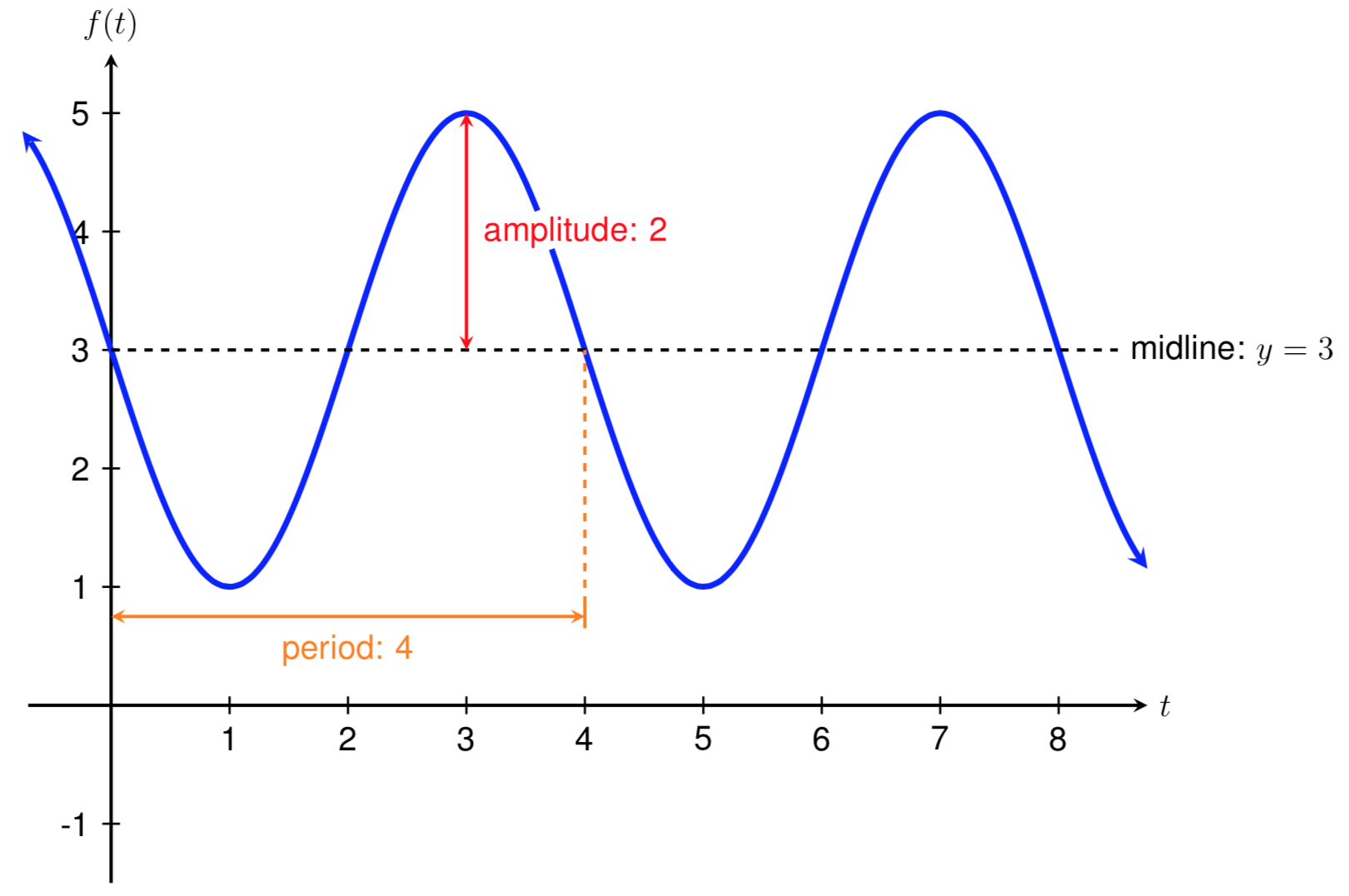
To begin, let’s sketch a graph of the function based on the known information. We know that the graph crosses the \(y\)-axis on the midline at the point \((0,3)\) and that the function is decreasing at that point. We also know that the amplitude of the function is 2 and the period is 4. Below is a graph of the function that fits this description.
described in detail following the image
graph of -2sin(pi/2theta)+3
Since we know the period is 4, we can use the relationship \(P = 2\pi/|B|\) to solve for B. Substituting 4 in for \(P\text{,}\) we get
\begin{align*} 4 \amp= \frac{2\pi}{|B|} \\ \\ |B| \cdot 4 \amp= 2\pi \\ \\ |B| \amp= \frac{2\pi}{4} \\ \\ |B| \amp= \frac{\pi}{2} \end{align*}
We may assume that the value of \(B\) is positive, which gives us
\begin{gather*} B = \frac{\pi}{2} \end{gather*}
Next, we know that the function crosses the \(y\)-axis at the point \((0,3)\text{,}\) which is on the midline of the function. Therefore, the midline of the function is \(y=3\) so
\begin{equation*} k=3 \end{equation*}
Finally, the amplitude of the function is 2, so
\begin{equation*} |A|=2 \end{equation*}
We now need to decide what type of sinusoidal function to use and whether \(A\) is positive or negative. Note that the function above crosses the \(y\)-axis at its midline. Therefore, we can use a sine graph to model this function. Since the function is decreasing as it crosses the \(y\)-axis, we also need to use a vertical reflection, which means that
\begin{equation*} A=-2 \end{equation*}
Using our work above and substituting our known values into the generalized sine function \(f(t)=A\sin(Bt) + k\) gives us the following formula for the function described and graphed above.
\begin{equation*} f(t) = -2\sin\left(\frac{\pi}{2}t\right) + 3 \end{equation*}
To check our solution, we can use a graphing calculator to graph the function we came up with and confirm that it matches the graph shown above.

Example 2.20.

Sketch a graph of \(\displaystyle f(t)=4\sin\left(\frac{\pi}{3}t-\frac{\pi}{3}\right)\text{.}\)
Solution.
To reveal the horizontal shift, we first need to factor what is inside the sine function. Factoring out a \(\pi/3\) from both terms gives us
\begin{equation*} f(t) = 4\sin\left(\frac{\pi}{3}(t-1)\right) \end{equation*}
Now that the function is in the form \(f(t)=A\sin(B(t-h))+k\text{,}\) we can determine the period, midline, amplitude, and horizontal shift of the function in order to help us graph it.
The stretch/compression factor is \(B=\pi/3\) so the period is
\begin{equation*} P = \frac{2\pi}{|B|} = \frac{2\pi}{\pi/3} = 2\pi \cdot \frac{3}{\pi} = 6 \end{equation*}
The vertical stretch/compression factor is \(|A|=|4|=4\text{,}\) so the amplitude of the function is 4.
The vertical shift of the function is \(k=0\text{,}\) so the midline of the function is \(y=0\text{,}\) which is the \(x\)-axis. Therefore, there is no vertical shift of this function.
Finally, the horizontal shift of the function is \(h=1\text{.}\) Since \(h\) is positive, the graph will be shifted to the right by 1.
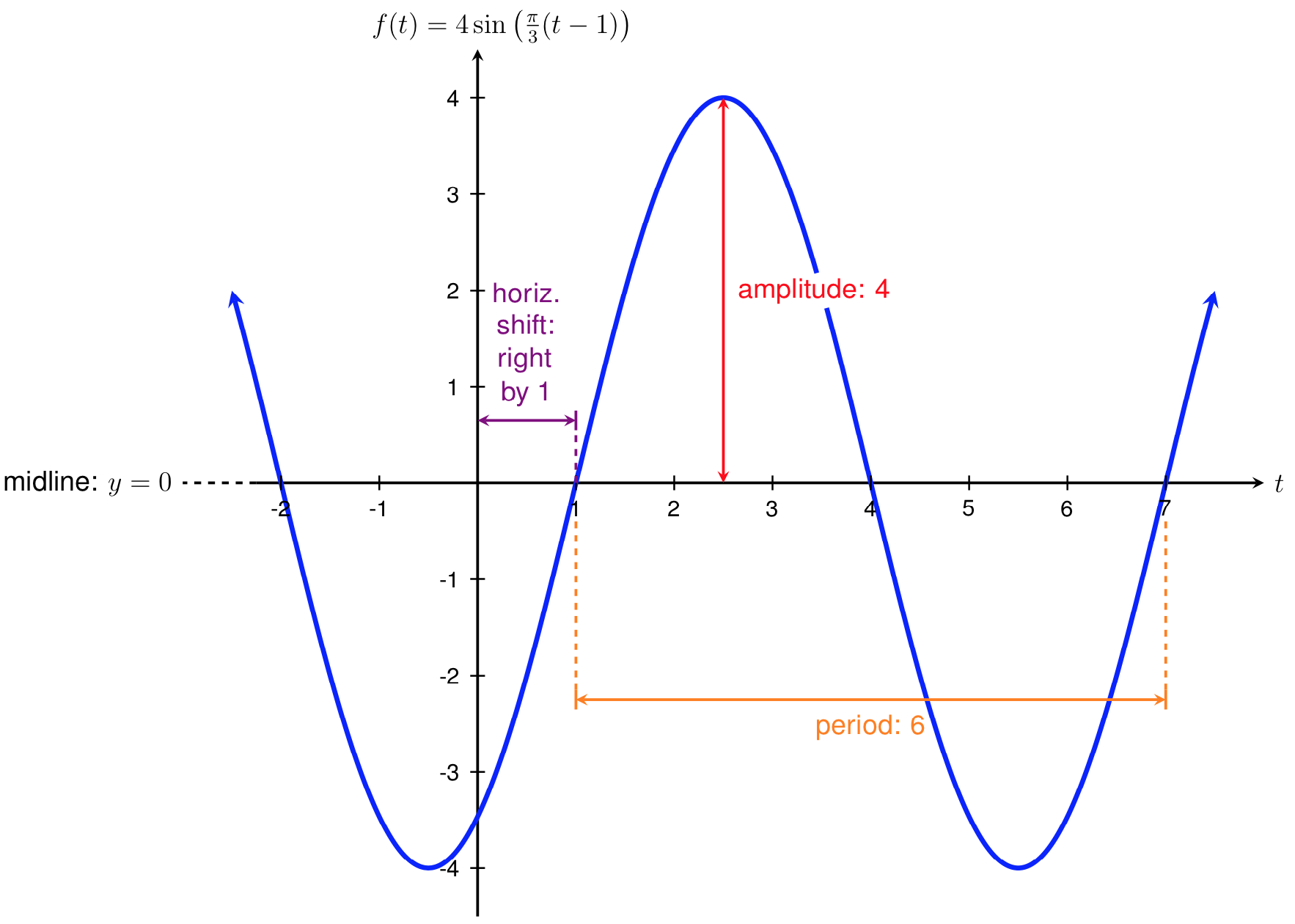
Using our knowledge of the graph of \(f(t)=\sin(t)\text{,}\) we can sketch a transformed graph of
\begin{equation*} f(t) = 4\sin\left(\frac{\pi}{3}(t-1)\right) \end{equation*}
Note that the midline of the two functions is the same, but their amplitude and period are different. In addition, the transformed function is shifted horizontally from the original function. Therefore, the transformed graph involves a vertical stretch of 4, a horizontal compression by a factor of \(3/\pi\text{,}\) and a horizontal shift right by 1 from the original graph of \(f(t)=\sin(t)\text{,}\) which we discussed in a previous section 1.3. Shown below is the graph of the transformed function
\begin{equation*} f(t) = 4\sin\left(\frac{\pi}{3}(t-1)\right) \end{equation*}
described in detail following the image
graph of 4sin(pi/3(t-1))

Exercises 2.2.2 Exercises

1. Generalized Cosine Function.

Consider the generalized cosine function: \(f(x) = A\cos(B(x-h))+k.\)
(a) What is the period of \(f(x)\text{?}\)
(b) What is the midline of the function \(f(x)\text{?}\) \(y\) =
(c) What is the amplitude of the function \(f(x)\text{.}\)

2. Period, Midline, and Amplitude.

Identify the period, midline, and amplitude of each of the trigonometric functions below.
(a) \(f(t) = 8\sin(t) +10\)
Period:
Midline: \(y\)=
Amplitude:
(b) \(g(x) = -2\sin\big(\frac{2\pi}{3}x\big)\)
Period:
Midline: \(y\)=
Amplitude:
Hint.
Identity and label the parts of a generalized sinusoidal function:
\begin{equation*} p(x)=A\sin(B(x-h))+k \end{equation*}

3. Period, Midline, and Amplitude.

Identify the period, midline, and amplitude of each of the trigonometric functions below.
(a) \(f(\theta) = 9\cos(6\pi \theta) -3\)
Period:
Midline: \(y\)=
Amplitude:
(b) \(g(x) = -5\cos(3 x)+4\)
Period:
Midline: \(y\)=
Amplitude:
Hint.
Identity and label the parts of a generalized sinusoidal function:
\begin{equation*} p(x)=A\cos(B(x-h))+k \end{equation*}

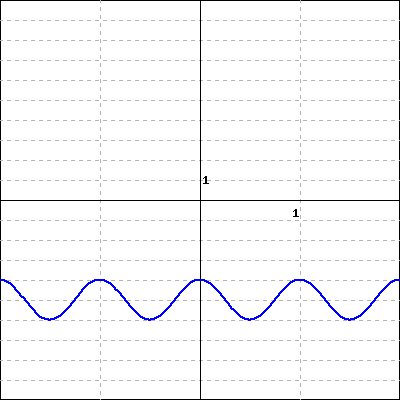
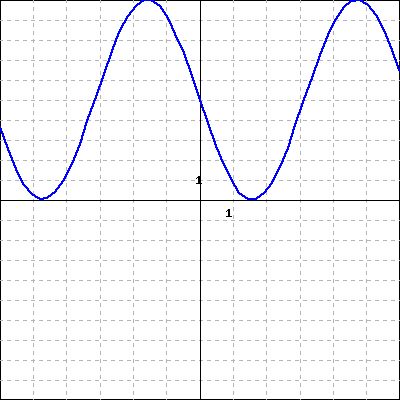
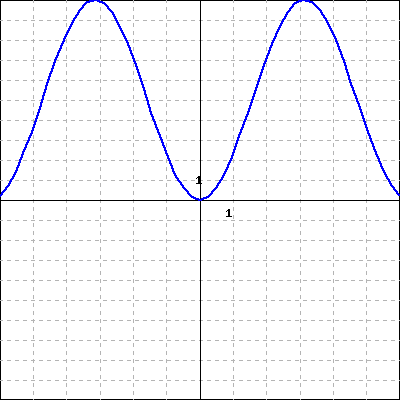
4. Identifying Graphs.

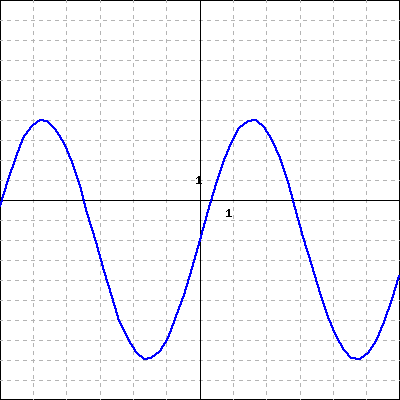
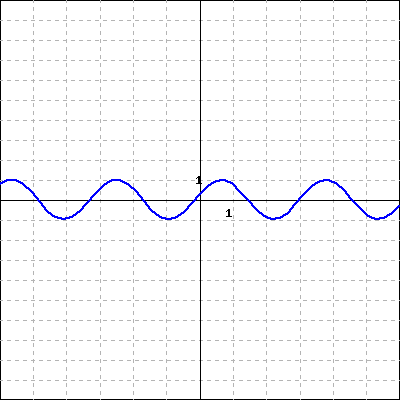
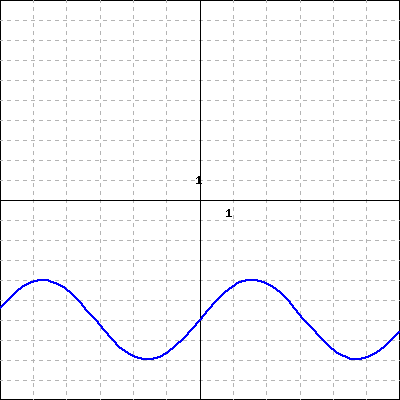
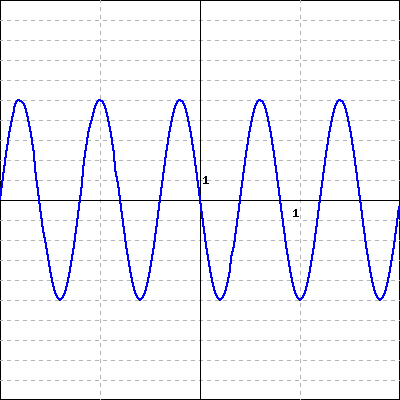
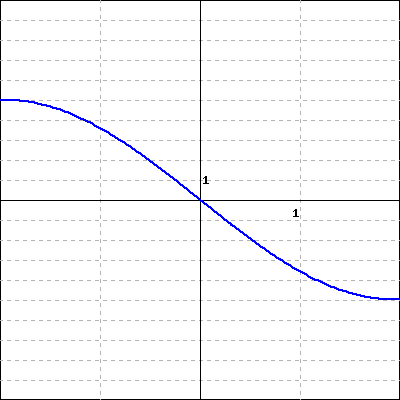
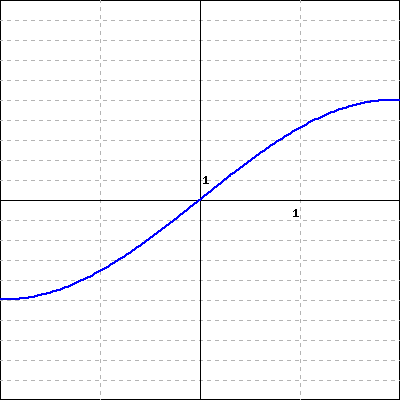
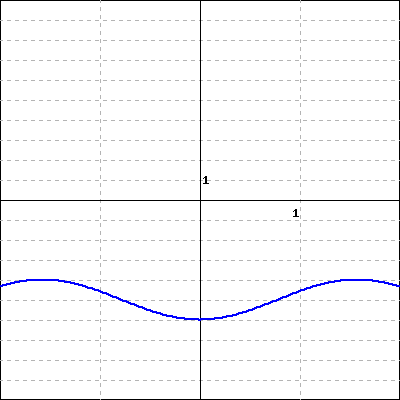
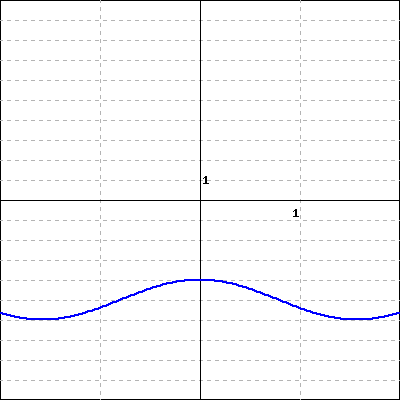
Which of the following graphs represents \(f(x) = 2\sin(x) - 6\text{?}\)
A B C D
Hint.
Identity and label the parts of a generalized sinusoidal function and determine how each part affects the graph.

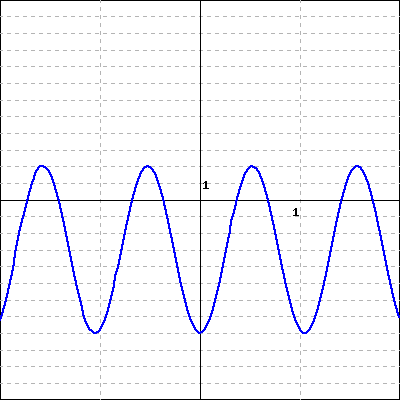
5. Identifying Graphs.

Which of the following graphs represents \(f(x) = -5\sin(\frac{5\pi x}{2})\text{?}\)
A B C D
Hint.
Identity and label the parts of a generalized sinusoidal function and determine how each part affects the graph.

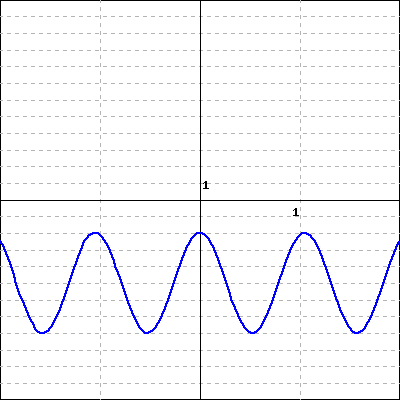
6. Identifying Graphs.

Which of the following graphs represents \(f(x) = \cos(2\pi x) - 5\text{?}\)
A B C D
Hint.
Identity and label the parts of a generalized sinusoidal function and determine how each part affects the graph.

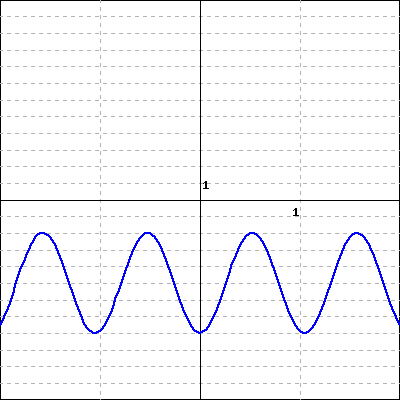
7. Identifying Graphs.

Which of the following graphs represents \(f(x) = -5\cos(6 x) - 3\text{?}\)
A B C D
Hint.
Identity and label the parts of a generalized sinusoidal function and determine how each part affects the graph.

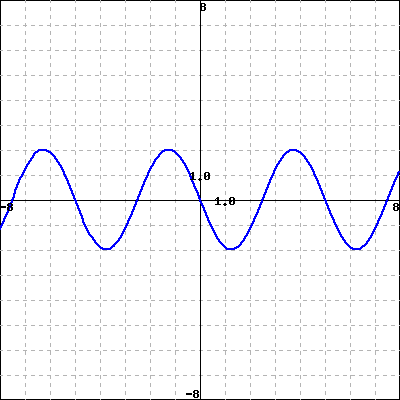
8. Writing Formula from Graph.

Identify the period, midline, and amplitude of the graph above.
(a) The period is .
(b) The midline is \(y=\).
(c) The amplitude is .
(d) Write a formula for the graph above using sine.
\(f(x) =\).
(e) Write a formula for the graph above using cosine.
\(f(x) =\).
Hint.
Recall the generalized sinusoidal function:
\begin{equation*} f(x)=A\sin(B(x-h))+k \end{equation*}
and keep in mind what each parameter represents. Can we solve for the \(B\) value if we know the period?
For part e), note that sine and cosine are cofunctions.

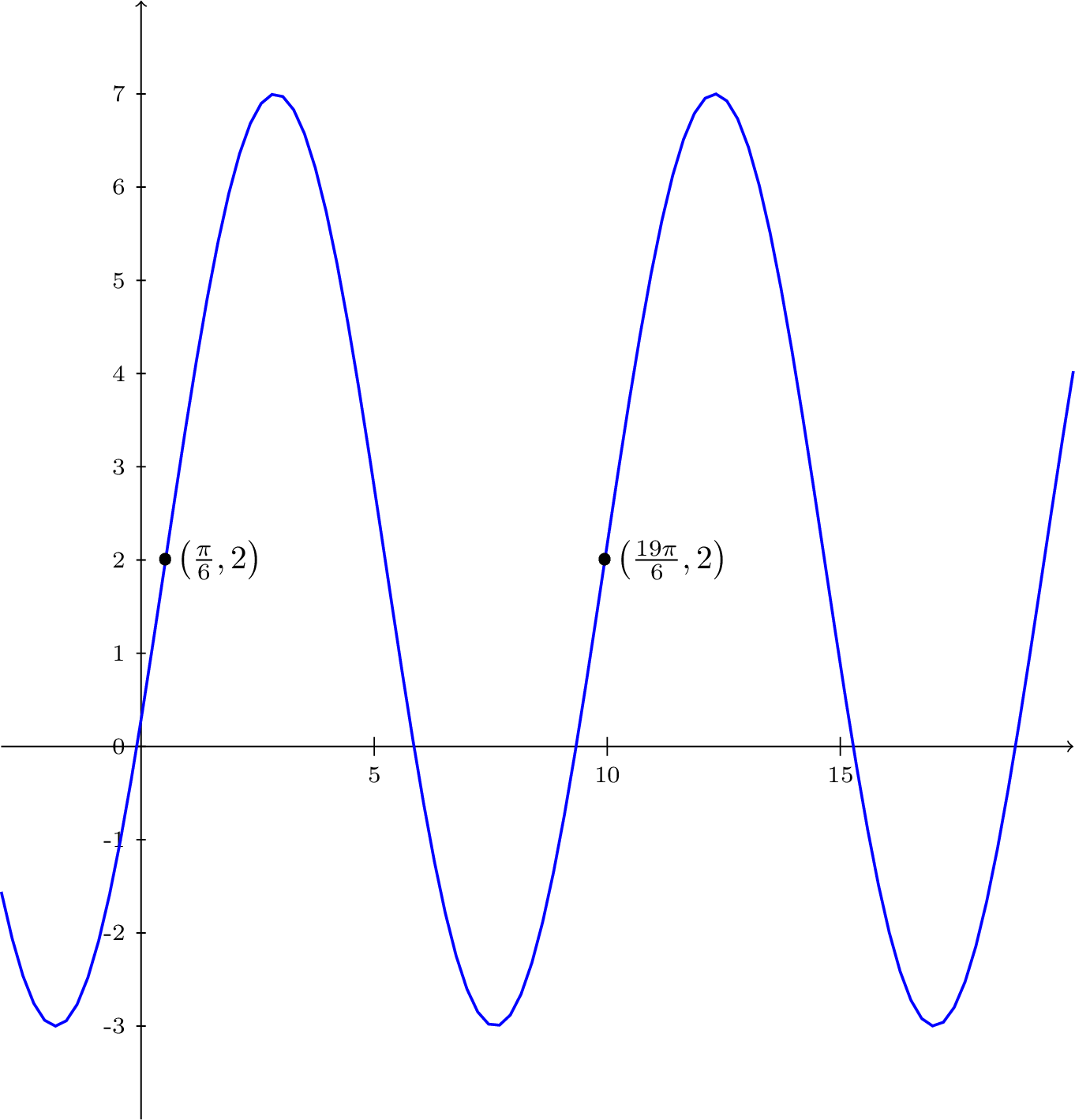
9. Writing Formula from Graph.

Write a formula for the generalized sinusoidal function graphed above.
\(f(x) =\).

10. Translations.

[(a)]
For each of the following functions, choose the statement that best describes how the graph of the function differs from the graph of
\begin{equation*} f(\theta) = 4\cos(2\theta) +2. \end{equation*}
\(g(\theta) = 4\cos(2\theta+1)+2\)
  • \(g(\theta)\) is a shift of \(f(\theta)\) by 1 unit to the left.
  • \(g(\theta)\) is a shift of \(f(\theta)\) by 1 unit to the right.
  • \(g(\theta)\) is a shift of \(f(\theta)\) by \(\frac{1}{2}\) unit to the left.
  • \(g(\theta)\) is a shift of \(f(\theta)\) by \(\frac{1}{2}\) unit to the right.
  • None of the above statements are true.
\(j(\theta) = 4\cos(2(\theta+1))+2\)
  • \(h(\theta)\) is a shift of \(f(\theta)\) by 1 unit to the left.
  • \(h(\theta)\) is a shift of \(f(\theta)\) by 1 unit to the right.
  • \(h(\theta)\) is a shift of \(f(\theta)\) by \(\frac{1}{2}\) unit to the left.
  • \(h(\theta)\) is a shift of \(f(\theta)\) by \(\frac{1}{2}\) unit to the right.
  • None of the above statements are true.
\(k(\theta) = 4\cos(2\theta-1)+2\)
  • \(k(\theta)\) is a shift of \(f(\theta)\) by 1 unit to the left.
  • \(k(\theta)\) is a shift of \(f(\theta)\) by 1 unit to the right.
  • \(k(\theta)\) is a shift of \(f(\theta)\) by \(\frac{1}{2}\) unit to the left.
  • \(k(\theta)\) is a shift of \(f(\theta)\) by \(\frac{1}{2}\) unit to the right.
  • None of the above statements are true.
Hint.
To determine the horizontal shift, pay special attention to what the input for the trigonometric function is in the generalized sinusoidal function:
\begin{equation*} f(x)=A\cos(B(x-h))+k\text{.} \end{equation*}

11. Comparison of Translations.

Let \(f(x) = 5\sin(x)+5\) and \(g(x) = -5\sin(x)+5\text{.}\)
(a) Which of the following is the graph of \(f(x)\text{?}\)
(b) Which of the following is the graph of \(g(x)\text{?}\)
A B C D
Answer the following about the function \(f(x)\text{:}\)
(c) The period of \(f(x)\) is .
(d) The amplitude of \(f(x)\) is .
(e) The midline of \(f(x)\) is \(y =\) .
(f) Choose the statement that best describes the starting behavior of \(f(x)\text{.}\) That is, what happens as \(f(x)\) crosses the vertical axis?
  • \(f(x)\) crosses the vertical axis at the midline and increases as the input values get bigger.
  • \(f(x)\) crosses the vertical axis at the midline and decreases as the input values get bigger.
  • \(f(x)\) crosses the vertical axis at its maximum value and decreases as the input values get bigger.
  • \(f(x)\) crosses the vertical axis at its minimum value and increases as the input values get bigger.
Answer the following about the function \(g(x)\text{:}\)
(g) The period of \(g(x)\) is .
(h) The amplitude of \(g(x)\) is .
(i) The midline of \(g(x)\) is \(y =\) .
(j) Choose the statement that best describes the starting behavior of \(g(x)\text{.}\) That is, what happens as \(g(x)\) crosses the vertical axis?
  • \(g(x)\) crosses the vertical axis at the midline and increases as the input values get bigger.
  • \(g(x)\) crosses the vertical axis at the midline and decreases as the input values get bigger.
  • \(g(x)\) crosses the vertical axis at its maximum value and decreases as the input values get bigger.
  • \(g(x)\) crosses the vertical axis at its minimum value and increases as the input values get bigger.
(k) Choose the statements below that can describe the differences between the two functions \(f(x)\) and \(g(x)\text{.}\)
  • \(f(x)\) and \(g(x)\) are both vertical stretches and shifts of \(\sin(x)\text{,}\) but \(g(x)\) is also a reflection of \(\sin(x)\) across the horizontal axis.
  • \(f(x)\) and \(g(x)\) are both vertical stretches and shifts of \(\sin(x)\text{,}\) but \(g(x)\) is also a reflection of \(\sin(x)\) across the vertical axis.
  • \(g(x)\) is the function \(f(x)\) reflected across the horizontal axis.
  • \(g(x)\) is the function \(f(x)\) reflected across the vertical axis.
  • \(f(x)\) and \(g(x)\) are the same function.
Hint.
a)-b) Keep in mind how sine usually behaves at the vertical axis.
k) What does a horizontal reflection of \(\sin(x)\) look like? What does a vertical reflection of \(\sin(x)\) look like?