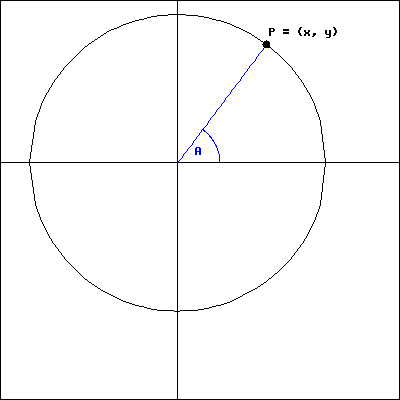
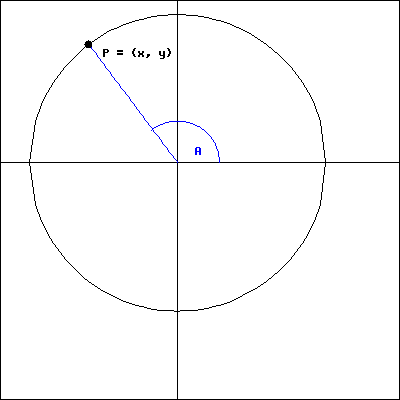
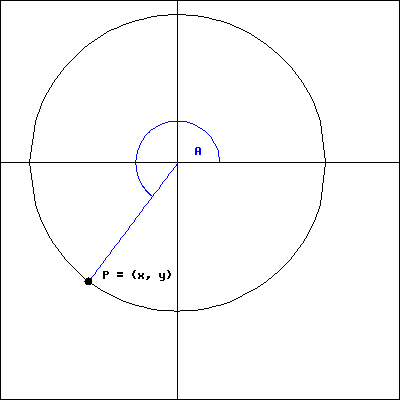
Section 1.6 Inverse Trigonometric Functions

In this chapter, we have evaluated trigonometric functions at various angles, but what if we need to know what angle yields a specific sine, cosine, or tangent value? To find angles, we need inverse trigonometric functions.

Subsection 1.6.1 Examples with Exact Values

Example 1.46.

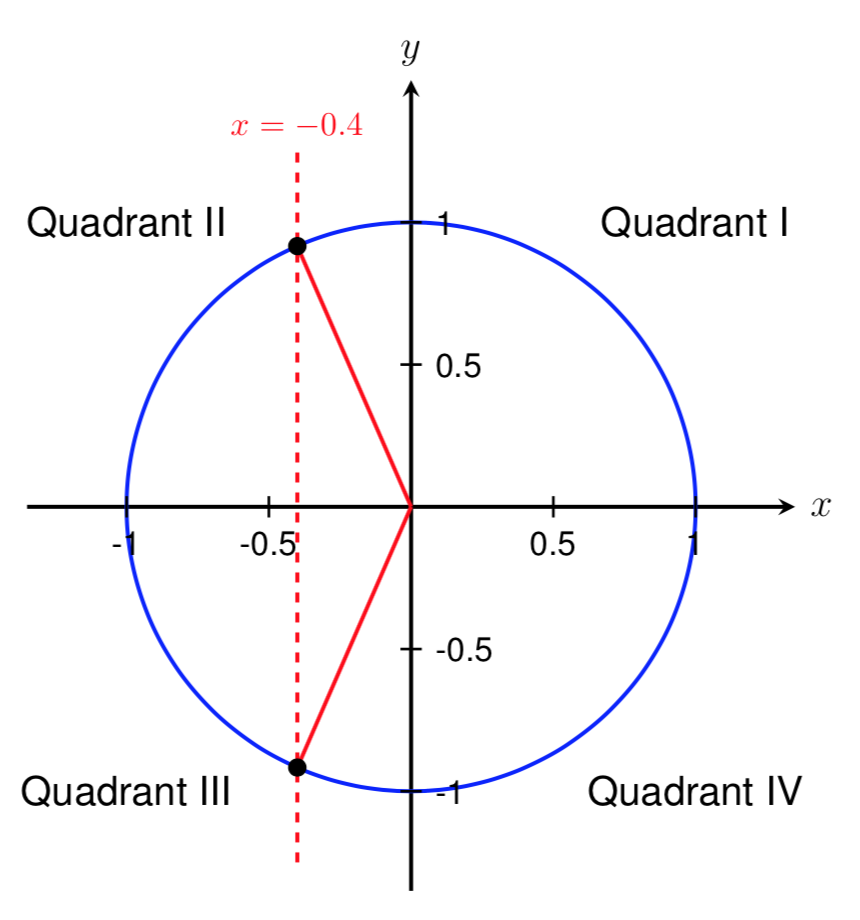
If \(\cos(\theta)=-0.4\text{,}\) in which quadrants can \(\theta\) lie?
Solution.
Since our cosine value is negative and cosine corresponds to the \(x\) coordinate of a point on the unit circle, \(\theta\) could lie in Quadrant II or Quadrant III.
described in detail following the image
unit circle with cos(theta)=-0.4
In the previous example, we were given a trigonometric value and could use the definition of cosine to determine the quadrants in which \(\theta\) could lie. However, in order to solve for \(\theta\text{,}\) we need an additional tool.

Inverse Sine, Cosine, and Tangent Functions.

If \(\sin(\theta)=a\text{,}\) then \(\sin^{-1}(a)=\theta\)
If \(\cos(\theta)=a\text{,}\) then \(\cos^{-1}(a)=\theta\)
If \(\tan(\theta)=a\text{,}\) then \(\tan^{-1}(a)=\theta\)
Note that the output of each of these inverse functions is an angle.

Note 1.47 Common Notation.

The inverse sine function, \(\sin^{-1}(a)\) is sometimes called the arcsine function, and notated \(\arcsin(a)\text{.}\)
The inverse cosine function, \(\cos^{-1}(a)\) is sometimes called the arccosine function, and notated \(\arccos(a)\text{.}\)
The inverse tangent function, \(\tan^{-1}(a)\) is sometimes called the arctangent function, and notated \(\arctan(a)\text{.}\)

Caution 1.48.

Based only on the definitions above, the inverse trigonometric functions are not actually functions at all! For example, since \(\sin(0)=0\) and \(\sin(2\pi)=0\text{,}\) we have that \(\sin^{-1}(0)=0\) and \(\sin^{-1}(0)=2\pi\text{.}\)
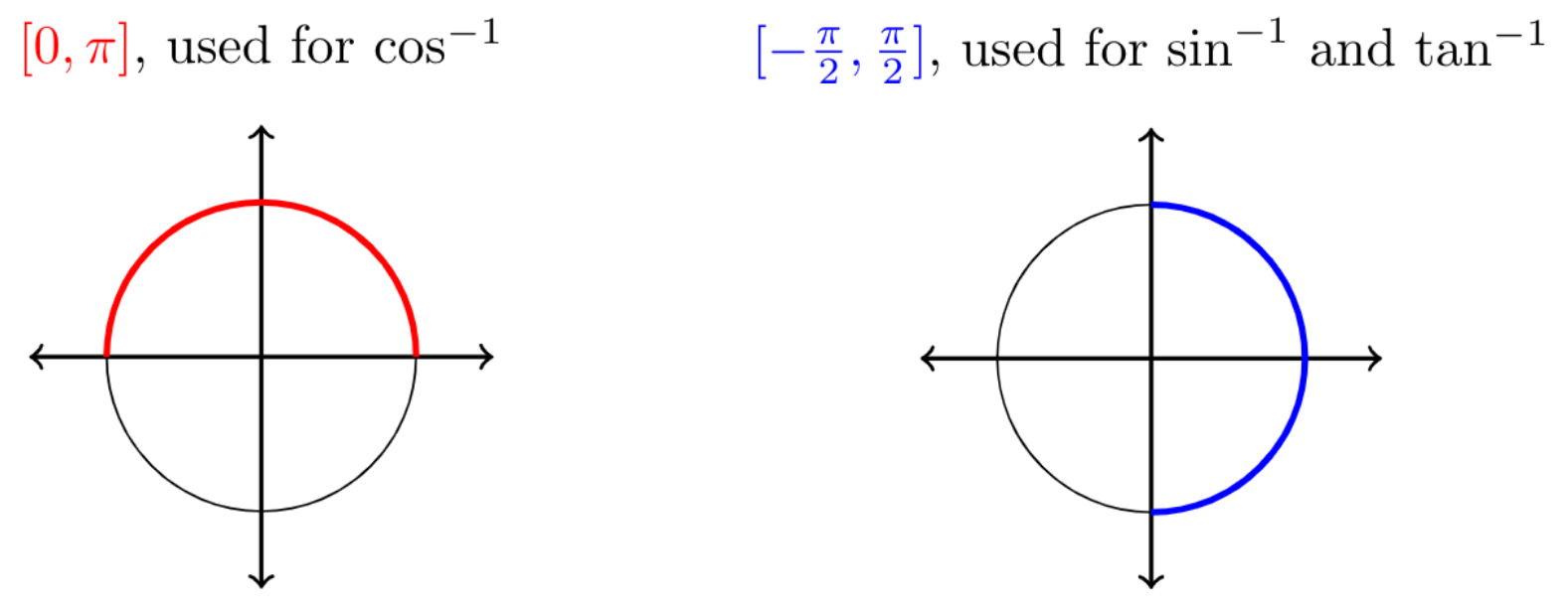
This can be fixed by restricting the outputs to a certain interval. For example, most calculators will give an output for \(\cos^{-1}\) in the interval \([0,\pi]\text{,}\) but will give an output for \(\sin^{-1}\) and \(\tan^{-1}\) in the interval \([-\frac{\pi}{2},\frac{\pi}{2}]\text{.}\)

Example 1.49.

Find two angles in the interval \([0,2\pi]\) such that \(\displaystyle \sin(\theta)=\frac{1}{2}\text{.}\)
Solution.
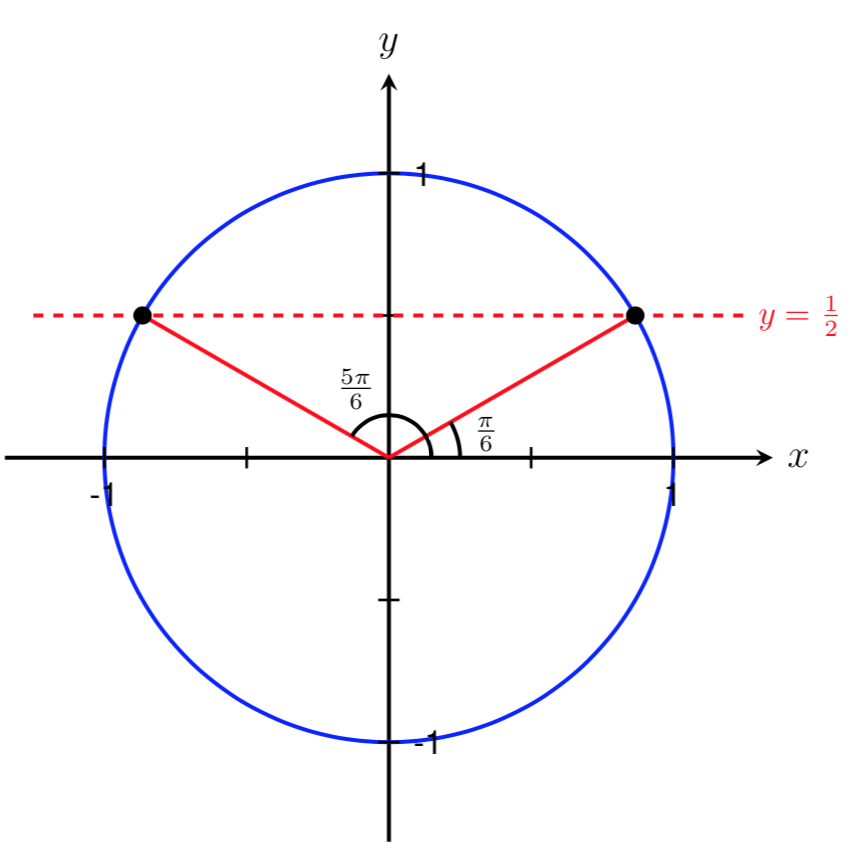
Since we are given a sine value, we know that we are looking for angles with a \(y\) coordinate of \(1/2\) on the unit circle.
From the common angles on the unit circle, the two angles where \(\sin(\theta)=1/2\) in the interval \([0,2\pi]\) are
\begin{equation*} \theta = \frac{\pi}{6} \hspace{.25in} \text{and} \hspace{.25in} \theta = \frac{5\pi}{6} \end{equation*}
described in detail following the image
unit circle with sin(theta)=0.5

Example 1.50.

Find two angles in the interval \([0,2\pi]\) such that \(\displaystyle \cos(\theta)=-\frac{\sqrt{3}}{2}\text{.}\)
Solution.
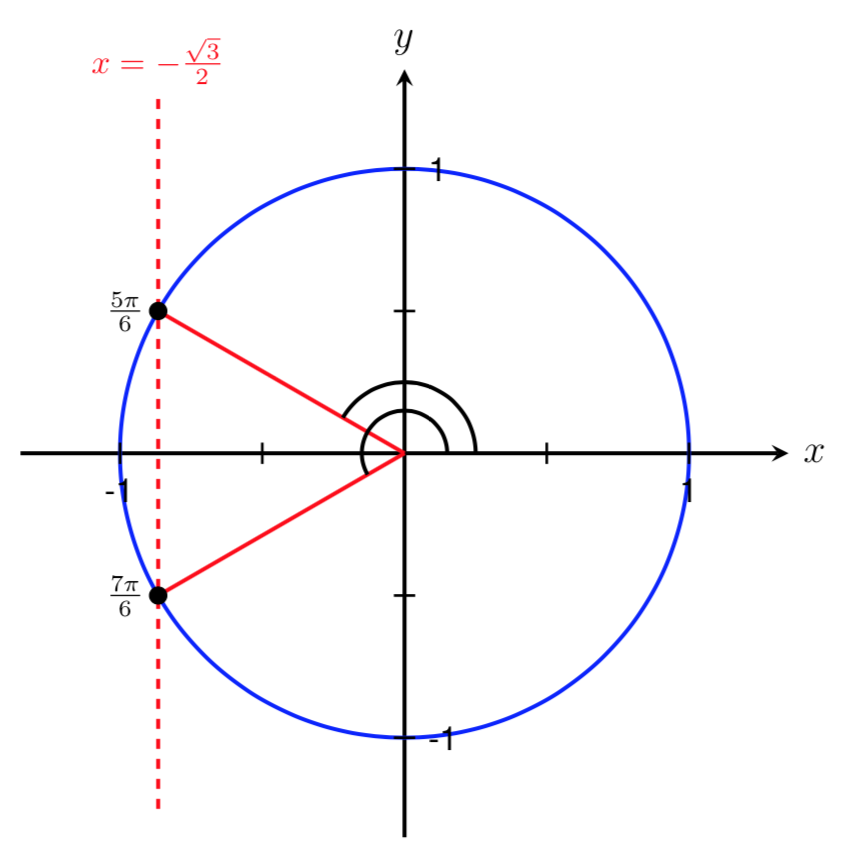
Since we are given a cosine value, we know that we are looking for angles with an \(x\) coordinate of \(-\sqrt{3}/2\) on the unit circle.
From the common angles on the unit circle, the two angles where \(\cos(\theta)=-\sqrt{3}/2\) in the interval \([0,2\pi]\) are
\begin{equation*} \theta = \frac{5\pi}{6} \hspace{.25in} \text{and} \hspace{.25in} \theta = \frac{7\pi}{6} \end{equation*}
described in detail following the image
unit circle with cos(theta)=-sqrt(3)/2

Example 1.51.

Find two angles in the interval \([0,2\pi]\) such that \(\tan(\theta)=1\text{.}\)
Solution.
Since we are given a tangent value of 1 and \(\tan(\theta) = y/x\text{,}\) we know that we are looking for angles where the \(x\) and \(y\) values are equal on the unit circle.
From the common angles on the unit circle, the two angles where the \(x\) and \(y\) values are equal and \(\tan(\theta)=1\) in the interval \([0,2\pi]\) are
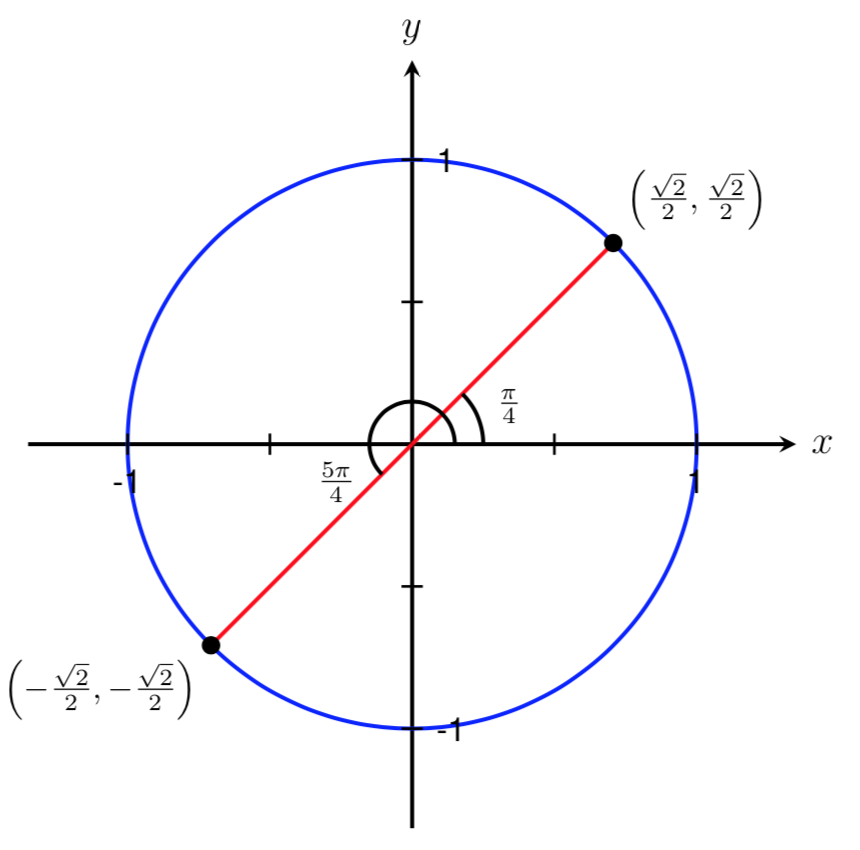
\begin{equation*} \theta = \frac{\pi}{4} \hspace{.25in} \text{and} \hspace{.25in} \theta = \frac{5\pi}{4} \end{equation*}
described in detail following the image
unit circle with tan(theta)=1

Example 1.52.

Find all angles in the interval \(\displaystyle [0,2\pi]\) such that
\begin{equation*} \displaystyle \text{a.} \hspace{.1in} \sin(\theta)=-1 \hspace{.5in} \text{b.} \hspace{.1in} \cos(\theta)=\frac{\sqrt{2}}{2} \hspace{.5in} \text{c.} \hspace{.1in} \tan(\theta)=\sqrt{3} \end{equation*}
Solution.
  1. Since we are given a sine value of \(-1\text{,}\) we know that we are looking for angles where the \(y\) value is equal to \(-1\text{.}\) The only such angle in the interval \(\displaystyle [0,2\pi]\) is \(\theta=\frac{3\pi}{2}\text{.}\)
  2. Since we are given a cosine value of \(\frac{\sqrt{2}}{2}\text{,}\) we are looking for angles where the \(x\) value is equal to \(\frac{\sqrt{2}}{2}\text{.}\) From the common angles on the unit circle, the two angles in the interval \(\displaystyle [0,2\pi]\) are
    \begin{equation*} \frac{\pi}{4} \hspace{.25in} \text{ and } \hspace{.25in} \frac{7\pi}{4} \end{equation*}
  3. This time we are looking for angles such that
    \begin{equation*} \tan(\theta)=\frac{\sin(\theta)}{\cos(\theta)}=\sqrt{3} \end{equation*}
    Since
    \begin{equation*} \sqrt{3}=\frac{\sqrt{3}/2}{1/2}=\frac{-\sqrt{3}/2}{-1/2} \end{equation*}
    the two such angles are \(\frac{\pi}{3}\) (which corresponds to \(\sin(\theta)=\sqrt{3}/2\) and \(\cos(\theta)=1/2\)) and \(\frac{4\pi}{3}\) (which corresponds to \(\sin(\theta)=-\sqrt{3}/2\) and \(\cos(\theta)=-1/2\)).

Subsection 1.6.2 More Examples with Non-Exact Values

In the previous examples and exercises, we were able to use the unit circle to solve for \(\theta\text{,}\) but if we are given trigonometric values that do not correspond to common angles on the unit circle, we will need to use a calculator to find approximate values for \(\theta\text{.}\)

Example 1.53.

Find two angles in the interval \([0,2\pi]\) such that \(\cos(\theta)=-0.4\text{.}\)
Solution.
Let’s start by drawing a picture and labeling the known information and the angles we are trying to find.
Since we are given a cosine value, we know that we are looking for angles with an \(x\) coordinate of \(-0.4\) on the unit circle. Below is a sketch showing two angles that correspond to \(\cos(\theta) = -0.4\text{.}\) Recall back to ExampleΒ 1.46 that these two angles lie in Quadrant II and Quadrant III since our cosine value is negative.
described in detail following the image
unit circle with cos(theta)=-0.4
Since \(x=-0.4\) does not correspond to a common angle on the unit circle, we need to use a calculator to solve for an approximate value of \(\theta\text{.}\) Applying the inverse cosine function we get that
\begin{equation*} \theta = \cos^{-1}(-0.4) \end{equation*}
To evaluate this, we can use our calculator. Since the output of the inverse function is an angle, our calculator will give us an angle in degrees if it is in degree mode or an angle in radians if it is in radian mode.
Here, we need to decide whether to provide our answer in degrees or radians. Since we are given the interval \([0,2\pi]\text{,}\) which is radians, we will provide our answers in radians. Using our calculator in radian mode we get that
\begin{equation*} \theta \approx 1.982 \text{ radians} \end{equation*}
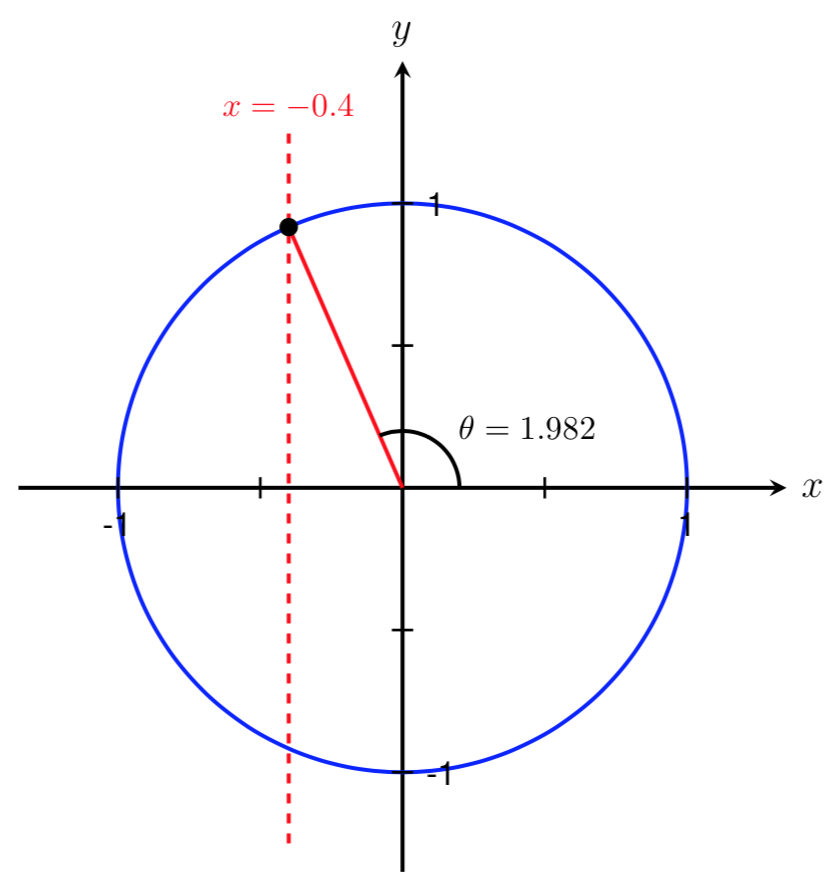
We have now found one angle in the interval \([0,2\pi]\) such that \(\cos(\theta) = -0.4\text{.}\) However, as shown above, \(\theta\) could lie in either Quadrant II or Quadrant III. Since 1.982 is bigger than \(\pi/2 \approx 1.571\) and smaller than \(\pi \approx 3.142\text{,}\) we know that \(\theta=1.982\) lies in Quadrant II. Therefore, we have found the angle shown below.
described in detail following the image
unit circle with cos(theta)=-0.4 and only one angle shown
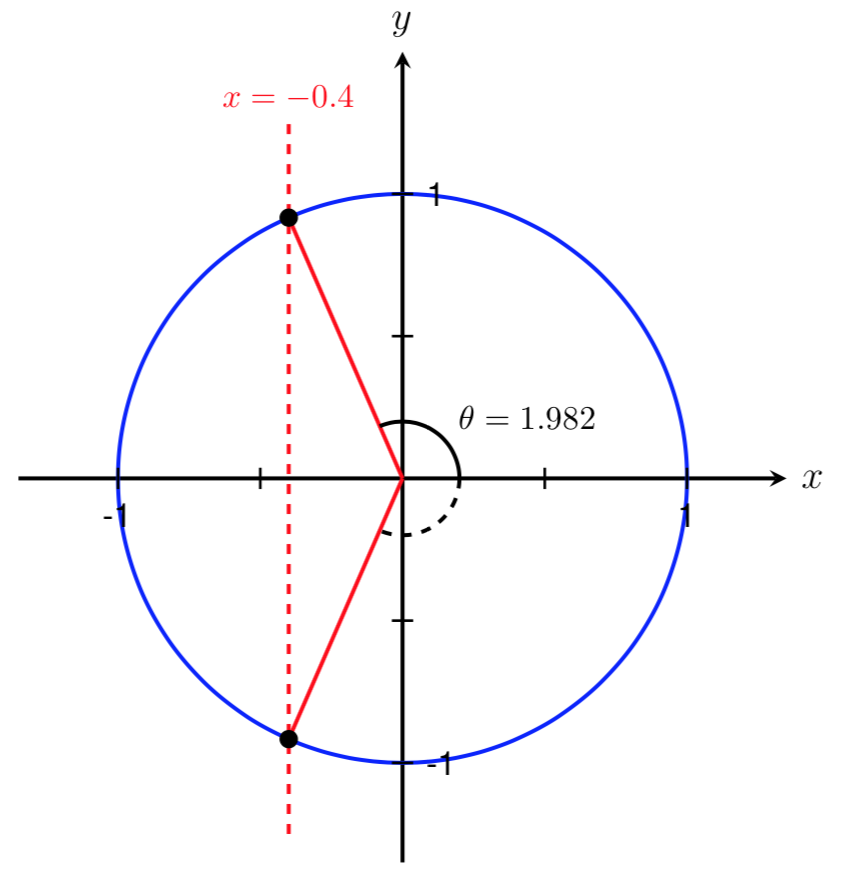
We can now use symmetry to find a second angle in the interval \([0,2\pi]\) such that \(\cos(\theta) = -0.4\text{.}\) From our work in ExampleΒ 1.46, we know this angle should be located in Quadrant III. By symmetry, we also know that the two angles shown below are equal.
described in detail following the image
unit circle with cos(theta)=-0.4 and symmetry of two angles shown
Therefore, to find the second angle, we can take the first angle we found and subtract it from \(2\pi\text{.}\) This gives us an angle of
\begin{equation*} \theta \approx 2\pi - 1.982 \approx 4.301 \text{ radians} \end{equation*}
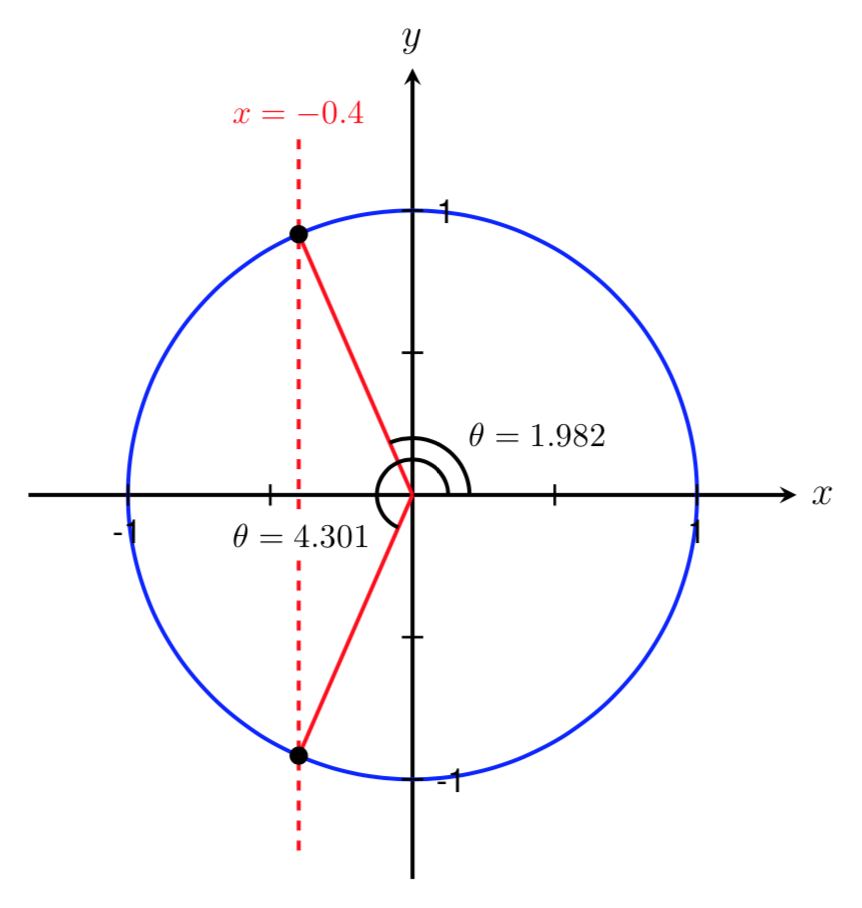
Thus, the two angles in the interval \([0,2\pi]\) that satisfy \(\cos(\theta) = -0.4\) are
\begin{equation*} \theta \approx 1.982 \text{ radians} \hspace{.25in} \text{ and } \hspace{.25in} \theta \approx 4.301 \text{ radians} \end{equation*}
described in detail following the image
unit circle with cos(theta)=-0.4 and two angles labeled
An easy way to check our solutions is to evaluate \(\cos(1.982)\) and \(\cos(4.301)\) on our calculators. If our calculator returns values close to \(-0.4\text{,}\) then we know the angles we have found are correct. Using our calculator (in radian mode), we get
\begin{equation*} \cos(1.982)=-0.3997 \hspace{.25in} \text{ and } \hspace{.25in} \cos(4.301)=-0.3999 \end{equation*}
Since both of these values are very close and round to -0.4, we can be confident that we have found the two angles in the interval \([0,2\pi]\) that satisfy \(\cos(\theta)=-0.4\text{.}\)

Example 1.54.

Find two angles in the interval \([0,2\pi]\) such that \(\sin(\theta)=0.65\text{.}\)
Solution.
Let’s start by drawing a picture and labeling the known information and the angles we are trying to find.
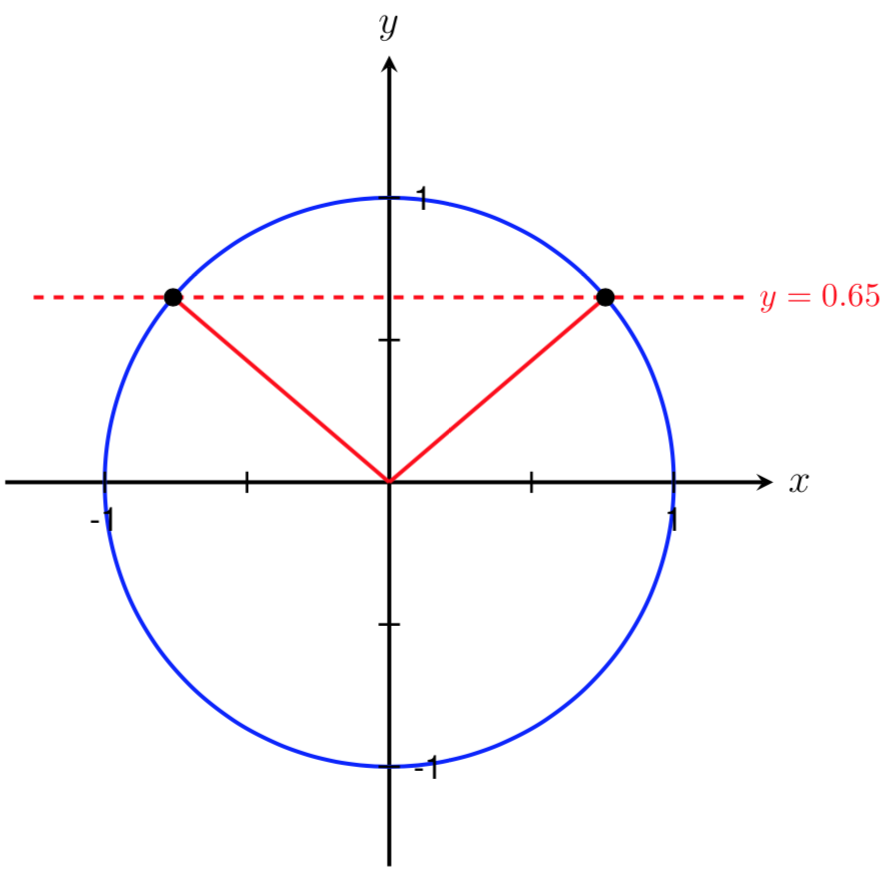
Since we are given a sine value, we know that we are looking for angles with an \(y\) coordinate of \(0.65\) on the unit circle. Below is a sketch showing two angles that correspond to \(\sin(\theta) = 0.65\text{.}\) Note that these two angles lie in Quadrant I and Quadrant II since our sine value is positive.
described in detail following the image
unit circle with sin(theta)=0.65
Since \(y=0.65\) does not correspond to a common angle on the unit circle, we need to use a calculator to solve for an approximate value of \(\theta\text{.}\) Applying the inverse sine function we get that
\begin{equation*} \theta = \sin^{-1}(0.65) \end{equation*}
Using our calculator in radian mode we get that
\begin{equation*} \theta \approx 0.708 \text{ radians} \end{equation*}
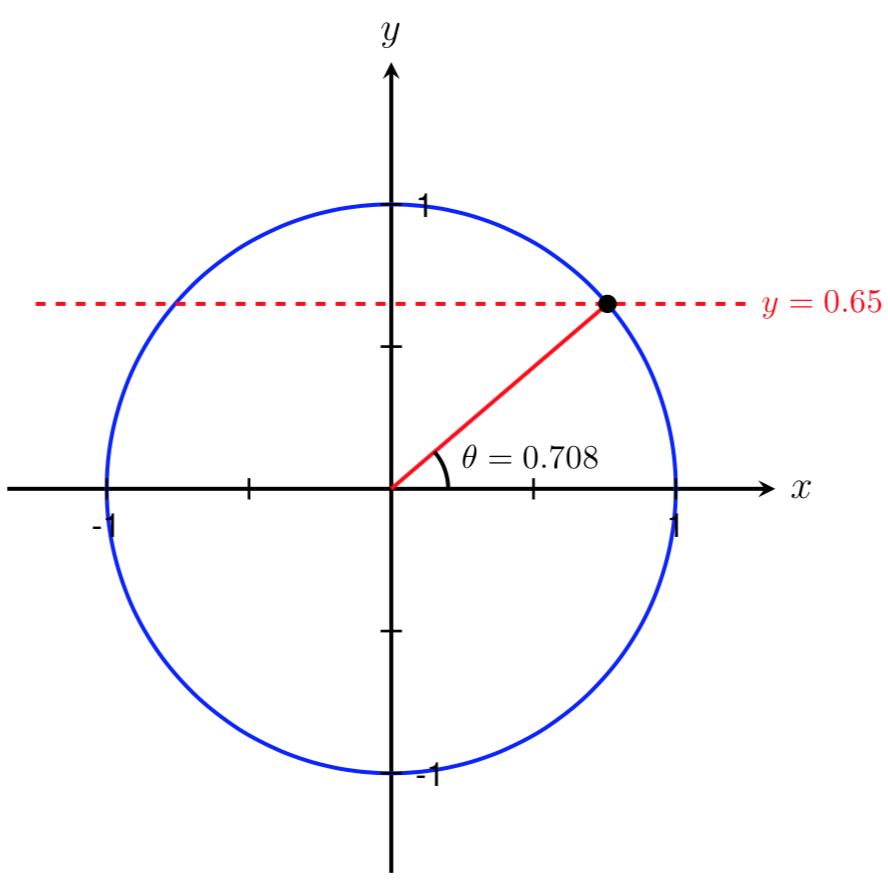
We have now found one angle in the interval \([0,2\pi]\) such that \(\sin(\theta) = 0.65\text{.}\) However, as shown above, \(\theta\) could lie in either Quadrant I or Quadrant II. Since 0.708 is bigger than 0 and smaller than \(\pi/2 \approx 1.571\text{,}\) we know that \(\theta=0.708\) lies in Quadrant I. Therefore, we have found the angle shown below.
described in detail following the image
unit circle with sin(theta)=0.65 and only one angle shown
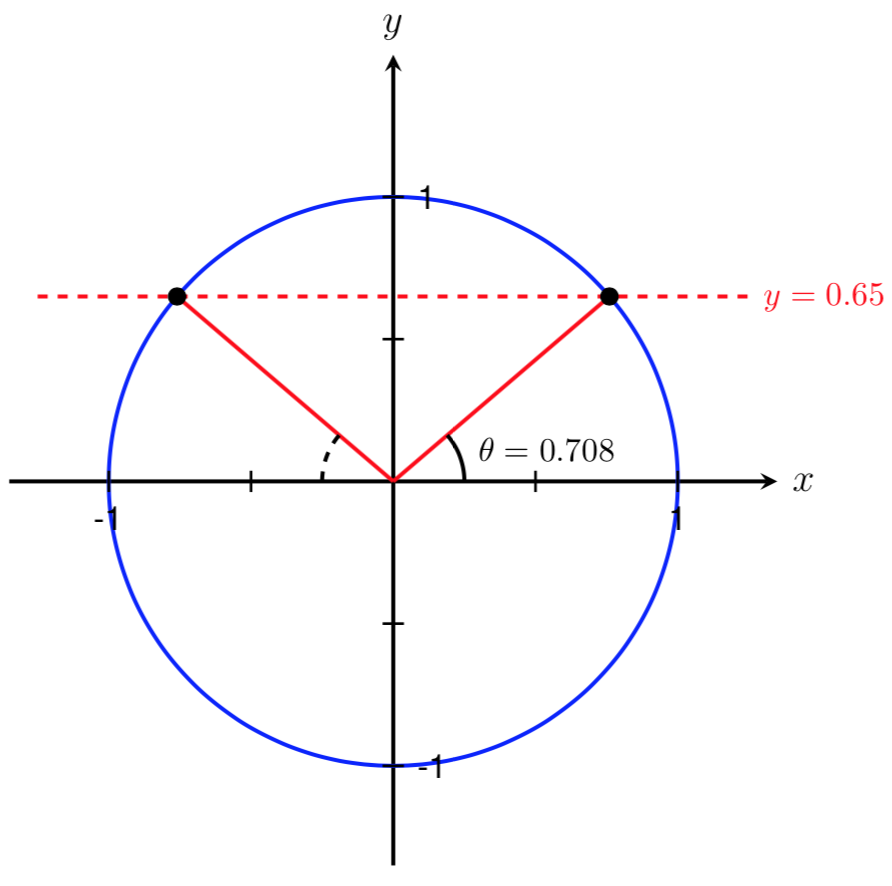
We can now use symmetry to find a second angle in the interval \([0,2\pi]\) such that \(\sin(\theta) = 0.65\text{.}\) From our work above, we know this angle should be located in Quadrant II. By symmetry, we also know that the two angles shown below are equal.
described in detail following the image
unit circle with sin(theta)=0.65 and symmetry of two angles shown
Therefore, to find the second angle, we can take the first angle we found and subtract it from \(\pi\text{.}\) This gives us an angle of
\begin{equation*} \theta \approx \pi - 0.708 \approx 2.434 \text{ radians} \end{equation*}
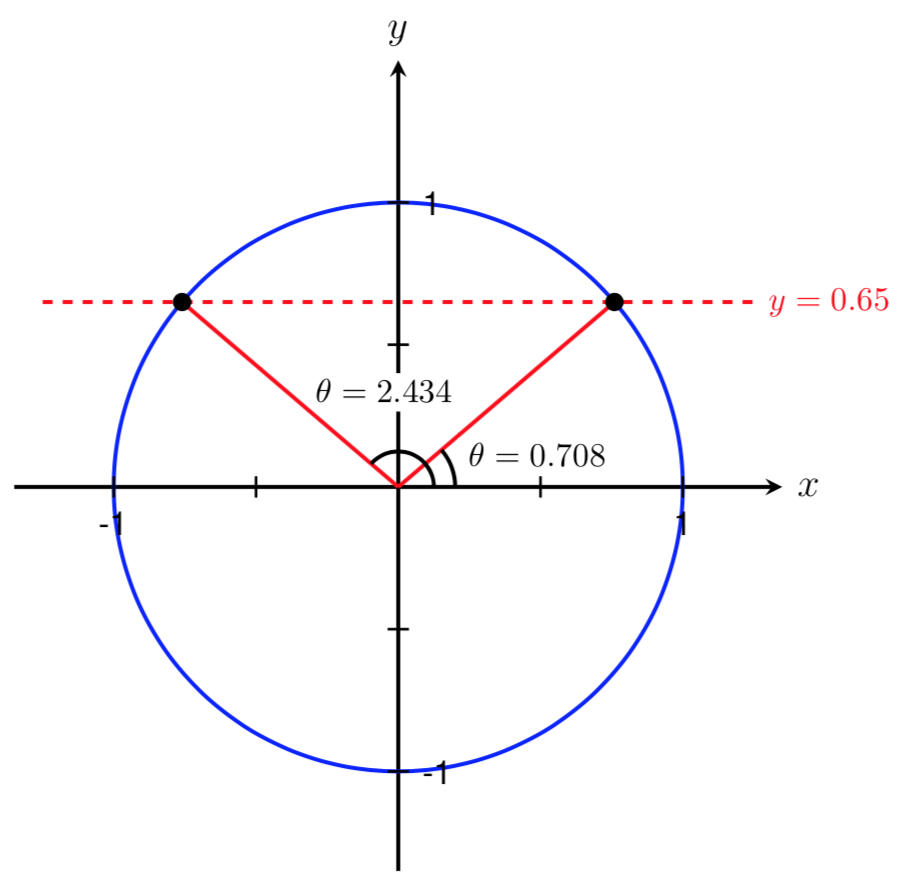
Thus, the two angles in the interval \([0,2\pi]\) that satisfy \(\sin(\theta) = 0.65\) are
\begin{equation*} \theta \approx 0.708 \text{ radians} \hspace{.25in} \text{ and } \hspace{.25in} \theta \approx 2.434 \text{ radians} \end{equation*}
described in detail following the image
unit circle with sin(theta)=0.65 and two angles labeled
Before we move on, let’s check our solutions by evaluating \(\sin(0.708)\) and \(\sin(2.434)\) on our calculators. If our calculator returns values close to \(0.65\text{,}\) then we know the angles we have found are correct. Using our calculator (in radian mode), we get
\begin{equation*} \sin(0.708)=0.6503 \hspace{.25in} \text{ and } \hspace{.25in} \sin(2.434)=0.6500 \end{equation*}
Since both of these values are very close to 0.65, we can be confident that we have found the two angles in the interval \([0,2\pi]\) that satisfy \(\sin(\theta)=0.65\text{.}\)

Example 1.55.

Find all angles in the interval \([0,2\pi]\) such that \(\tan(\theta)=7\text{.}\)
Solution.
Since we are given a tangent value, we know that we are looking for angles where \(y/x=7\) on the unit circle. In addition, our tangent value is positive, so this means that \(\theta\) must lie in Quadrant I, where both \(x\) and \(y\) are positive, or in Quadrant III, where both \(x\) and \(y\) are negative.
Since \(\tan(\theta)=7\) does not correspond to a common angle on the unit circle, we need to use a calculator to solve for an approximate value of \(\theta\text{.}\) Applying the inverse tangent function we get that
\begin{equation*} \theta = \tan^{-1}(7) \end{equation*}
Using our calculator in radian mode we get that
\begin{equation*} \theta \approx 1.429 \text{ radians} \end{equation*}
We have now found one angle in the interval \([0,2\pi]\) such that \(\tan(\theta) = 7\text{.}\) However, from our work above, we know that \(\theta\) could lie in either Quadrant I or Quadrant III. Since 1.429 is bigger than 0 and smaller than \(\pi/2 \approx 1.571\text{,}\) we know that \(\theta=1.429\) lies in Quadrant I. Therefore, we have found the angle shown below.
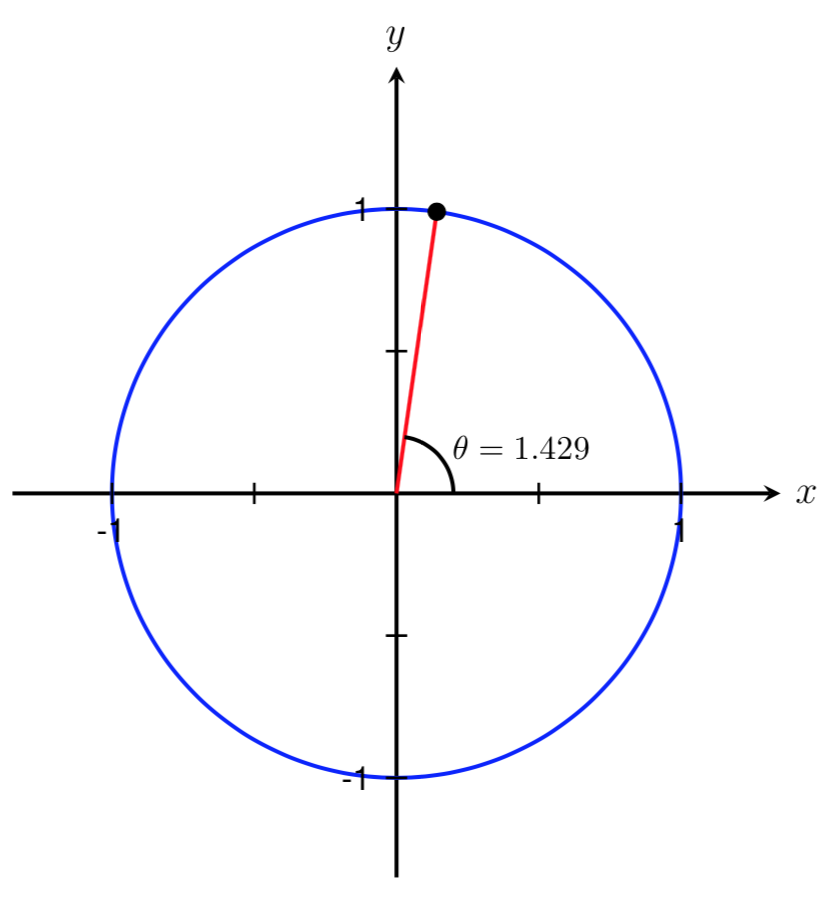
described in detail following the image
unit circle with tan(theta)=7 and only one angle shown
We can now use our knowledge of the tangent function to find a second angle in the interval \([0,2\pi]\) such that \(\tan(\theta) = 7\text{.}\) From our work above, we know this angle should be located in Quadrant III, and from SectionΒ 1.4, we know that the period of tangent is \(\pi\text{.}\) Therefore, the other angle where \(\tan(\theta)=7\) should be located halfway around the unit circle from our first value.
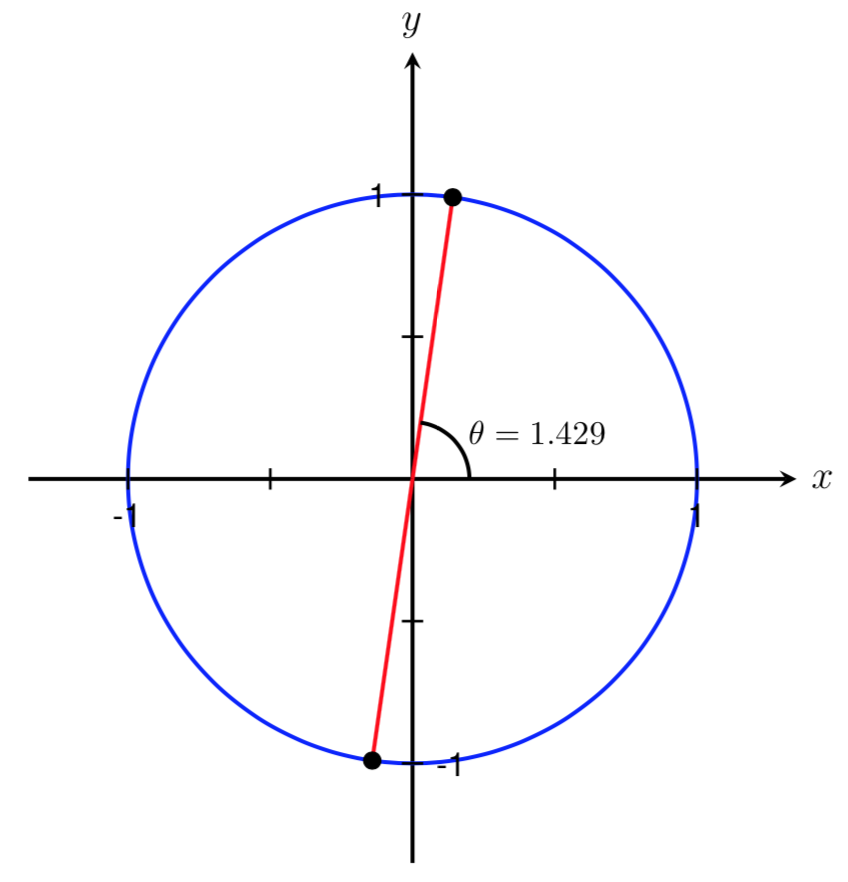
described in detail following the image
unit circle with tan(theta)=7 and two angles shown
To find this second angle, we can add \(\pi\) to the first angle we found, which gives us an angle of
\begin{equation*} \theta \approx 1.429 + \pi \approx 4.570 \text{ radians} \end{equation*}
Thus, the two angles in the interval \([0,2\pi]\) that satisfy \(\tan(\theta) = 7\) are
\begin{equation*} \theta \approx 1.429 \text{ radians} \hspace{.25in} \text{ and } \hspace{.25in} \theta \approx 4.570 \text{ radians} \end{equation*}
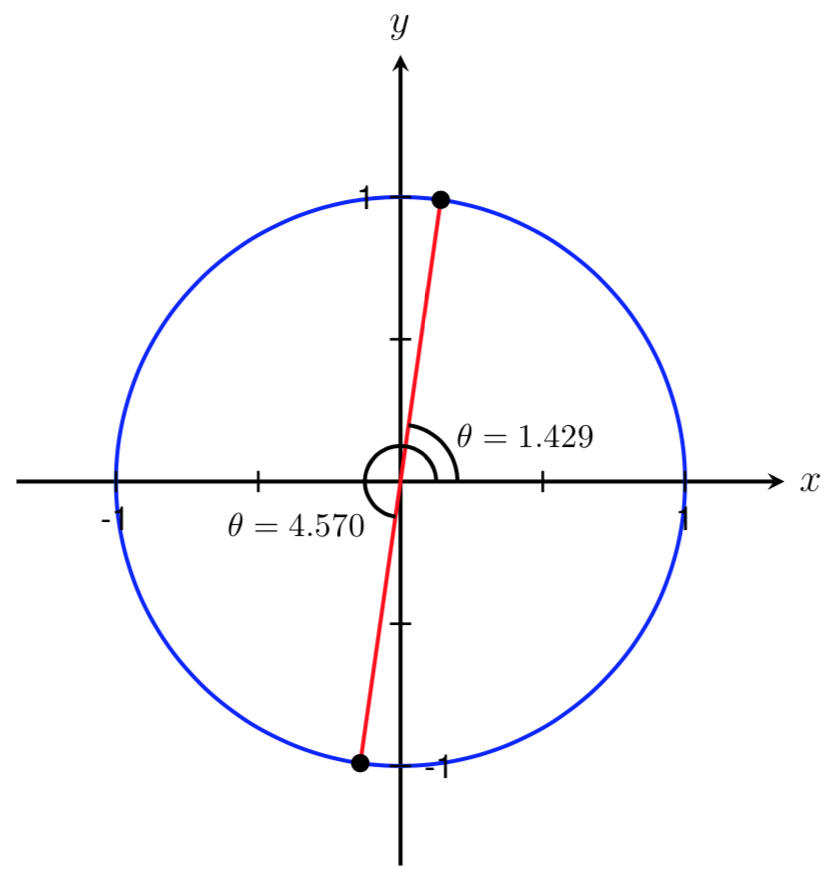
described in detail following the image
unit circle with tan(theta)=7 and two angles labeled
Before we move on, let’s check our solutions by evaluating \(\tan(1.429)\) and \(\tan(4.570)\) on our calculators. If our calculator returns values close to \(7\text{,}\) then we know the angles we have found are correct. Using our calculator (in radian mode), we get
\begin{equation*} \tan(1.429)=7.005 \hspace{.25in} \text{ and } \hspace{.25in} \tan(4.570)=6.975 \end{equation*}
Since both of these values are very close to 7, we can be confident that we have found the two angles in the interval \([0,2\pi]\) that satisfy \(\tan(\theta)=7\text{.}\)
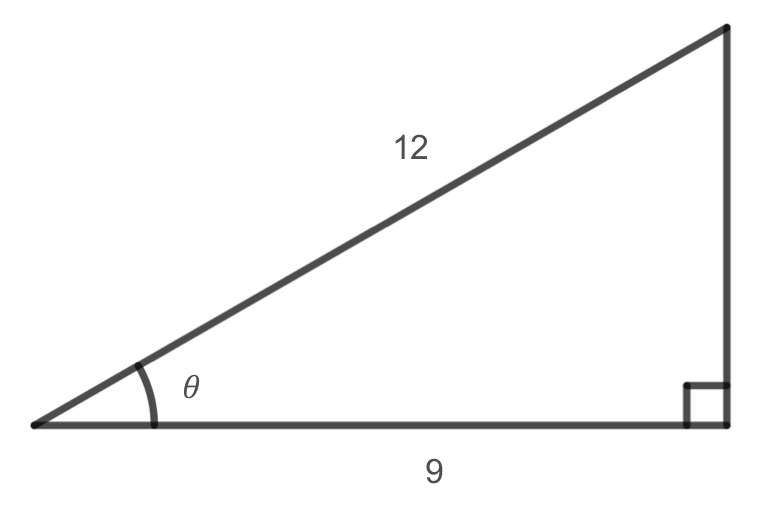
Using inverse trig functions, we can also solve for the angles of a right triangle given two of its sides.

Example 1.56.

Solve the triangle for the angle \(\theta\text{.}\)
described in detail following the image
right triangle with hypotenuse and adjacent side labeled
Solution.
Since we know the hypotenuse and the side adjacent to the angle, it makes sense for us to use the cosine function.
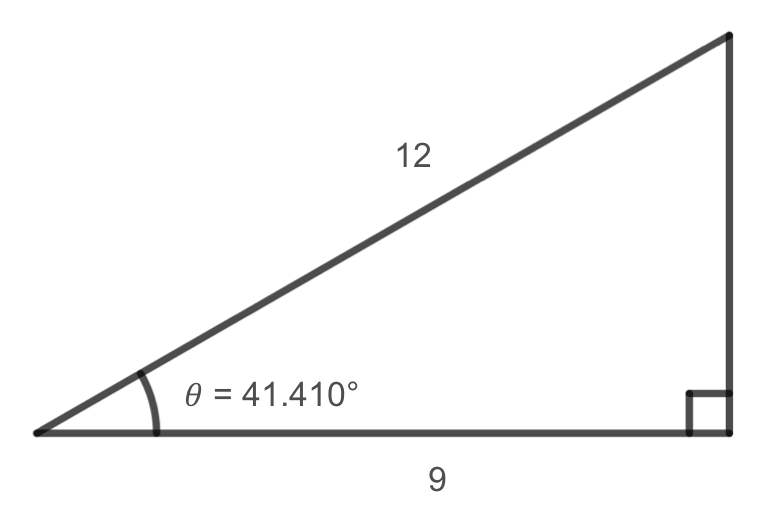
\begin{align*} \cos(\theta) \amp = \frac{9}{12} \amp\amp\text{Using the definition of the inverse} \\ \\ \theta \amp = \cos^{-1}\left(\frac{9}{12}\right) \amp\amp\text{Evaluating on our calculator} \\ \\ \theta \amp \approx 0.723 \text{ radians} \amp\amp\text{or about } \ 41.410^\circ \end{align*}
described in detail following the image
right triangle with hypotenuse, adjacent side, and angle labeled

Exercises 1.6.3 Exercises

1. Quadrants for Solutions: Sine.

If \(\sin(A)= -0.87\text{,}\) in which quadrants could \(A\) lie in? There may be more than one correct answer.
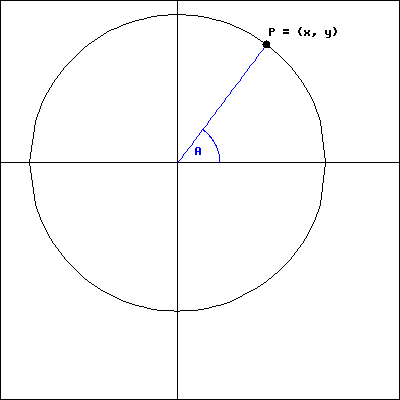
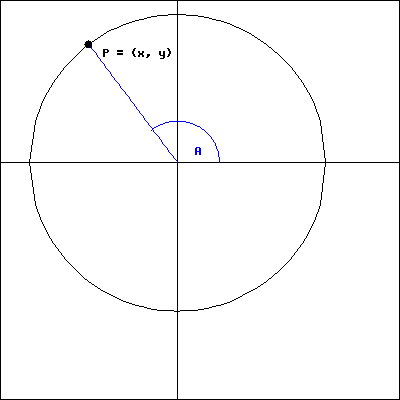
If \(\sin(A)= -0.87\text{,}\) which of the following graphs could represent this situation? There may be more than one correct answer.
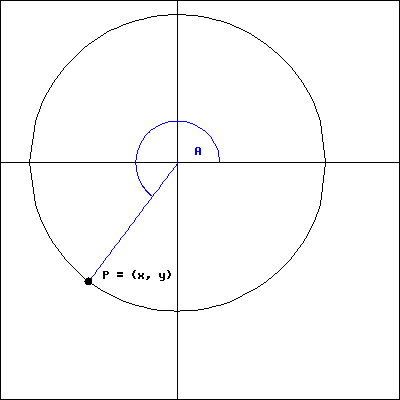
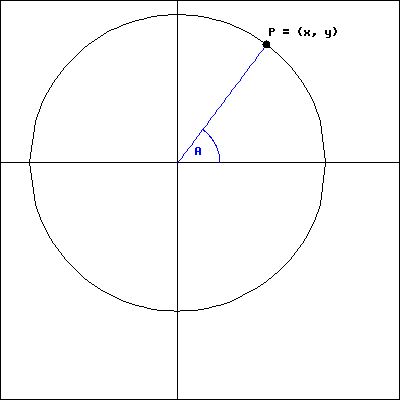
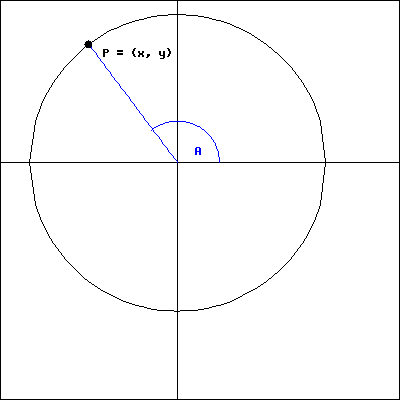
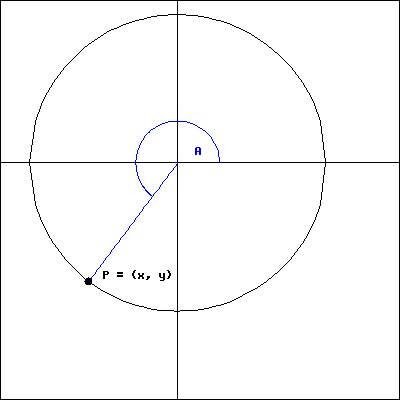
W X
Y Z
Hint.
In the coordinate pair \((x,y)\) on the unit circle, which coordinate is \(\sin(\theta)\) associated with?

2. Quadrants for Solutions: Cosine.

If \(\cos(A)= -0.65\text{,}\) in which quadrants could \(A\) lie in? There may be more than one correct answer.
If \(\cos(A)= -0.65\text{,}\) which of the following graphs could represent this situation? There may be more than one correct answer.
W X
Y Z
Hint.
In the coordinate pair \((x,y)\) on the unit circle, which coordinate is \(\cos (\theta)\) associated with?

3. Quadrants for Solutions: Tangent.

If \(\tan(A)= -0.43\text{,}\) in which quadrants could \(A\) lie in? There may be more than one correct answer.
If \(\tan(A)= -0.43\text{,}\) which of the following graphs could represent this situation? There may be more than one correct answer.
W X
Y Z
Hint.
Recall that \(\tan(\theta)=\frac{\sin(\theta)}{\cos(\theta)}\text{.}\) Based on what we know about the previous problems, what quadrants could this lie in?

4. Inverses on the Unit Circle.

Use your unit circle to find two angles \(\theta\) between 0 and \(2\pi\) such that \(\sin(\theta) =\) \(\frac{\sqrt{2}}{2}\text{.}\) Enter your answers as a comma separated list. Note that all solutions should be in radians.
\(\theta =\)
Use your unit circle to find two angles \(\theta\) between 0 and \(2\pi\) such that \(\cos(\theta) =\) \(\frac{1}{2}\text{.}\) Enter your answers as a comma separated list. Note that all solutions should be in radians.
\(\theta =\)
Hint.
Which coordinates are \(sin(\theta)\) and \(\cos(\theta)\) associated with?

5. Finding Inverses with a Calculator.

Find two angles \(\theta\) between 0 and \(2\pi\) such that \(\sin(\theta) =\) 0.01. Start by drawing a sketch. Enter your answers as a comma separated list. Note that all solutions should be in radians.
\(\theta =\)
Find two angles \(\theta\) between 0 and \(2\pi\) such that \(\cos(\theta) =\) -0.81. Start by drawing a sketch. Enter your answers as a comma separated list. Note that all solutions should be in radians.
\(\theta =\)
Hint.
When drawing your sketch, recall which coordinates the sine and cosine function are associated with respectively.

6. Application of Inverse Trigonometry.

Having had recent knee surgery, Tom is under doctor’s orders not to hike up any incline that is \(45^\circ\) or steeper.
(a) If \(\theta\) is the angle formed by a hill and the ground such that \(\tan(\theta)=\)3.1, can Tom hike this hill? There may be more than one correct answer.
  • No. Since \(\tan(\theta)=\)3.1 and \(\theta\) is an angle between 0 and \(90^\circ\text{,}\) then \(\theta=\arctan\)(3.1) is an angle less than \(45^\circ\text{.}\)
  • No. Since \(\tan(\theta)=\)3.1 and \(\theta\) is an angle between 0 and \(90^\circ\text{,}\) then \(\theta=\arctan\)(3.1) is an angle greater than \(45^\circ\text{.}\)
  • No. Since \(\tan(\theta)=\)3.1 is positive, then \(\theta\) must be an angle greater than \(45^\circ\text{.}\)
  • Yes. Since \(\tan(\theta)=\)3.1 and \(\tan\)(-1.88283844476764)\(=\theta\text{,}\) then \(\theta=\arctan\)(3.1)=-1.88283844476764 radians is an angle less than \(\frac{\pi}{4}\) (or \(45^\circ\)).
  • None of the above
(b) What if \(\sin(\theta)= 0.8\text{?}\) Can Tom hike this hill? There may be more than one correct answer.
  • No. Since \(\sin(\theta)=\)0.8 is positive, then \(\theta\) must be an angle greater than \(45^\circ\text{.}\)
  • Yes. Since \(\sin(\theta)=\)0.8 is positive, then \(\theta\) must be an angle between 0 and \(45^\circ\text{.}\)
  • Yes. Since \(\sin(\theta)=\)0.8 and \(\sin\)(-4.06888786800161)=0.8, then \(\theta=\arcsin\)(0.8)=-4.06888786800161 radians is an angle less than \(\frac{\pi}{4}\) (or \(45^\circ\)).
  • No. Since \(\sin(\theta)=\)0.8 and \(\theta\) is an angle between 0 and \(90^\circ\text{,}\) then \(\theta=\arcsin\)(0.8) is an angle greater than \(45^\circ\text{.}\)
  • Yes. Since \(\sin(\theta)=\)0.8 and \(\theta\) is an angle between 0 and \(90^\circ\text{,}\) then \(\theta=\arcsin\)(0.8) is an angle less than \(45^\circ\text{.}\)
  • None of the above
Hint.
How can we use inverse trig functions to solve for \(\theta\text{?}\)

7. Limitations of Calculators.

Use your calculator to compute the values of arcsin(\(x\)) for several different values of \(x\text{.}\) Take note of what range of values you get and what quadrants they lie in.
(a) What quadrants do the values of arcsin\((x)\) seem to lie in?
(b) What are the limitations of using your calculator to find all angles \(\theta\) between 0 and \(2\pi\) such that \(\sin(\theta)=.3\text{?}\)
  • The calculator’s arcsine button will never tell you the angles \(\theta\) in quadrants II, III, or IV.
  • The calculator will only give you outputs between 0 and \(2\pi\text{.}\)
  • The calculator’s arcsine button will never tell you the angles \(\theta\) in quadrants III or IV.
  • There are two such angles \(\theta\text{,}\) but your calculator can only give you one angle.
  • The calculator’s arcsine button will never give you the angles \(\theta\) in quadrants II or III.
  • None of the above
(c) Is there a similar limitation for using the arccosine function on your calculator to find values of \(\theta\) between 0 and \(2\pi\) with \(\cos(\theta)=.7\text{?}\)
  • No. There is a unique value of \(\theta\) between 0 and \(2\pi\) such that \(\cos(\theta)=.7\text{.}\)
  • The calculator’s arccosine button will never tell you the angles \(\theta\) in quadrants II or III.
  • The calculator’s arccosine button will never tell you the angles \(\theta\) in quadrants II, III, or IV.
  • Yes. Again, the calculator will only give you outputs between 0 and \(2\pi\text{.}\)
  • Yes. Again, there are two such angles \(\theta\text{,}\) but your calculator can only give you one angle.
  • None of the above

8. Finding Angles with a Triangle.

The top of a 100 foot tower is to be anchored by cables to the ground. We recommend drawing a sketch of the tower and the cables on a separate piece of paper.
(a) If the cables are 600 feet long, what angle do they form with the ground? radians.
(b) Suppose instead that new cables are used anchored 50 feet from the tower, what angle do they form with the ground? radians.
Hint.
Label your sketch with known quantities and what we are trying to solve for. Can we set up a trigonometric equation with the desired quantities?

9. Ferris Wheel.

Suppose you are 37.5 meters high on a Ferris wheel whose diameter is 50 meters, that the wheel makes one full rotation every 6 minutes, and that you boarded at ground level (the 6:00 position). How long might you have been on the wheel? Is this is the only possibility? Provide one answer between 0 and 6 minutes.
You could’ve been on the ferris wheel for minutes.
Is this the only possibility (between 0 and 6 minutes)?
  • No, there are two points during the first revolution where you are at the same height.
  • No, because every 6 minutes you will get back to the same height on the ferris wheel.
  • Yes, there is a unique time at which your height is 37.5 meters on the ferris wheel.
  • Yes, there is are four points during the first revolution where you are at the same height, one for each quadrant.
  • None of the above
Hint.
Sketch a picture of the situation. Form a triangle with known and desired quantities and set up a trigonometric equation.