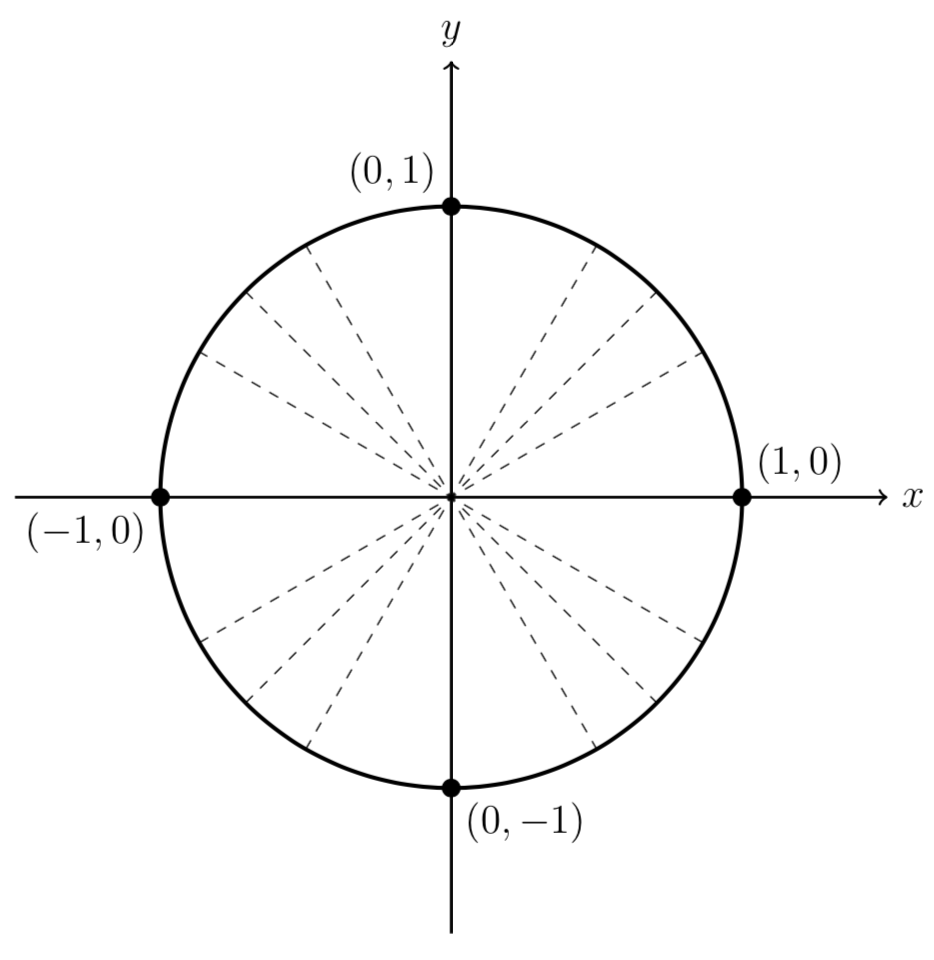
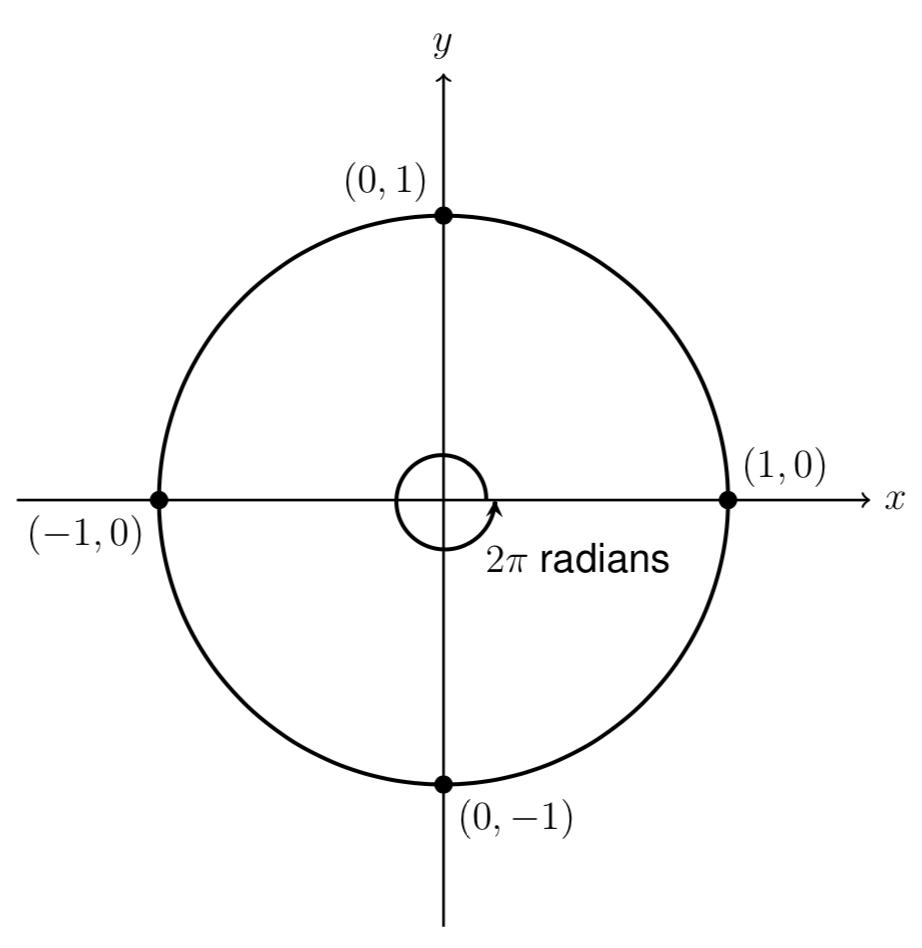
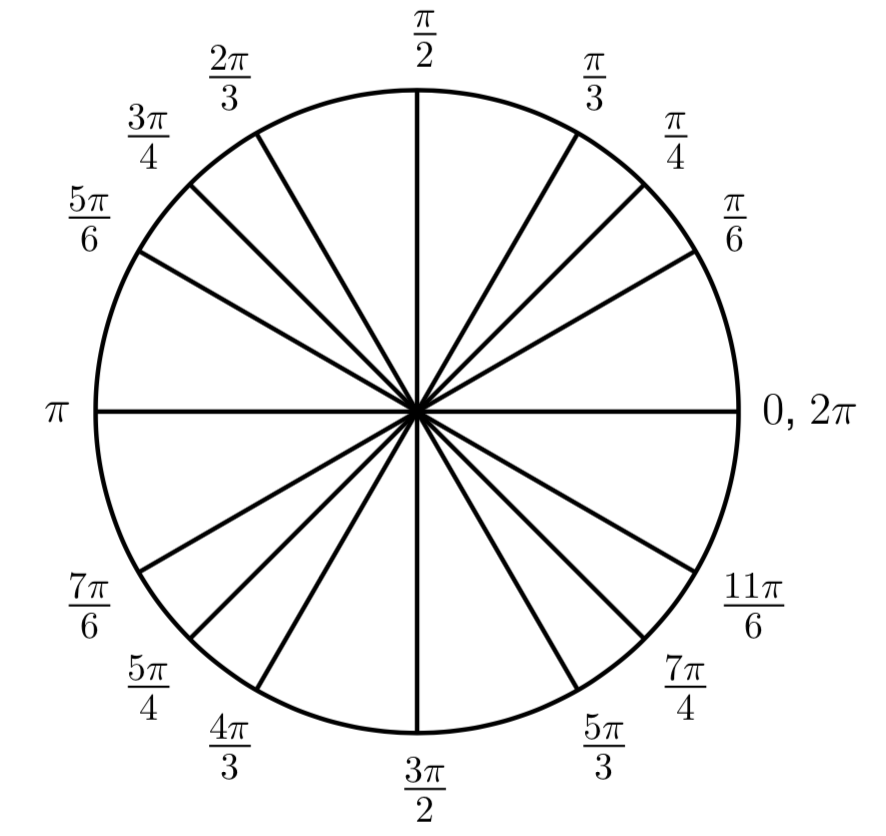
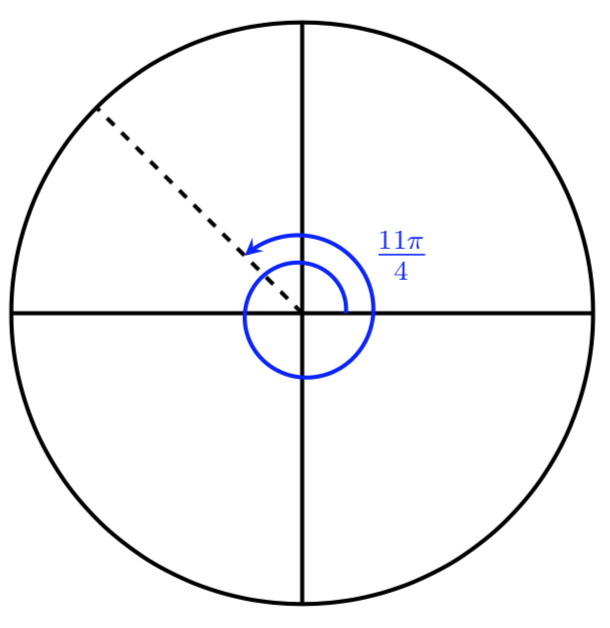
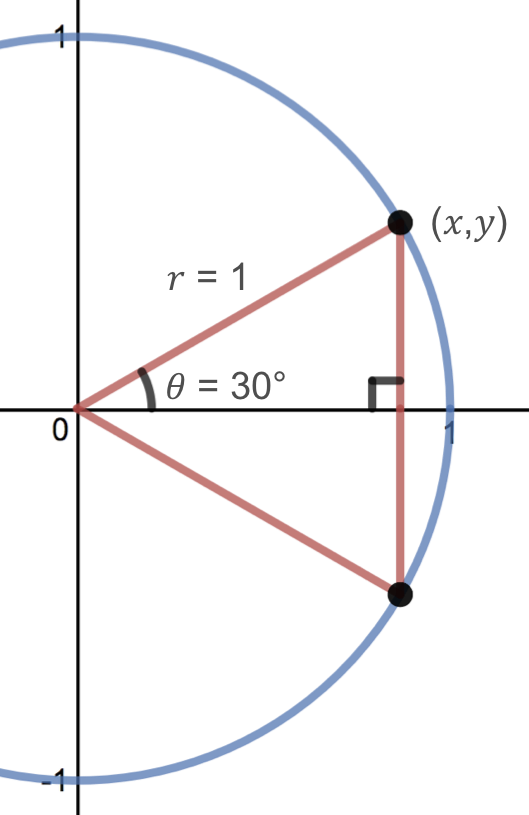
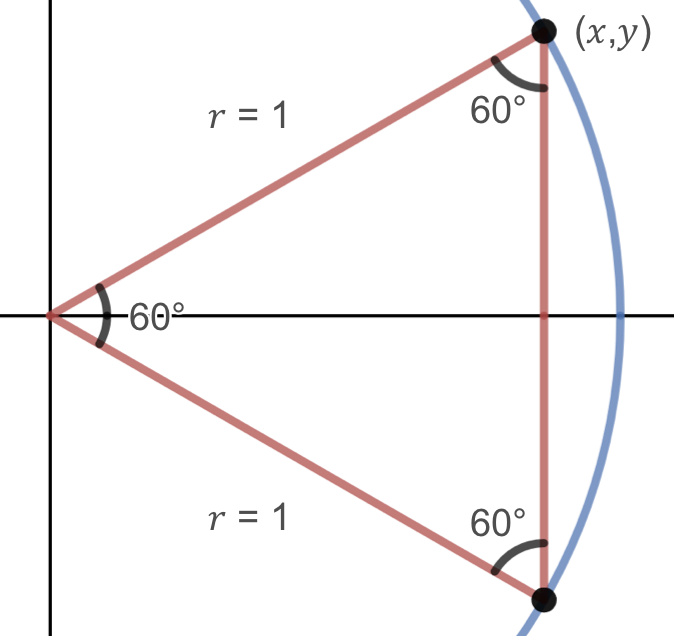
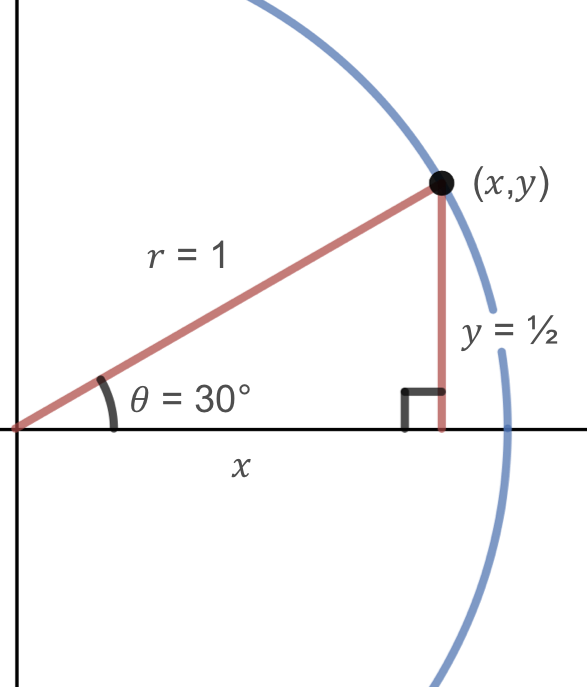
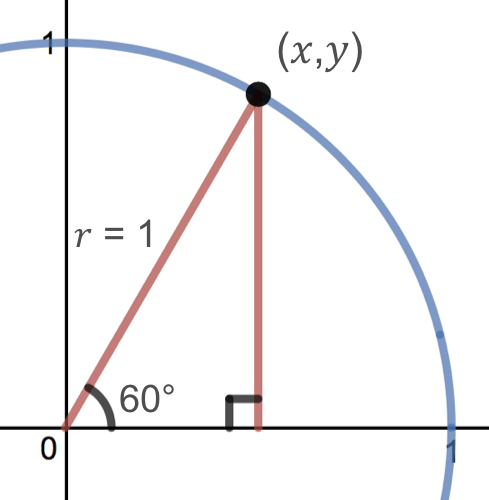
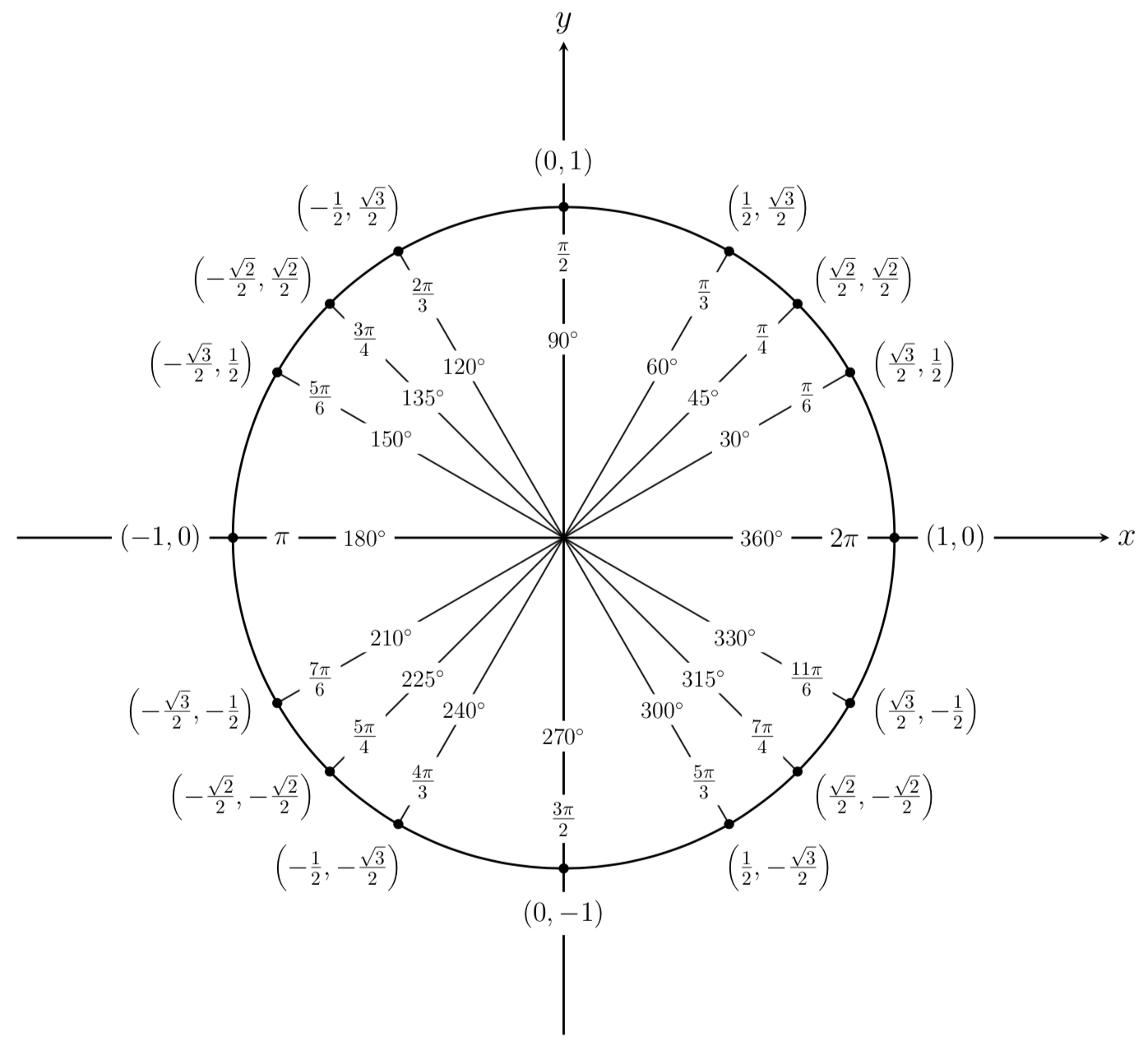
Let’s start by drawing a picture and labeling the known information.
We want to find the
\(x\) and
\(y\) coordinates of the point on the unit circle corresponding to an angle of 45 degrees or
\(\pi/4\text{.}\) To do this, we can draw a vertical line from the point down to the
\(x\)-axis, which forms a right triangle. The hypotenuse of this triangle is 1, since it corresponds to the radius of the unit circle, and the side lengths of this triangle are equal to
\(x\) and
\(y\text{.}\)
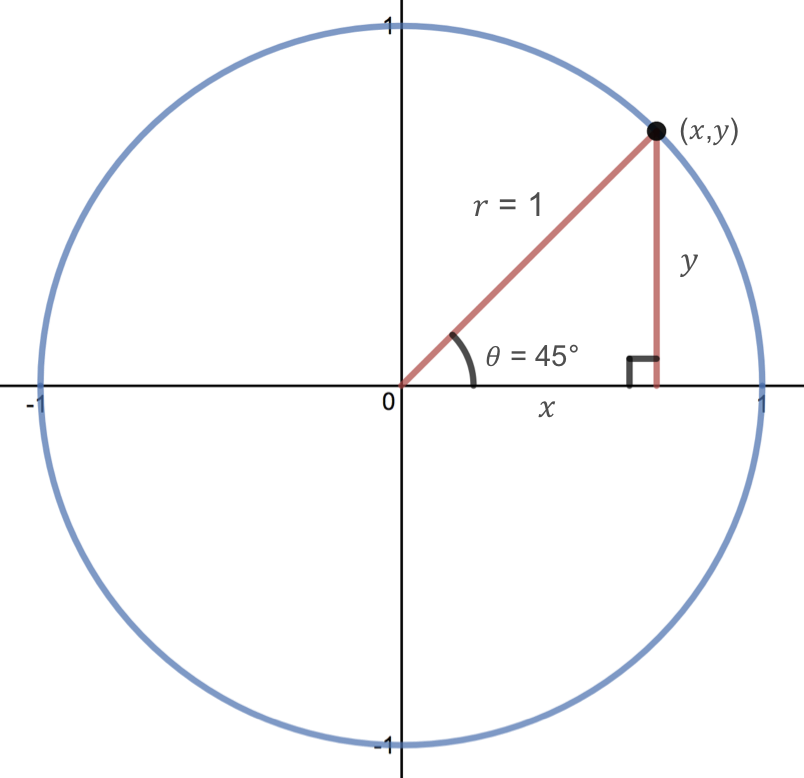
unit circle with 45 degree angle
Now, using the Pythagorean Theorem, we get that
\begin{equation*}
x^2+y^2=1^2 \hspace{.25in} \text{ which simplifies to } \hspace{.25in} x^2+y^2=1
\end{equation*}
Since the triangle formed is a 45-45-90 degree triangle, side lengths \(x\) and \(y\) must be equal. Therefore, we can substitute in \(x=y\) into the above equation.
\begin{align*}
x^2+y^2 \amp = 1 \amp\amp \text{Substitute in } x=y \\
\\
x^2+x^2 \amp = 1 \amp\amp \text{Add like terms } \\
\\
2x^2 \amp = 1 \amp\amp \text{Divide by 2} \\
\\
x^2 \amp = \frac{1}{2} \amp\amp \text{Take the square root} \\
\\
x \amp = \pm\sqrt{\vphantom{\frac{1^2}{2}}\frac{1}{2}} \amp\amp \text{Since the } x \text{ value is positive, we keep the positive root so} \\
\\
x \amp = \sqrt{\vphantom{\frac{1^2}{2}}\frac{1}{2}} \amp\amp
\end{align*}
Often this value is written with a rationalized denominator. Remember that to rationalize the denominator, we multiply by a term equivalent to 1 to get rid of the radical in the denominator, so
\begin{equation*}
x = \sqrt{\vphantom{\frac{1^2}{2}}\frac{1}{2}} \, \sqrt{\vphantom{\frac{1^2}{2}}\frac{2}{2}} = \sqrt{\vphantom{\frac{1^2}{2}}\frac{2}{4}} = \frac{\sqrt{2}}{2}
\end{equation*}
and since
\(x\) and
\(y\) are equal,
\(\displaystyle y=\frac{\sqrt{2}}{2}\text{.}\)
Thus, the \((x,y)\) coordinates for the point on the unit circle corresponding to an angle of 45 degrees or \(\pi/4\) radians are
\begin{equation*}
(x,y) = \left(\frac{\sqrt{2}}{2},\frac{\sqrt{2}}{2}\right)\text{.}
\end{equation*}