Supplemental Videos.
The main topics of this section are also presented in the following videos:

| when | \(t=\alert{0}\text{,}\) | \(C=800+130(\alert{0})=800\) |
| when | \(t=\alert{4}\text{,}\) | \(C=800+130(\alert{4})=1320\) |
| when | \(t=\alert{10}\text{,}\) | \(C=800+130(\alert{10})=2100\) |
| \(t\) | \(C\) | \((t,C)\) |
| \(0\) | \(800\) | \((0, 800)\) |
| \(4\) | \(1320\) | \((4, 1320)\) |
| \(10\) | \(2100\) | \((10,2100)\) |
| Year \((t)\) | Total sales \((S)\) |
| 2000 | $612,000 |
| 2001 | $663,000 |
| 2002 | $692,000 |
| 2003 | $749,000 |
| 2004 | $904,000 |
| Weight in ounces \((w)\) | Postage \((p)\) |
| \(0 \lt w \le 1 \) | $0.47 |
| \(1 \lt w \le 2 \) | $0.68 |
| \(2 \lt w \le 3 \) | $0.89 |
| \(3 \lt w \le 4 \) | $1.10 |
| \(4 \lt w \le 5 \) | $1.31 |
| \(5 \lt w \le 6 \) | $1.52 |
| \(6 \lt w \le 7 \) | $1.73 |
| Age | Cholesterol count | Age | Cholesterol count | |
| 53 | 217 | \(\alert{51}\) | \(\alert{209}\) | |
| 48 | 232 | 53 | 241 | |
| 55 | 198 | 49 | 186 | |
| 56 | 238 | \(\alert{51}\) | \(\alert{216}\) | |
| \(\alert{51}\) | \(\alert{227}\) | 57 | 208 | |
| 52 | 264 | 52 | 248 | |
| 53 | 195 | 50 | 214 | |
| 47 | 203 | 56 | 271 | |
| 48 | 212 | 53 | 193 | |
| 50 | 234 | 48 | 172 |
| \(x\) | \(3.5\) | \(2.0\) | \(2.5\) | \(3.5\) | \(2.5\) | \(4.0\) | \(2.5\) | \(3.0\) |
| \(y\) | \(2.5\) | \(3.0\) | \(2.5\) | \(4.0\) | \(3.5\) | \(4.0\) | \(2.0\) | \(2.5\) |
| \(x\) | \(-3\) | \(-2\) | \(-1\) | \(0\) | \(1\) | \(2\) | \(3\) |
| \(y\) | \(17\) | \(3\) | \(0\) | \(-1\) | \(0\) | \(3\) | \(17\) |
Y= key, clear out any other equations, and define \(Y_1 = 1776 - 16X^2.\)
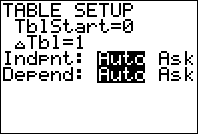
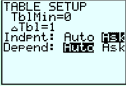
2ndWINDOW to access the TblSet (Table Setup) menu and set it to look like Figure 1.15. This setting will give us an initial x-value of 0 \((TblStart = 0)\) and an increment of one unit in the \(x\)-values, \((\Delta Tbl = 1)\text{.}\) It also fills in values of both variables automatically. Now press 2nd GRAPH to see the table of values, as shown in Figure 1.16. From this table, we can check the heights we found in Example 1.12.
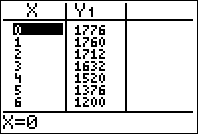
| when \(t=1\) | \(h=1760\) | |
| when \(t=2\) | \(h=1712\) |
| \(f(1)=1760\) | and | \(f(2)=1712\) |
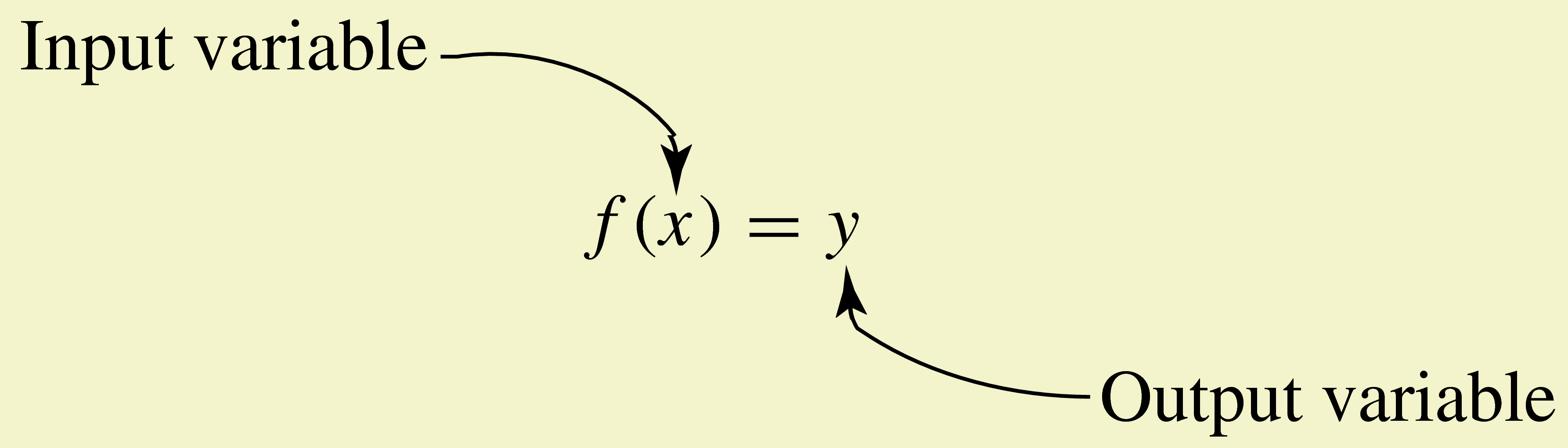
| when \(w=1\text{,}\) | \(p=0.47\) | so | \(g(1)=0.47\) | |
| when \(w=3\text{,}\) | \(p=0.89\) | so | \(g(3)=0.89\) | |
| when \(w=6.75\text{,}\) | \(p=1.73\) | so | \(g(6.75)=1.73\) |
| \(a\) | \(20\) | \(25\) | \(30\) | \(35\) | \(40\) | \(45\) | \(50\) | \(55\) | \(60\) | \(65\) | \(70\) |
| \(r\) | \(150\) | \(146\) | \(142\) | \(139\) | \(135\) | \(131\) | \(127\) | \(124\) | \(120\) | \(116\) | \(112\) |
| \(x\) | \(f(x)\) | |
| \(-2\) | \(\) | \(f(\alert{-2})=5-(\alert{-2})^3=~\) |
| \(0\) | \(\) | \(f(\alert{0})=5-\alert{0}^3=\) |
| \(1\) | \(\) | \(f(\alert{1})=5-\alert{1}^3=\) |
| \(3\) | \(\) | \(f(\alert{3})=5-\alert{3}^3=\) |
| \(x\) | \(f(x)\) |
| \(-2\) | \(\alert{13} \) |
| \(0\) | \(\alert{5}\) |
| \(1\) | \(\alert{4}\) |
| \(3\) | \(\alert{-22}\) |
Y=, clear any old functions, and enter
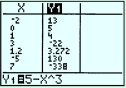
2nd WINDOW) and choose Ask after Indpnt, as shown in Figure 1.25, and press ENTER. This setting allows you to enter any \(x\)-values you like. Next, press TABLE (using 2nd GRAPH).
(-) 2 ENTER for the \(x\)-value, and the calculator will fill in the \(y\)-value. Continue by entering 0, 1, 3, or any other \(x\)-values you choose. One such table is shown in Figure 1.26.
Y= screen. Use the \(\boxed{\rightarrow}\) and \(\boxed{\uparrow}\) arrow keys to highlight \(Y_1\) at the top of the second column. The definition of \(Y_1\) will appear at the bottom of the display, as shown in Figure 1.26. You can key in a new definition here, and the second column will be updated automatically to show the \(y\)-values of the new function.
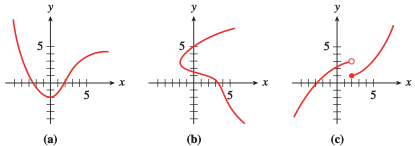
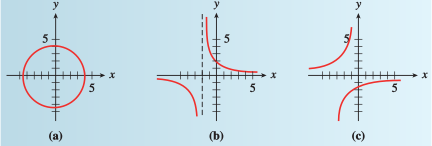
| \(x\) | \(0\) | \(2\) | \(4\) | \(6\) | \(8\) |
|---|---|---|---|---|---|
| \(f(x)\) | \(3\) | \(2\) | \(6\) | \(7\) | \(1\) |
| Values of \(f(x)\) |
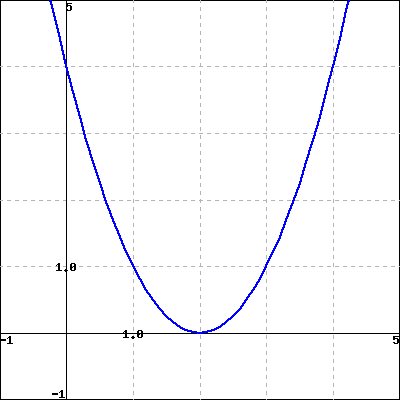
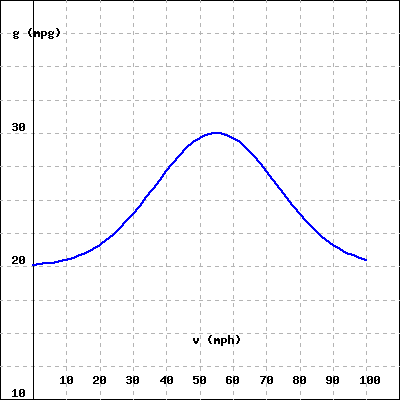
| Denomination (value of bill) | 1 | 5 | 10 | 20 | 50 | 100 |
| Dollar Value in Circulation | 8.4 | 9.7 | 14.8 | 110.1 | 60.2 | 524.5 |

