Section 3.2 Solving Generalized Equations

In the previous section, we learned how to solve basic trigonometric equations like \(\sin(\theta)=\frac{1}{2}\text{.}\) In this section, we will learn how to solve more complicated trig equations, specifically, generalized trig equations.

Subsection 3.2.1 Solving Generalized Trig Equations

Example 3.8.

Solve the trigonometric equation \(2\sin(3\theta)=1\) for all possible values of \(\theta\text{.}\)
Solution.
Similar to the examples in the previous section, we can sketch a graph of \(f(\theta)=2\sin(3\theta)\) to see where it intersects with the line \(y=1\text{.}\) Just like before, the angles that correspond to the intersection points of these two functions are the solutions to the equation \(2\sin(3\theta)=1\text{.}\) If we look at the graph, we can see that there are an infinite number of solutions to this equation.
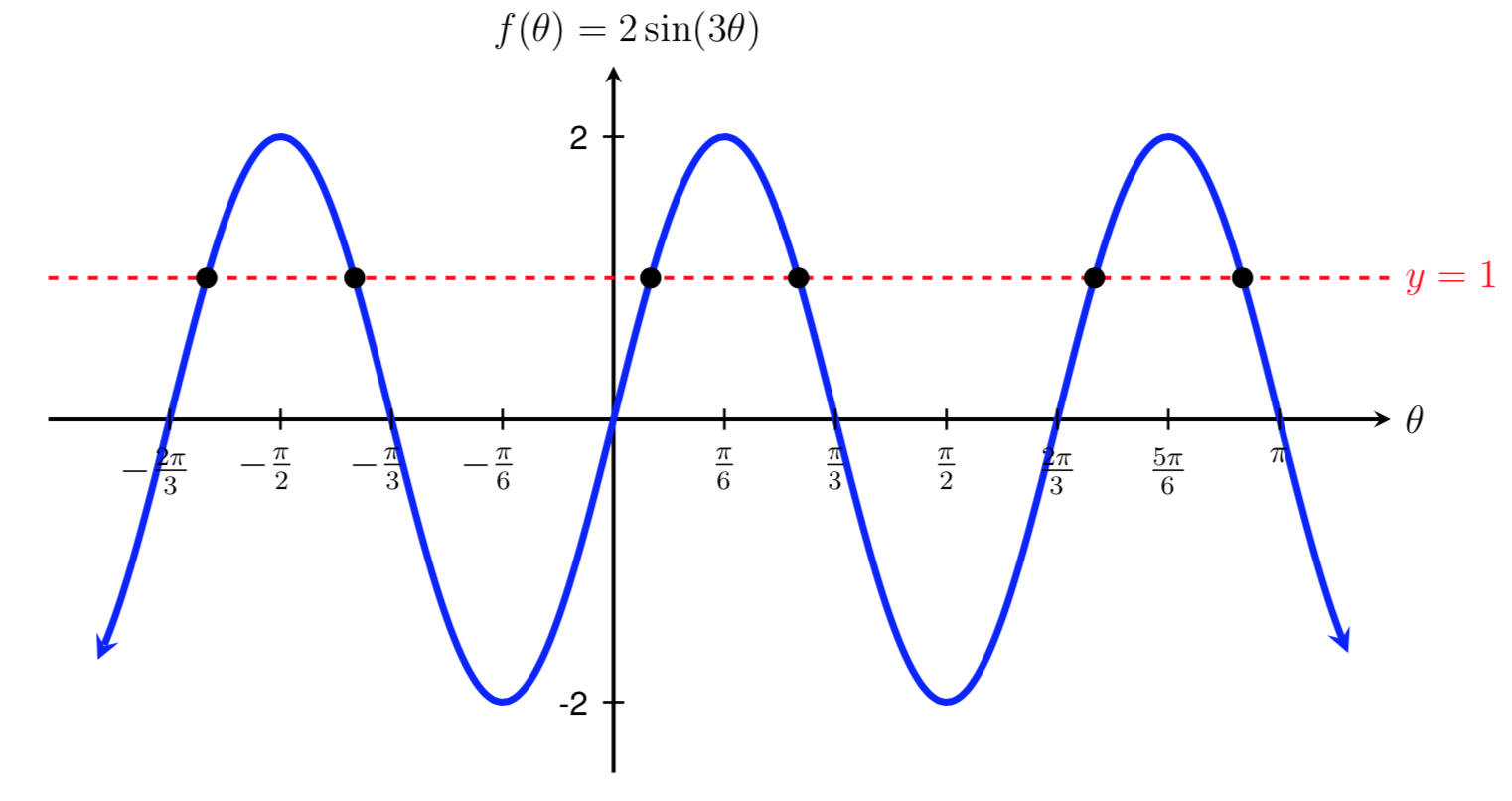
described in detail following the image
graph of 2sin(3theta)=1
The key difference between this example and examples that we’ve seen before is that we now have an input of \(3\theta\) instead of just \(\theta\) into our sine function. To solve this equation, we need to identify all angles, \(\theta\text{,}\) such that \(2\sin(3\theta)=1\text{.}\)
To solve this problem, we can first isolate the sine function by dividing each side of the equation by \(2\text{,}\) which gives us
\begin{equation*} \sin(3\theta)=\frac{1}{2} \end{equation*}
While we know what angles have a sine value of \(\frac{1}{2}\text{,}\) it is less clear how to proceed when we have \(3\theta\) as our input. To make the problem more familiar, we can introduce a new variable \(\phi\) and set \(\phi=3\theta\text{.}\) Then, substituting \(\phi\) into our equation, we get
\begin{equation*} \sin(\phi)=\frac{1}{2} \end{equation*}
In ExampleΒ 3.1, we found that the solutions to this equation are
\begin{equation*} \phi = \frac{\pi}{6}+2\pi k \hspace{.25in} \text{and} \hspace{.25in} \phi = \frac{5\pi}{6} + 2\pi k \hspace{.25in} \text{ where } k \text{ is any integer} \end{equation*}
Since we want to solve for all possible values of \(\theta\text{,}\) we can use our substitution and replace \(\phi\) with \(3\theta\) in the solutions above. Therefore, we have that
\begin{equation*} 3\theta = \frac{\pi}{6}+2\pi k \hspace{.25in} \text{and} \hspace{.25in} 3\theta = \frac{5\pi}{6} + 2\pi k \hspace{.25in} \text{ where } k \text{ is any integer} \end{equation*}
Our final step in solving for \(\theta\) is to divide each side of the equations by \(3\text{,}\) so we have
\begin{equation*} \theta = \frac{\frac{\pi}{6}+2\pi k}{3} \hspace{.25in} \text{and} \hspace{.25in} \theta = \frac{\frac{5\pi}{6} + 2\pi k}{3} \hspace{.25in} \text{ where } k \text{ is any integer} \end{equation*}
and simplifying we get
\begin{equation*} \theta = \frac{\pi}{18}+\frac{2\pi}{3} k \hspace{.25in} \text{and} \hspace{.25in} \theta = \frac{5\pi}{18} + \frac{2\pi}{3} k \hspace{.25in} \text{ where } k \text{ is any integer} \end{equation*}
Notice that when we divide the right side of our equations by \(3\text{,}\) we must divide each term by \(3\) in order to simplify the equations. Therefore, we end up adding multiples of \(\frac{2\pi}{3}\) to our initial solutions instead of multiples of \(2\pi\text{.}\) Also note that the sine function we are dealing with, \(f(\theta)=2\sin(3\theta)\text{,}\) has a period of \(\frac{2\pi}{3}\text{.}\)

Example 3.9.

Solve the trigonometric equation \(2\sin(3(x-2)) = 1\) for all possible values of \(x\text{.}\)
Solution.
To solve this problem, we can first isolate the sine function by dividing each side of the equation by \(2\text{,}\) which give us
\begin{equation*} \sin(3(x-2)) = \frac{1}{2} \end{equation*}
Set \(\phi = 3(x-2)\text{.}\) Then, substituting \(\phi\) into our new equation, we get
\begin{equation*} \sin(\phi) = \frac{1}{2} \end{equation*}
In ExampleΒ 3.1, we found that the solutions to this equation are
\begin{equation*} \phi = \frac{\pi}{6}+2\pi k \hspace{.25in} \text{and} \hspace{.25in} \phi = \frac{5\pi}{6} + 2\pi k \hspace{.25in} \text{ where } k \text{ is any integer} \end{equation*}
We can use our substitution and replace \(\phi\) with \(3(x-2)\) in the solutions above. Therefore, we have that
\begin{equation*} 3(x-2) = \frac{\pi}{6}+2\pi k \hspace{.25in} \text{and} \hspace{.25in} 3(x-2) = \frac{5\pi}{6} + 2\pi k \hspace{.25in} \text{ where } k \text{ is any integer} \end{equation*}
We need to solve for \(x\text{.}\) To isolate the \(x\text{,}\) let’s divide each side of the equations by \(3\text{.}\) Doing so and simplifying gives us
\begin{equation*} x-2 = \frac{\pi}{18}+\frac{2\pi}{3} k \hspace{.25in} \text{and} \hspace{.25in} x-2 = \frac{5\pi}{18} + \frac{2\pi}{3} k \hspace{.25in} \text{ where } k \text{ is any integer} \end{equation*}
Our final step in solving for \(x\) is to add \(2\) to each of the equations, so the solutions are:
\begin{equation*} x = 2+\frac{\pi}{18}+\frac{2\pi}{3} k \hspace{.25in} \text{and} \hspace{.25in} x = 2+\frac{5\pi}{18} + \frac{2\pi}{3} k \hspace{.25in} \text{ where } k \text{ is any integer} \end{equation*}

Example 3.10.

Solve the trigonometric equation \(\tan(\frac{1}{5}(x+4)) = 3\) for all possible values of \(x\text{.}\)
Solution.
For this problem, the tangent function has already been isolated. So, set \(\phi = \frac{1}{5}(x+4)\text{.}\) Then, substituting \(\phi\) into the equation gives us \(\tan(\phi) = 3\text{.}\) We then take the inverse tangent to both sides of the equation. Doing so give us \(\phi = \tan^{-1}(3)\text{.}\)
Using a calculator, we find that
\begin{equation*} \phi \approx 1.249 \end{equation*}
To get all solutions for \(\phi\text{,}\) recall that the tangent function has period \(\pi\text{.}\) Hence,
\begin{equation*} \phi \approx 1.249 + \pi k \end{equation*}
where \(k\) is an integer.
Now, if we undo the substitution, we have that
\begin{equation*} \frac{1}{5}(x+4) \approx 1.249 + \pi k\text{.} \end{equation*}
We can then use simple algebra to solve for \(x\) from this equation. Let’s start by multiplying both sides by \(5\text{.}\) This gives us
\begin{equation*} x+4 \approx 5(1.249 + \pi k) \end{equation*}
Next, we subtract \(4\) to both sides of the previous equation. Then,
\begin{equation*} x \approx 5(1.249 + \pi k) - 4 \end{equation*}
Therefore, the solutions to the trig equation is given by
\begin{equation*} x \approx 5(1.249 + \pi k) - 4, \ \text{ or equivalently, } \ x \approx 2.245 + 5\pi k, \text{ where } \ k \ \text{ is an integer.} \end{equation*}

Exercises 3.2.2 Exercises

1. Solving With Inverse of Cosine.

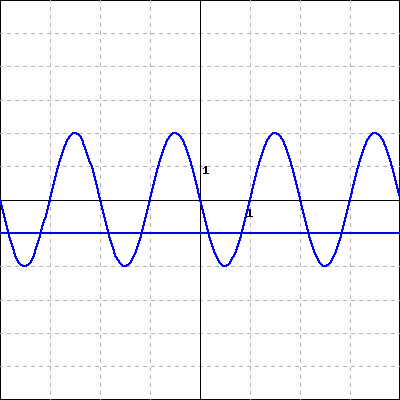
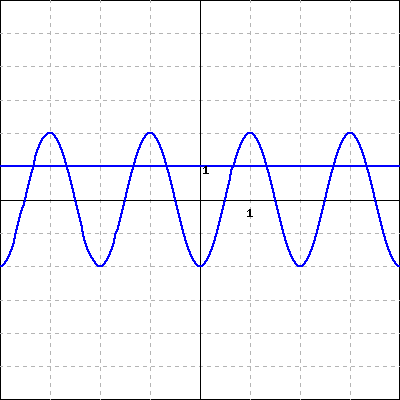
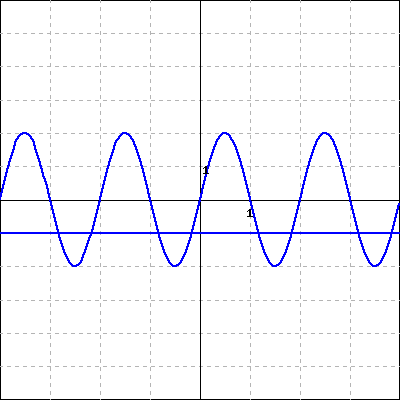
(a) The equation \(-2\cos(\pi\theta)=1\) can be represented as intersection points of the two curves \(y=1\) and \(y=-2\cos(\pi\theta)\text{.}\) Which of the following graphs below represents the equation \(-2\cos(\pi\theta)=1\) as intersection points of these two curves on the interval \([-4, 4]\text{?}\)
A B C D
(b) According to the graph you chose above, there are solutions to this equation on the interval \([-4,4]\text{.}\)
(c) Solve \(-2\cos(\pi\theta) = 1\) for all possible \(\theta\text{.}\)
Solutions with smaller positive base angle: \(\theta =\) + \(n\)
Solutions with larger positive base angle: \(\theta =\) + \(n\)
where \(n\) is any integer, and the base angles are the two smallest positive base angles.
(d) Use your answer to parts (a)-(c) to solve \(-2\cos(\pi\theta) = 1\) for \(\theta\) in \([-4, 4]\text{.}\) Enter your answers as a comma separated list.
\(\theta =\) .
For parts (c) and (d), use radian measure and enter your answers using at least four significant digits.
Hint.
a) Where does \(\cos(\pi\theta)\) cross the vertical axis? What happens as \(\theta\) increases? What if it is reflected across the horizontal axis?
c) Keep in mind which quadrants our answer should be in. What is the period of this function?

2. Solving With Inverse of Sine on an Interval.

Find all possible solutions for \(\theta\) to the equation \(\sin\big(\frac{\theta}{2}\big) = \frac{1}{6}\) on the interval \([-\pi, 1\pi]\text{.}\)
\(\theta =\) radians.
Enter your answer as a comma separated list. Use radian measure and round your answer to at least four significant digits.
Hint.
When finding the general solution, keep the period of the function in mind. How can we use our general solution to find the solutions within the given interval?

3. Solving With Inverse of Tangent on an Interval.

Find all possible solutions for \(\theta\) to the equation \(\tan(\theta) =4\) on the interval \([-\pi, \pi]\text{.}\)
\(\theta =\) radians.
Enter your answer as a comma separated list. Use radian measure and round your answer to at least four significant digits.
Hint.
When finding the general solution, keep the period of the function in mind. How can we use our general solution to find the solutions within the given interval?

4. Solving With Inverse of Sine.

Find all possible solutions for \(\theta\) to the equation \(\sin(2(\theta+2)) = 1\text{.}\)
\(\theta =\) + \(n\)
where \(n\) is any integer, and the base angle is the smallest positive angle possible.
Use radian measure and enter your answers using at least four significant digits.
Hint.
When finding the general solution, keep the period of the function in mind. How can we use our general solution to find the solutions within the given interval?

5. Solving With Secant on an Interval.

Find all possible solutions for \(\theta\) to the equation \(\sec(3\theta+0.5) = -2\) on the interval \([-\pi, \pi]\text{.}\) Include exact answers whenever possible.
\(\theta =\) radians.
Enter your answer as a comma separated list. Use radian measure and round your answer to at least four significant digits.
Hint.
First change the equation to be an equivalent equation in terms of cosine. When finding the general solution, keep the period of the function in mind. How can we use our general solution to find the solutions within the given interval?

6. Solving With Inverse of Tangent.

Find all possible solutions for \(\theta\) to the equation \(4\tan(-2\theta+2) = 11\text{.}\)
\(\theta =\) + \(n\)
where \(n\) is any integer, and the base angle is the smallest possible positive value.
Hint.
When finding the general solution, keep the period of the function in mind. How can we use our general solution to find the solutions within the given interval?

7. Solving With Multiple Trig Functions.

Find all possible solutions for \(\theta\) to the equation \(\sin(\theta)\tan(\theta)-7\sin(\theta) = 0\text{.}\)
Solutions with base angle in quadrant I: \(\theta =\) + \(n\)
Solutions with base angle on x-axis: \(\theta =\) + \(n\)
where \(n\) is any integer, and both base angles are between \(0\) and \(\pi\text{.}\)
Use radian measure and enter your answers using at least four significant digits.
Hint.
Is there a common factor between the terms? If there is a product of two factors equal to \(0\text{,}\) what do we know about the factors?

8. Solving With Multiple Trig Functions.

Find all possible solutions for \(\theta\) to the equation \(6\sin(\theta)\cos(\theta)-\sin(\theta) = 0\text{.}\)
Solutions with base angle in quadrant I: \(\theta =\) + \(n\)
Solutions with base angle in quadrant IV: \(\theta =\) + \(n\)
Solutions with base angle on x-axis: \(\theta =\) + \(n\)
where \(n\) is any integer, and all base angles are between \(0\) and \(2\pi\text{.}\)
Use radian measure and enter your answers using at least four significant digits.
Hint.
Is there a common factor between the terms? If there is a product of two factors equal to \(0\text{,}\) what do we know about the factors?

9. Solving in an Interval.

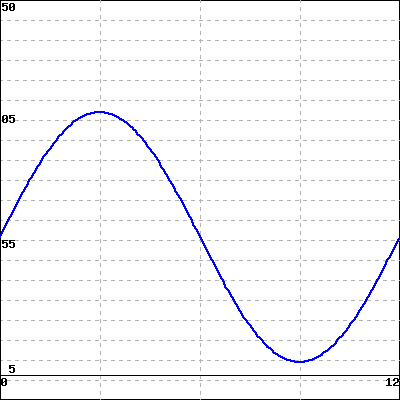
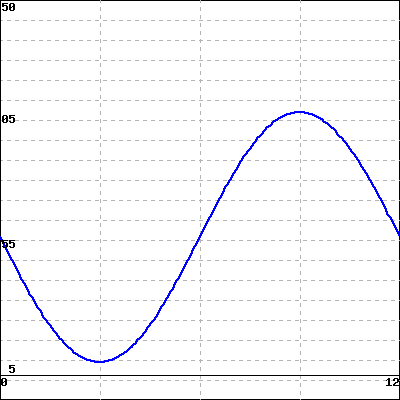
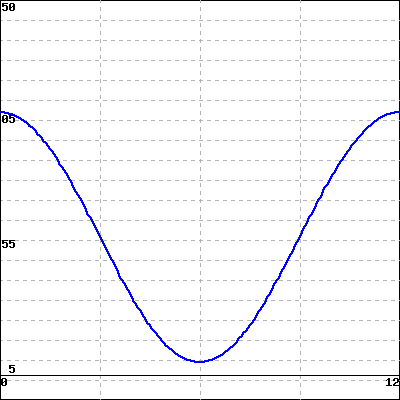
Suppose that the average temperature in Lincoln, NE in degrees Fahrenheit \(t\) months after January 1, 2016 (that is, January 1 corresponds to \(t=0\)) is given by the following equation:
\begin{equation*} T(t) = -50\cos\big(\frac{\pi}{6}t\big)+ 55. \end{equation*}
(a) Which of the following is the graph of \(T(t)\) on the interval \([0,12]\text{?}\)
A B C D
(b) According to your answer in part (a), how many times in the course of 2016 does our model say the temperature should be \(60\) degrees. times.
(c) Find all values of \(t\) on the interval \([0,12]\) for which the temperature in Lincoln, NE is predicted by this model to be \(60\) degrees. Enter your answer as a comma separated list. Use radian measure and round your answer to at least four significant digits.
Hint.
c) Note that the given equation tells us temperature at a specific time. What equation do we set up to solve for the time at a specific temperature? To solve, isolate the trigonometric function and keep the period of the function in mind when finding the general solution. Then find the solutions that fall within the specified interval.

10. Solving in an Interval.

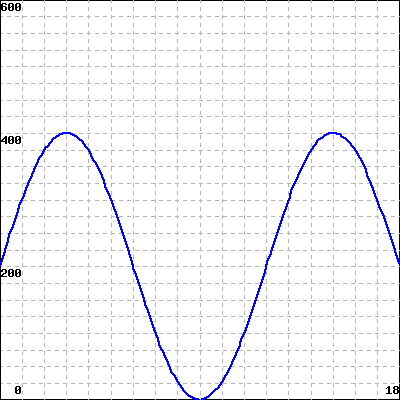
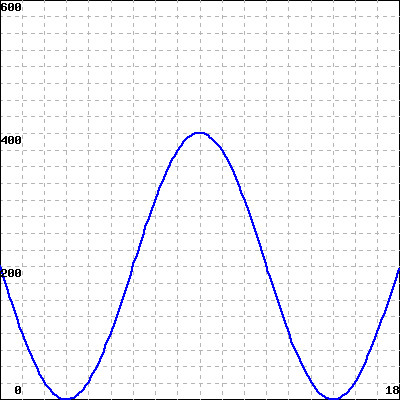
It is estimated that nearly 80% of the world’s population of Sandhill Cranes migrate through central Nebraska twice each year. Suppose that we may model the crane population along the Platte River, in thousands of cranes, using the following function:
\begin{equation*} P(t) = 200\cos\big(\frac{\pi}{6}t-\pi\big) + 200 \end{equation*}
where \(t\) is in months after January 1, 2016.
(a) Which of the following is the graph of \(P(t)\) on the interval \([0,18]\text{?}\)
A B C D
(b) Assuming the model holds, find all times \(t\) when there are approximately 260 thousand cranes along the Platte River.
Solutions with smaller positive value of \(t\text{:}\) \(t =\) + \(n\)
Solutions with larger positive value of \(t\text{:}\) \(t =\) + \(n\)
where \(n\) is any integer, and both values of \(t\) are between \(0\) and \(12\text{.}\)
Use radian measure and enter your answers using at least four significant digits.
(c) Based on the graph above, how many times will the Sandhill Crane population be equal to 260 thousand on the interval \([0,18]\text{?}\) times
(d) Use your solutions to parts (a) through (c) to find all times \(t\) in the interval \([0,18]\) such that there are approximately 260 thousand cranes. Enter your answer as a comma separated list. Use radian measure and round your answer to at least four significant digits.
Hint.
b) Follow the method done in the previous problem to find the general solution.
d) Based on the general solution, find the solutions that lie in the specified interval.