Section 1.7 Comparing Linear Functions

Subsection 1.7.1 Using Ratios for Comparison

Which is more expensive, a 64-ounce bottle of Velvolux dish soap that costs $3.52, or a 60-ounce bottle of Rainfresh dish soap that costs $3.36?
You are probably familiar with the notion of comparison shopping. To decide which dish soap is the better buy, we compute the unit price, or price per ounce, for each bottle. The unit price for Velvolux is
\begin{equation*} \frac{352 \text{ cents}}{64 \text{ ounces}}= 5.5 \text{ cents per ounce} \end{equation*}
and the unit price for Rainfresh is
\begin{equation*} \frac{336 \text{ cents}}{60 \text{ ounces}}= 5.6 \text{ cents per ounce} \end{equation*}
The Velvolux costs less per ounce, so it is the better buy. By computing the price of each brand for the same amount of soap, it is easy to compare them.
In many situations, a ratio, similar to a unit price, can provide a basis for comparison. ExampleΒ 1.145 uses a ratio to measure a rate of growth.

Example 1.145.

Which grow faster, Hybrid A wheat seedlings, which grow 11.2 centimeters in 14 days, or Hybrid B seedlings, which grow 13.5 centimeters in 18 days?
Solution.
We compute the growth rate for each strain of wheat. Growth rate is expressed as a ratio, \(\dfrac{\text{centimeters}}{\text{days}}\text{,}\) or centimeters per day. The growth rate for Hybrid A is
\begin{equation*} \frac{11.2 \text{ centimeters}}{14 \text{ days}}= 0.8 \text{ centimeters per day} \end{equation*}
and the growth rate for Hybrid B is
\begin{equation*} \frac{13.5 \text{ centimeters}}{18 \text{ days}}= 0.75 \text{ centimeters per day} \end{equation*}
Because their rate of growth is larger, the Hybrid A seedlings grow faster.

By computing the growth of each strain of wheat seedling over the same unit of time, a single day, we have a basis for comparison. In this case, the ratio \(\dfrac{\text{centimeters}}{\text{day}}\) measures the rate of growth of the wheat seedlings.

Example 1.146.

Delbert traveled \(258\) miles on \(12\) gallons of gas, and Francine traveled \(182\) miles on \(8\) gallons of gas. Compute the ratio \(\dfrac{\text{miles}}{\text{gallon}}\) for each car. Whose car gets the better gas mileage?
Solution.
Delbert’s gas mileage was
\begin{equation*} \dfrac{258\text{ miles}}{12\text{ gallons}}=21.5\text{ mpg} \end{equation*}
and Francine’s was
\begin{equation*} \dfrac{182\text{ miles}}{8\text{ gallons}}=22.75\text{ mpg} \end{equation*}
Delbert gets better mileage.
In ExampleΒ 1.146, the ratio \(\dfrac{\text{miles}}{\text{gallon}}\) measures the rate at which each car uses gasoline. By computing the mileage for each car for the same amount of gas, we have a basis for comparison. We can use this same idea, finding a common basis for comparison, to measure the steepness of an incline.

Subsection 1.7.2 Some Properties of Lines

For any constant \(k\text{:}\)
  • The graph of the equation \(y=k\) is a horizontal line through \((0,k)\) and its slope is zero.
  • The graph of the equation \(x=k\) is a vertical line through \((k,0)\) and its slope is undefined.
You may have a hard time remembering which is horizontal and which is vertical. One thing that can help is to remember that if \(y=3\text{,}\) then \(x\) can be whatever value it wants, but the value for \(y\) is fixed at 3. So, though we can range over all possible \(x\) values, \(y\) is always three, which is why we have a horizontal line. You can come up with a similar statement for the case when \(x=3\) to explain why this must be a vertical line.
Another important property that lines can have is how two lines intersect. We have two special cases that we address first lines that are perpendicular and lines that are parallel. Recall, from your last algebra class that:
Let \(l_1: y = m_1x + b_1\) and \(l_2: y = m_2x + b_2\) be two lines. Then, we say that
  • \(l_1\) and \(l_2\) are parallel if \(m_1 = m_2\) and \(b_1\neq b_2.\)
  • \(l_1\) and \(l_2\) are perpendicular if \(m_1 = \frac{-1}{m_2}\) (negative reciprocal).
Note that for two lines to parallel, they must have different \(y\)-intercepts, otherwise they are the same line.

Example 1.147.

Find the equation of a line passing through the point \((4,-1)\) and parallel to the line \(y=3x+2\)
Solution.
Since the two lines are parallel we know that the slope of the new line must be the same as the slope of the original line. That is \(m_1=3=m_2\text{.}\) We can now use point slope form \(y=y_1+m(x-x_1)\) to get \(y=(-1)+3(x-4)\text{.}\) At this point we have the equation of a line. However, most people are more comfortable writing lines in slope-intercept form so we will do that here (by simplifying and distributing): \(y=3x-13\text{.}\)

Example 1.148.

Find the equation of a line passing through the point \((4,-1)\) and perpendicular to the line \(y=3x+2\)
Solution.
Since the two lines are perpendicular we know that the slope of the new line must be the opposite reciprocal of the slope of the original line. Since \(m_1=3\text{,}\) \(m_2=-\frac{1}{3}\text{.}\) We can now use point slope form \(y=y_1+m(x-x_1)\) to get \(y=(-1)-\frac{1}{3}(x-4)\text{.}\) At this point we have the equation of a line. In slope-interept form, we have \(y=-\frac{1}{3}x-\frac{7}{3}\) after distributing and simplifying.
In addition to finding the equation for parallel and perpendicular lines, it is often useful to be able to describe the point at which two lines intersect. One way to find where two lines intersect is to first put the lines in slope intercept form and then set the two equations equal to each other.

Example 1.149.

Find the point where the lines \(y=2x+4\) and \(y=-x+3\) intersect.
Solution.
Since both of these equations are solved for \(y\text{,}\) we can set them equal to each other and then solve for \(x\text{:}\)
\begin{equation*} \begin{aligned} 2x+4 \amp= -x+3 \\ 3x+4 \amp= 3 \\ 3x \amp= -1 \\ x\amp= -\frac{1}{3} \end{aligned} \end{equation*}
To find the \(y\)-coordinate, we can substitute \(x\) into either of the original equations: \(y=2\left(-\frac{1}{3}\right)+4=\frac{10}{3}\text{.}\) Therefore the two lines intersect at the point \(\left(-\frac{1}{3},\frac{10}{3}\right)\text{.}\)

Example 1.150.

Renting a truck through Quick Rentals will cost you a fixed rate of 15 dollars plus 25 cents per mile. Renting a truck through Handy Trucks runs 25 dollars plus 15 cents per mile. If you were planning to rent a truck, how many miles would you need to drive in order for Handy Trucks to be a better deal?
Solution.
We first need to recognize that we have two linear equations \(y=0.25x+15\) and \(y=0.15x+25\text{.}\) If we plug one mile into both equations we can see that Quick Rentals is much cheaper if you are only driving a mile. In order to find where Handy Trucks is cheaper it makes sense to try finding the point where both companies cost the same amount. In order to do this we find the intersection between the two lines.
\begin{gather} 0.25x+15=0.15+25\tag{1.3}\\ 0.10x=10\tag{1.4}\\ x=100\tag{1.5} \end{gather}
Therefore, as long as you are driving more than 100 miles, (\(x >100\)) we know that Handy Trucks is the better deal.
If you would like to review different strategies for finding where two lines intersect, refer to the Systems of Linear Equations SectionΒ I.3.1 from Intermediate Algebra.

Exercises 1.7.3 Exercises

1. Matching Linear Functions to Graphs.

Without a calculator, match each equation with its graph A-G. \(\displaystyle y = x - 3\) \(\displaystyle -3 x + 3 = y\) \(\displaystyle 4 = y\) \(\displaystyle y = -2 x - 4\) \(\displaystyle y = x + 3\) \(\displaystyle y = \frac{x}{4}\) \(\displaystyle 3 = x\)
(Click on a graph to enlarge it)

2. Forms of a Linear Function.

What is \(\ldots\)
a) the general point-slope equation for a line?
b) the general slope-intercept equation for a line?
c) an equation of a line passing through the point \((1.800,-6.300)\) and parallel to \(y = 6.200 x - 3.000\text{?}\)
\(y=\)
d) the slope of a line perpendicular to \(y= 0.600(x + 5.200) - 3.800\text{?}\)
Slope\(=\)
e) an equation of a line perpendicular to the line defined by \((6.300,2.000)\) and \((4.100,3.900)\) and passing through the point \((6.300,2.000)\text{?}\)
\(y=\)
f) the slope-intercept equation for a line with \(m= 8.000\) and \(y\)-intercept \((0, 0.000)\text{?}\)
\(y=\)
g) an equation of the horizontal line passing through \((-2.700, -8.700)\text{?}\)
\(y=\)
h) an equation of the vertical line passing through \((-1.000,6.400)\text{?}\)
\(x=\)
i) the linear function \(h\) such that \(h(-8.100)=-7.600\) and \(h(-6.900)=-0.600\text{?}\)
\(h=\)
Determine if the following pairs of lines are parallel, perpendicular, or neither.
j) \(y= -8.2+1x\) and \(y = -3.8+\left(-1\right)x\)
k) \(y=-0.2+\left(-6.3\right)x\) and \(y=-9.9+\left(-6.3\right)x\)
l) \(y = 9.400\) and \(x = -5.500\)
Hint.
a) his information can be found here: https://mathbooks.unl.edu/PreCalculus/Finding-Linear-Functions.html
b) This information can be found here: https://mathbooks.unl.edu/PreCalculus/linear-functions.html
c) Recall that parallel lines are lines with the same slope. Use this information and the given point to use Point-Slope or Slope-Intercept Form.
d) Recall that the slope of the line perpendicular to the line \(y=mx+b\) is slope\(=-\dfrac{1}{m}\text{.}\)
e) We will first find the slope of the line defined by \((6.300,2.000)\) and \((4.100,3.900)\text{.}\) Recall the slope formula:
\begin{equation*} m=\frac{y_2-y_1}{x_2-x_1}. \end{equation*}
Again, the slope of the perpendicular line will be given by \(-\dfrac{1}{m}\text{.}\)
Use this information and the given point to find the equation of the line.
f) We are given all the information we need in order to use Slope-Intercept form.
g) Recall the equation of a horizontal line is of the form \(y=k\text{,}\) for a constant \(k\text{.}\)
h) Similarly to part g), the equation of a vertical line is of the formula \(x=k\text{,}\) for a constant \(k\text{.}\)
i) We need to calculate the slope first. Recall the slope formula:
\begin{equation*} m=\frac{y_2-y_1}{x_2-x_1}. \end{equation*}
Use this information and one of the given points to find the formula for the line.
j) Recall parallel lines have the same slope and perpendicular lines have the following relationship: \(-m_1=\dfrac{1}{m_2}\text{.}\)
k) Use the information from part j).
l) Use the information from part j).

3. Applied Comparing Linear Functions.

Suppose a new MyPhone cellphone costs $ 700, and depreciates in value by $ 20 per month. A new Cyborg phone costs $ 600, and depreciates in value by 15 per month.
a) Let \(M(x)\) be the value of a MyPhone \(x\) months after it was purchased, and let \(C(x)\) be the value of a Cyborg \(x\) months after it was purchased. Write formulas for \(M(x)\) and \(C(x)\text{.}\)
\(M(x)=\)
\(C(x)=\)
b) If Carrie and Miranda buy phones at the same time, Carrie buying the Cyborg and Miranda buying the MyPhone, when will their phones have the same value? If you get a decimal answer, please round your answer to the next whole month (round up).
\(x=\) months
c) After how many months are each of the phones worth nothing? If you get a decimal answer, please round your answer to the next whole month (round up).
The MyPhone is worth nothing after months.
The Cyborg is worth nothing after months.
Hint.
a) Think about what each of the given values means in the context (which are slopes and which are vertical intercepts).
b) In order to find how long it takes for Carrie and Miranda’s phones to be worth the same amount, we need to set the equations from part a) equal to each other and solve for \(x\text{.}\)
c) We want to know when each phone is worth nothing, so we need to set each equation equal to 0 to find how many months it takes.

5. Parallel Lines.

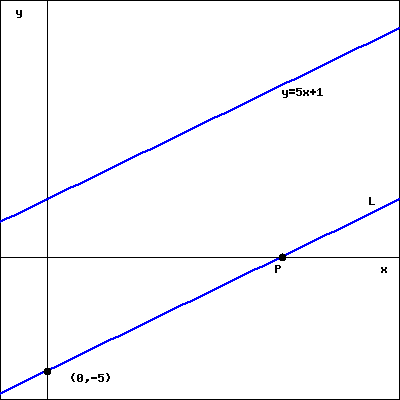
Line \(L\) in the figure below is parallel to the graph of \(y = 5 x + 1\text{.}\) Find the coordinates of the point \(P\text{.}\)
(click on the graph to get a larger version)
\(P =\)

6. Perpendicular Lines.

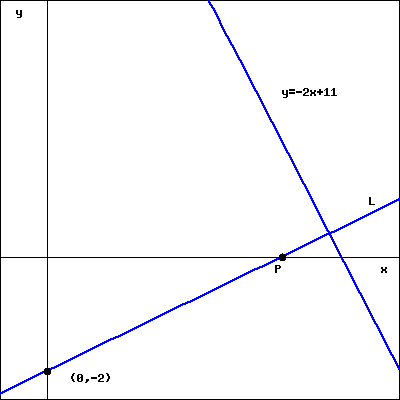
Line \(L\) in the figure below is perpendicular to the line \(y = -2 x + 11\text{.}\) Find the coordinates of the point \(P\)
(click on the graph to get a larger version)
\(P =\)