Section 2.3 Applications of Linear Equations

Algebra simplifies the process of solving real-world problems. This is done by using letters to represent unknowns, restating problems in the form of equations, and by offering systematic techniques for solving those equations. In this section, we will solve several types of real world problems using algebra.
To solve problems using algebra, first translate the wording of the problem into mathematical statements that describe the relationships between the given information and the unknowns. Usually, this translation to mathematical statements is the difficult step in the process. The key to the translation is to carefully read the problem and identify certain key words and phrases.
Key Words Translation
Sum: increased by, more than, plus, added to, total \(+\)
Difference: decreased by, subtracted from, less, minus \(-\)
Product: multiplied by, of, times, twice \(\cdot\)
Quotient: divided by, ratio, per \(\div\)
Equals: is, total, result \(=\)
When translating sentences into mathematical statements, be sure to read the sentence several times and parse out the key words and phrases. It is important to first identify what needs to be represented by a variable, and then specify what that variable will be. For instance, if we are solving a word problem that asks us to find the distance that a car travelled, we likely will want to define a variable to represent the distance the car travelled. It is important to be specific and include units if applicable: it is better to say "\(d=\)the distance travelled by the car in miles" than simply saying "\(d=\)distance".
In the previous paragraph, we chose the variable \(d\) to represent distance. You can choose any letter for your variables, but it can be helpful to chose a letter that aligns with what the variable represents (such as \(d\) for distance, \(t\) for time, etc.). However, we often just use \(x\text{.}\) As long as you clearly define your variables, it does not matter what variables you use.
Before we work with word problems, we will first practice translating simple sentences into equations.

Example 2.23.

Write an equation for the sequence of operations to describe each situation below.
  1. \(x\) is \(9\) more than \(y\text{.}\)
  2. Half of \(x\) is \(y\text{.}\)
  3. \(x\) is \(30\%\) of \(y\text{.}\)
Solution.
In all of these examples, it can be helpful to think of the word "is" as the equals sign.
  1. \(x\) is \(9\) more than \(y\) means that \(x=y+9\text{.}\)
  2. Half of \(x\) is \(y\) means that \(\frac{1}{2}x=y\text{.}\)
  3. \(x\) is \(30\%\) of \(y\) means that \(x=0.30y\text{.}\)
We will now expand these ideas to solve a word problem using a linear equation.

Example 2.24.

When 6 is subtracted from twice the sum of a number and 8, the result is 5. Find the number.
Solution.
Let \(n\) represent the unknown number. In the sentence above, "the sum of a number and 8" is represented by \(n+8\text{,}\) so "twice the sum of a number and 8" is \(2(n+8)\text{.}\) Next, "6 subtracted from twice the sum of a number and 8" would be 6 less than this, so it is \(2(n+8)-6\text{.}\) Finally, we are told that the result is 5; in other words, this expressions is equal to 5:
\begin{equation*} 2\cdot (n+8)-6=5 \end{equation*}
Now that we have translated the problem into a linear equation, we can solve for \(n\text{:}\)
\begin{equation*} \begin{aligned} 2(n+8)-6 \amp = 5\\ 2n+16-6\amp = 5\\ 2n+10\amp =5\\ 2n\amp = -5\\ n\amp = -\frac{5}{2} \end{aligned} \end{equation*}
We should always check our answer to be sure that we didn’t make a mistake in setting up or solving the problem. The sum of \(-\frac{5}{2}\) and \(8\) is \(-\frac{5}{2}+8=\frac{11}{2}\text{.}\) Twice this is \(\frac{11}{2}\cdot2=11\text{,}\) and \(6\) less than this is \(5\text{.}\) Since we got the desired result, we know that our answer is correct. The unknown numbers is \(-\frac{5}{2}\text{.}\)
General guidelines for setting up and solving word problems follow:

Guidelines for Word Problems.

  1. Read the problem several times, identify the key words and phrases, and organize the given information.
  2. Identify the variables by assigning a letter or expression to the unknown quantities.
  3. Translate and set up an algebraic equation that models the problem.
  4. Solve the resulting algebraic equation.
  5. Finally, answer the question in sentence form and make sure it makes sense (check it).
All of the equations in the following examples can be set up using only one variable. We can avoid two variables by looking for a relationship between the unknowns.

Example 2.25.

A rectangle has a perimeter measuring \(92\) meters. The length is \(2\) meters less than \(3\) times the width. Find the dimensions of the rectangle.
Solution.
The sentence "The length is \(2\) meters less than \(3\) times the width" gives us the relationship between the two important quantities, the length and the width. Let \(w\) represent the width of the rectangle. Since the length is \(2\) meters less than \(3\) times the width, the length must be \(3w-2\text{.}\)
The sentence "A rectangle has a perimeter measuring \(92\) meters" suggests an algebraic set up. The perimeter of a rectangle is always the sum of twice the length and twice the width; in this example, this means that the perimeter is
\begin{equation*} 2w+2(3w-2) \end{equation*}
Since we know that the perimeter is \(92\) meters, we have the following equation:
\begin{equation*} 92=2w+2(3w-2) \end{equation*}
Once you have set up an algebraic equation with one variable, solve for the width, \(w\text{.}\)
\begin{equation*} \begin{aligned} 92\amp =2w+2(3w-2) \amp \text{Distribute}\\ 92\amp =2w+6w-4 \amp\text{Combine like terms}\\ 92\amp =8w-4 \amp\text{Solve for }w\\ 96\amp =8w\\ 12\amp =w\\ \end{aligned} \end{equation*}
Now that we know the width, we can use the fact that the length is \(3w-2\) to find the length.
\begin{equation*} 3w-2=3(\alert{12})-2=36-2=34 \end{equation*}
This means that the dimensions of the rectangle are \(12\) meters by \(34\) meters. To check, we make sure the perimeter is actually \(92\) meters:
\begin{equation*} 2(12)+2(34)=24+68=92 \end{equation*}
For the rest of this section, we will explore several different categories of application problems that you might see, such as applications of interest, currency, distances, and more.

Subsection 2.3.1 Interest Applications

In problems involving simple interest, it is often helpful to use the simple interest formula \(I=prt\) where \(I\) is the simple interest earned on a principle investment, \(p\text{,}\) with an interest rate of \(r\) over \(t\) years.

Example 2.26.

Given a \(4.375\)% annual interest rate, how long will it take \(\$2,500\) to yield \(\$437.50\) in simple interest?
Solution.
Let \(t\) represent the time needed to earn $\(437.50\) at \(4.375\)%. Organize the information needed to use the formula for simple interest, \(I=prt\text{.}\)
Given interest for the time period \(I=\) $\(437.50\)
Given principal \(p=\) $\(2,500\)
Given rate \(r=4.375\%=0.04375\)
Next, substitute all of the known quantities into the formula and then solve for the only unknown, \(t\text{.}\)
\begin{equation*} \begin{aligned} I\amp = prt\\ \alert{437.50}\amp = \alert{2500}(\alert{0.04375})t\\ 437.50\amp = 109.375t\\ \frac{437.50}{109.375}\amp = \frac{109.375t}{109.375}\\ 4\amp = t \end{aligned} \end{equation*}
It takes \(4\) years for \(\$2,500\) invested at \(4.375\)% to earn \(\$437.50\) in simple interest.

Example 2.27.

Stephanie invested her total savings of \(\$12,500\) in two accounts earning simple interest. Her mutual fund account earned \(7\)% last year and her CD earned \(4.5\)%. If her total interest for the year was \(\$670\text{,}\) how much was in each account?
Solution.
The sum of the money in each account is \(\$12,500\text{.}\) When a total is involved, a common technique used to avoid two variables is to represent the second unknown as the difference of the total and the first unknown.
Let \(m\) represent the amount invested in the mutual fund.
Since the amount in the two accounts total \(\$12,500\text{,}\) the amount in the CD must be \(12,500-m\text{.}\)
Interest earned in the mutual fund (in dollars)
\begin{align*} I\amp = prt\\ \amp = m\cdot 0.07\cdot 1\\ \amp =0.07m \end{align*}
Interest earned in the CD (in dollars)
\begin{align*} I\amp = prt\\ \amp = (12,500-m)\cdot 0.045\cdot 1\\ \amp = 0.045(12,500-m) \end{align*}
Total Interest \(\$670\)
The total interest is the sum of the interest earned from each account.
\begin{equation*} \begin{aligned} \text{mutual fund interest}+\text{CD interest} \amp = \text{total interest}\\ 0.07m +0.045(12,500-m)\amp = 670 \end{aligned} \end{equation*}
This equation models the problem with one variable. Solve for \(m\text{.}\)
\begin{equation*} \begin{aligned} 0.07m+0.045(12,500-m)\amp = 670\\ 0.07m+562.5-0.045m\amp = 670\\ 0.025m+562.5\amp = 670\\ 0.025m\amp = 107.5\\ m\amp = \frac{107.5}{0.025}\\ m\amp =4,300 \end{aligned} \end{equation*}
Use \(12,500-m\) to find the amount in the CD.
\begin{equation*} 12,500-m=12,500-\alert{4300}=8,200 \end{equation*}
Stephanie invested \(\$4,300\) at \(7\)% in a mutual fund and \(\$8,200\) at \(4.5\)% in a CD.

Subsection 2.3.2 Currency Applications

A new kind of problem we come across in applications is something we call currency problems. These problems involve finding the number of coins or bills given other information about value. It is important to be careful in defining our variables specifically - either for the number of currency or the value of the currency.

Example 2.28.

Ashley has $17.25 in her piggy bank, which has only quarters and fifty-cent pieces in it. Ashley has nine more fifty-cent pieces than she has quarters. How many coins of each denomination does she have?
Solution.
Let \(q\) represent the number of quarters. Since Ashley has nine more fifty-cent pieces than quarters, the number of fifty cent pieces she has is \(q+9\text{.}\)
Since a quarter is worth \(\$0.25\text{,}\) \(0.25q\) represents the value of Ashley’s quarters. Similarly, since a fifty-cent piece is worth \(\$0.50\text{,}\) \(0.50(q+9)\) gives the value of Ashley’s fifty-cent pieces.
Since Ashley has a total of \(\$17.25\text{,}\) it must be the case that the sum of these values is \(17.25\text{:}\)
\begin{equation*} 0.25q+0.50(q+9)=17.25 \end{equation*}
We can now solve for \(q\text{:}\)
\begin{equation*} \begin{aligned} 0.25q+0.50(q+9) \amp= 17.25 \\ 0.25q+0.50q+4.50 \amp= 17.25 \\ 0.75q+4.50 \amp= 17.25 \\ 0.75q \amp= 12.75 \\ q \amp= 17 \end{aligned} \end{equation*}
Ashley has \(17\) quarters, and therefore \(26\) fifty-cent pieces.

Caution 2.29.

A common mistake in currency problems is to translate nickels being worth 5 cents to their value being \(.5\text{.}\) As a decimal, nickels are worth \(.05\text{!}\)

Subsection 2.3.3 Mixing Applications

Mixture problems often include a percentage and some total amount. It is important to make a distinction between these two types of quantities. For example, if a problem states that a 10-ounce container is filled with a \(3\)% saline (salt) solution, then this means that the container is filled with a mixture of salt and water as follows:
\(\) \(Percentage\) \(Amount\)
\(Salt\) \(3\)%\(=0.03\) \(0.03\) (\(10\) ounces)\(=0.3\) ounces
\(Water\) \(97\)%\(=0.97\) \(0.97\) (\(10\) ounces)\(=9.7\) ounces
In other words, we multiply the percentage times the total to get the amount of each part of the mixture.

Example 2.30.

How many milliliters of a \(15\)% alcohol solution must be mixed with \(110\) milliliters of a \(35\)% solution to obtain a \(25\)% solution?
Solution.
It is often helpful to use a table to organize your work for application problems. We will use the following table to keep track of all the different solutions in this problem:
Solution Percent Alcohol Total Amount of Liquid Amount of Alcohol
\(15\)% solution
\(35\)% solution
Mixture
Let \(m\) be the milliliters of the \(15\)% solution. To get the amount of alcohol in this part of the mixture, we multiply the percentage by the amount: \(0.15m\text{.}\)
Likewise, to get the amount of the second part of the mixture, we multiply the percentage by the amount: \(0.35\cdot 110=38.5\text{.}\)
Let’s now think about the mixture of these two solutions. We know that we’re aiming for a \(25\)% solution. Since there are \(m\) milliliters from the first solution and \(110\) milliliters from the second solution, the mixture will have \(m+110\) milliliters in it. Again, we find the amount of alcohol in the mixture by multiplying the percentage by the amount: \(0.25(m+110)\text{.}\) We can now fill in our table.
Solution Percent Alcohol Total Amount of Liquid Amount of Alcohol
\(15\)% solution \(15\)%\(=0.15\) \(m\) mL \(0.15(m\) mL\()=0.15m\) mL
\(35\)% solution \(35\)%\(=0.35\) \(110\) mL \(0.35(110\) mL\()=38.5\) mL
Mixture \(25\)%\(=0.25\) \(m+110\) mL \(0.25(m+110)\) mL
From our table, we see that the total amount of alcohol in the mixture is \(0.25(m+110)\text{.}\) On the other hand, we know that there are \(0.15m\) milliliters from the first solution and \(38.5\) milliliters from the second solution, for a total of \(0.15m+38.5\) milliliters of alcohol in the solution. We have found two different expressions for the total amount of alcohol in the mixture, so they must be equal:
\begin{equation*} 0.15m+38.5 = 0.25(m+110) \end{equation*}
We can now solve for \(m\text{.}\)
\begin{equation*} \begin{aligned} 0.15m+38.5\amp = 0.25(m+110)\\ 0.15m +38.5 \amp =0.25m+27.5\\ 38.5\amp = 0.10m+27.5\\ 11\amp =0.10m\\ 110\amp =m \end{aligned} \end{equation*}
We have found that we must mix \(110\) milliliters of a \(15\)% alcohol solution with \(110\) milliliters of a \(35\)% solution to obtain a \(25\)% solution.
Subsection 2.3.4 Distance Applications

The distance traveled is equal to the average rate times the time traveled at that rate, \(d=r\cdot t\text{.}\) These problems usually have a lot of data, so it helps to carefully rewrite the pertinent information as you define variables.

Example 2.31.

Two planes leave a city traveling in opposite directions. One travels at a rate of \(530\) mph and the other at a rate of \(600\) mph. How long will it take until they are \(3672.5\) miles apart?
Solution.
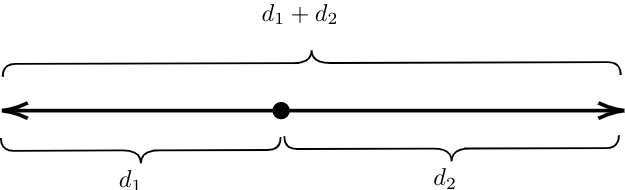
Let \(d_1\) represent the distance travelled by the first plane in miles, and let \(d_1\) represent the distance travelled by the second plane in miles. The key to this problem is that the sum of their distances is the distance between them:
described in detail following the image
Quadrants of the Plane
Let \(t\) represent the time it takes for them to be \(3672.5\) miles apart (in hours); this is what we’re actually looking for. The first plane travels at a rate of \(530\) mph, meaning that its distance is modeled by the equation
\begin{equation*} d_1=r\cdot t= 530 t \end{equation*}
The second plane travels at a rate of \(600\) mph, meaning that its distance is modeled by the equation
\begin{equation*} d_2=r\cdot t= 600 t \end{equation*}
Since the sum of their distances is the distance between them, after \(t\) hours the two planes will be
\begin{equation*} d_1+d_2=530t+600t=1130t \end{equation*}
miles apart. Now, we want to know when the distance is \(3672.5\text{.}\) Thus we solve:
\begin{equation*} \begin{aligned} 3672.5\amp =1130t\\ 3.25\amp =t \end{aligned} \end{equation*}
This tells us that it will take \(3\) hours and \(15\) minutes for the planes to be \(3672.5\) miles apart.

Exercises 2.3.5 Exercises

1. Translating verbal to equations.

This is similar to Problem 1 from your Section 2.3 worksheet.
For each sentence, choose the equation that best represents the situation.
1) \(x\) is \(49\) less than \(y\text{:}\)
2) \(y\) is \(40\)% of \(x\text{:}\)
3) \(y\) is half of \(4 x + 2\text{:}\)
4) The total of \(1\) less than \(y\) and \(z\) less than \(6\) is \(11\text{:}\)
Hint.
Try reading these out loud slowly.
The word "is" is often an indicator of where an equals sign should be.

2. Translating verbal to equations.

This is similar to Problem 2 from your Section 2.3 worksheet.
For each sentence, choose the equation that best represents the situation.
1) The quotient of twice \(x\) and \(2\) is \(99\text{:}\)
2) The product of \(y\) and the difference of \(y\) and \(7\) is \(9\text{:}\)
3) If \(3\) is subtracted from \(3\) times \(z\text{,}\) the result is \(4\) more than \(8\) times \(z\text{:}\)
Hint.
Try reading these out loud slowly.
The word "is" is often an indicator of where an equals sign should be.

3. Automobile journey.

This is similar to Problem 1 from your Section 2.3 (part 2) worksheet.
On a \(106.25\) mile automobile journey, Sanjay averaged \(28\) miles per hour on the first half of the time it took him to complete the trip, and he averaged \(57\) miles per hour on the second half of the time it took him to complete the trip. How long did the entire journey take if the two parts each took the same number of hours?
It took a total of
Hint.
Recall the distance formula, \(d=rt\text{.}\)
Let \(t\) be the total number of hours that Sanjay drove. How many hours did the first half of the journey take? How many hours did the second half take?
Using the speeds that Sanjay drove on each half of the journey, how far did Sanjay drive during each half of the journey? Note that it’s not half of \(106.25\text{!}\)

4. Mario and Luigi.

This is similar to Problem 2 from your Section 2.3 (part 2) worksheet.
Mario leaves Toad Town to visit Peach’s Castle, traveling \(2\) miles per hour. \(4\) hours later, Luigi leaves Toad Town, also headed to Peach’s Castle, traveling \(6\) miles per hour. How long after Luigi leaves Toad Town will the brother meet?
The brothers will meet hour(s) after Luigi leaves Toad Town.
Hint.
Recall the distance formula, \(d=rt\text{.}\)
Let \(t\) be the number of hours after Luigi leaves that the brothers will meet. When they meet, how many hours will Mario have been traveling?
Using their different travel times and speeds, how many miles did each brother travel? What can you say about their distances compared to one another?

5. Average speed.

This is Problem 3 from your Section 2.3 (part 2) worksheet.
Jim drives \(70\) miles per hour for \(5\) hours. His average daily speed must be at most \(65\) miles per hour. How long should he drive at \(55\) miles per hour so that his average speed is \(65\) miles per hour?
Jim must drive for hour(s).
Hint.
Let \(t\) be the number of hours Jim needs to drive. We know he drove \(70\) miles per hour for \(5\) hours and \(55\) miles per hour for \(t\) hours. What’s his total distance and total time?

6. Mixing solutions.

This is similar to Problem 5 from your Section 2.3 (part 2) worksheet.
How many milliliters of water must be mixed with \(31\) milliliters of a \(48\)% sulfuric acid solution to obtain a \(28\)% sulfuric acid solution? You can think of water as a \(0\)% sulfuric acid solution.
You must add milliliters of water.
Hint.
Let \(x\) be the number of milliliters of water you need to add. How many milliliters of the resulting \(28\)% solution will you have?
How many milliliters of sulfuric acid are there in the \(48\)% solution? In the water (of which she has \(x\) milliliters in total)?

7. Two dogs.

This is similar to Problem 7 from you Section 2.3 (part 2) worksheet.
Two dogs, Ozzy and Millie, start at the same place and run in the same direction parallel to one another. Millie runs \(17\) feet per second and Ozzy runs \(26\) feet per second. After how many seconds will they be \(90\) feet apart?
They will be \(90\) feet apart after seconds.
Hint.
It may be helpful to draw a picture of this situation.
Let \(t\) be the number of seconds it takes for Ozzy and Millie to be \(90\) feet apart. How far does Ozzy run in \(t\) seconds? How about Millie?
When the dogs are \(90\) feet apart, what is the relationship between their distances? Try to relate their distances in terms of a mathematical operation.

8. Two dogs.

This is similar to Problem 9 from you Section 2.3 (part 2) worksheet.
Josie and Red are two dogs standing next to each other in the dog park. Josie starts running straight west and Red starts running straight east. After \(22\) seconds, the two dogs are \(2750\) feet apart. Suppose Red runs \(5\) feet per second faster than Josie. How fast was Red running?
Red was running feet per second.
Hint.
It may be helpful to draw a picture of this situation.
Let \(r\) be Red’s speed in feet per second. How fast was Josie running?
After \(22\) seconds, how far had each dog run? What is the relationship between their distances?

9. Class schedule.

This is Problem 8 from your Section 2.3 (part 2) worksheet.
Sarah wants to do well in her classes, so she’s budgeting her time to decide how many classes to take. For each class she takes, she expects to spend \(3\) hours every week on homework. She also plans to spend a total of \(12\) extra hours studying every week. If Sarah has \(24\) hours every week to do homework and studying, how many classes can she take?
She can take classes.
Hint.
Let \(c\) be the number of classes Sarah takes. How many hours every week does she spend on homework?

10. Simple Interest.

This is similar to Problem 10 from your Section 2.3 (part 2) worksheet.
A brokerage account earns interest at an annual rate of \(11\)%. At the end of one year, Sheri would like to have a total of $\(3100\) in the account. How much should she deposit now? Recall the simple interest formula, \(I=prt\text{.}\)
Sheri should deposit $.
Hint.
The total amount in her account will be the amount she invests at the beginning plus the interest she earns.
Let \(p\) be the amount she invests. Using the simple interest formula, how much interest will Sherri earn in one year? How much will be in her account in total?

11. Sales tax.

This is similar to Problem 11 from your Section 2.3 (part 2) worksheet.
A merchant in a small store took in $\(579.10\) in one day. This included merchandise sales and the \(2.12\)% sales tax. Find the amount of merchandise sold.
The merchant sold $ in merchandise, not including sales tax.
Hint.
The total amount that merchant made from the merchandise plus the amount he made from sales tax.
Let \(m\) be the amount that was made from the merchandise. How much did the merchant receive from the %\(2.12\) sales tax?

12. Loose change.

This is similar to Problem 12 from your Section 2.3 (part 2) worksheet.
At the end of the day, Helen throws all the change from her purse into a box. The box contains only pennies, nickels, and dimes. At the end of one week she found that the total value of the coins was $\(2.56\text{.}\) If the number of dimes was \(7\) more than the number of nickels and the number of pennies was \(10\) more than the number of nickels, how many nickels were in the box?
There were nickels in the box.
Hint.
Let \(n\) be the number of nickels. How many dimes are there? How many pennies are there?
How much money does Helen have in nickels? In dimes? In pennies?