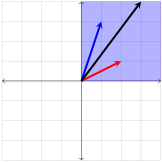
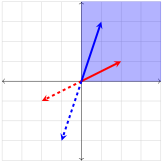
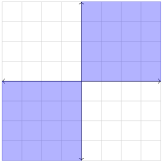
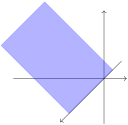
Let \(V\) be a vector space and let \(\mathbf{v}_1, \mathbf{v}_2,\ldots ,\mathbf{v}_p\) be vectors in \(V\text{.}\) The set of all linear combinations of
\begin{equation*}
\mathbf{v}_1, \mathbf{v}_2,\ldots ,\mathbf{v}_p
\end{equation*}
is called the span of \(\mathbf{v}_1, \mathbf{v}_2,\ldots ,\mathbf{v}_p\) and we write it as
\begin{equation*}
\mbox{span}(\mathbf{v}_1, \mathbf{v}_2,\ldots ,\mathbf{v}_p)
\end{equation*}
Given some subset \(S\) we say that vectors \(\mathbf{v}_1, \mathbf{v}_2,\ldots ,\mathbf{v}_p\) span \(S\) if every vector in \(S\) is a linear combination of the \(v_1,\ldots,v_p\text{.}\) That is,
\begin{equation*}
S = \mbox{span}(\mathbf{v}_1, \mathbf{v}_2,\ldots ,\mathbf{v}_p)
\end{equation*}
Any vector in \(S\) is said to be in the span of \(\mathbf{v}_1, \mathbf{v}_2,\ldots ,\mathbf{v}_p\text{.}\) The set
\begin{equation*}
\{\mathbf{v}_1, \mathbf{v}_2,\ldots ,\mathbf{v}_p\}
\end{equation*}
is called a spanning set for \(S\text{.}\)